
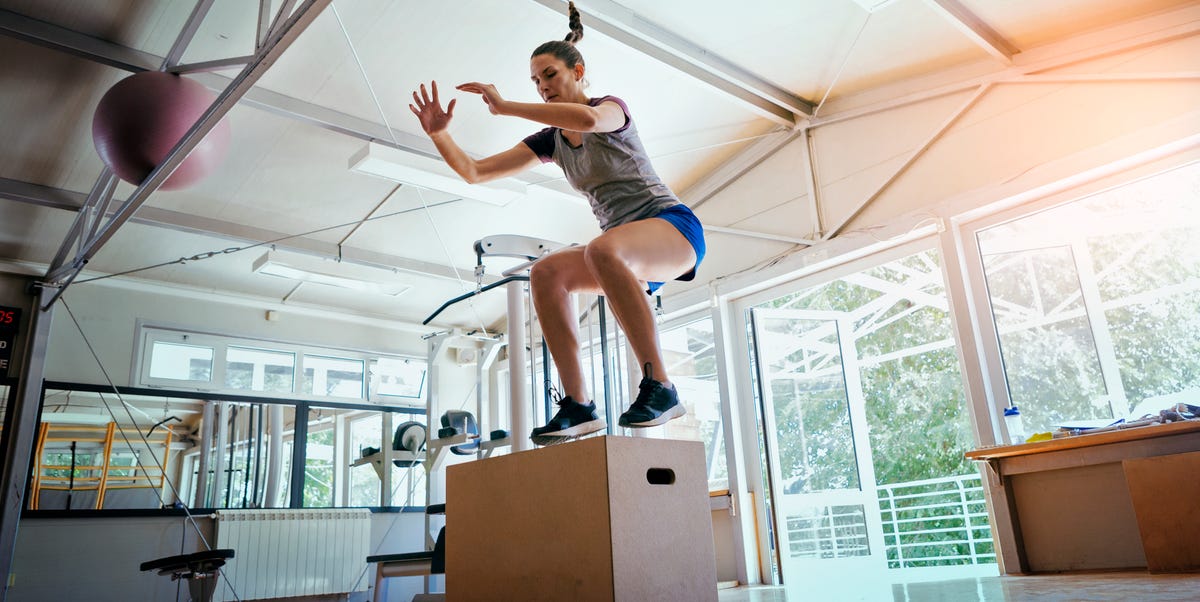
You can’t continue to get faster simply by running more. At some point, it pays to add in a different stimulus. That’s where plyometrics comes in. The fancy word for ‘hopping, skipping and jumping’, plyometrics has been found to improve running economy and encourage better running form – two things that will make you a faster runner.
‘I use plyometrics to help runners build explosive power, improve running economy, and develop the spring-like qualities their stride needs,’ says PT and founder of The Self Care Academy, Georgia Garlick. ‘Every step in running is essentially a single-leg hop, and plyometric work makes those hops more efficient.’
Plyometric exercises for running
Numerous studies have been published about the benefits of plyometrics for runners. One from 2024 found that a 10-week plyometric programme improved running economy (how efficiently you use oxygen to maintain a specific speed) in recreational runners, while another study found that a five-minute daily hopping exercise improved running economy at high speeds.
Brazilian research even suggested that adding plyometrics to your training can translate to tangible time improvements. Researchers tested two different plyometric interventions against a control group on amateur road runners’ 5k times. One group’s plyometric sessions focused on a move called the drop jump and the other on an exercise called the squat jump. While the the squat jump group improved their 5k time, on average, by a whopping 140.50 seconds (2 mins 20 secs), the drop jump group took off even more – an average of 170.63 seconds (2 mins 51 secs). The running-only group, meanwhile, shaved off only 4.75 seconds.
How to perform drop jumps safely
So, how do we perform drop jumps and squat jumps, as the study’s runners did, effectively and safely?
‘Drop jumps train your ability to absorb force and rebound quickly,’ says Garlick. To perform the movement safely, she says to step rather than jump (despite the name) off a box, landing ‘with your feet shoulder-width apart and knees tracking over toes, then immediately spring back up.’
‘The goal is to minimise ground contact time, so think of the floor as hot – touch and go. Keep the box height low to start and ensure your landings are quiet and controlled.’
Personal trainer and founder of KMAK Fitness Kunal Makwana also advises that beginners start by stepping off a low box – around 20-30cm – when attempting drop jumps. ‘Always warm up thoroughly beforehand, stick to low reps (4 to 8 per set), and allow sufficient recovery time between sets to reduce injury risk,’ he adds.
Above: Drop jumps demonstrated by qualified PT Lucy Molloy, who flagged the study to her followers earlier this year.
How to perform squat jumps safely
Squat jumps teach your body to generate force from a static position, says Garlick. ‘Start in a controlled squat, chest up and knees aligned with your toes,’ she says. ‘Drive powerfully upwards, fully extending through your hips, knees, and ankles. Land softly, absorb the impact, and reset between reps rather than bouncing straight into the next jump.’
Ensure you’re standing with your feet shoulder-width apart, adds Makwana, and ‘keep the movement controlled and focus on proper form over height.’
This article first appeared in Women’s Health UK
Related Story