
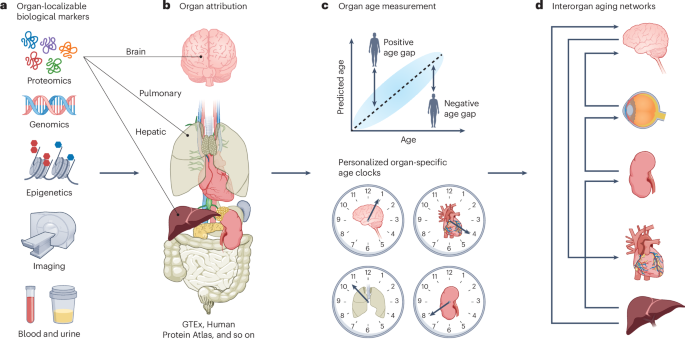
Ferrucci, L., Barzilai, N., Belsky, D. W. & Gladyshev, V. N. How to measure biological aging in humans. Nat. Med. 31, 1057 (2025).
López-Otín, C., Blasco, M. A., Partridge, L., Serrano, M. & Kroemer, G. The hallmarks of aging. Cell 153, 1194–1217 (2013).
Horvath, S. DNA methylation age of human tissues and cell types. Genome Biol. 14, 3156 (2013).
Moqri, M. et al. PRC2-AgeIndex as a universal biomarker of aging and rejuvenation. Nat. Commun. 15, 5956 (2024).
Huang, H. et al. Decoding aging clocks: new insights from metabolomics. Cell Metab. 37, 34–58 (2025).
Argentieri, M. A. et al. Proteomic aging clock predicts mortality and risk of common age-related diseases in diverse populations. Nat. Med. 30, 2450–2460 (2024).
Oh, H. S.-H. et al. Organ aging signatures in the plasma proteome track health and disease. Nature 624, 164–172 (2023).
Nie, C. et al. Distinct biological ages of organs and systems identified from a multi-omics study. Cell Rep. 38, 110459 (2022).
Kivimäki, M. et al. Proteomic organ-specific ageing signatures and 20-year risk of age-related diseases: the Whitehall II observational cohort study. Lancet Digit. Health 7, e195–e204 (2025).
Goeminne, L. J. E. et al. Plasma protein-based organ-specific aging and mortality models unveil diseases as accelerated aging of organismal systems. Cell Metab. 37, 205–222 (2025).
Oh, H. S.-H. et al. Plasma proteomics links brain and immune system aging with healthspan and longevity. Nat. Med. 31, 2703–2711 (2025).
Levine, M. E. et al. An epigenetic biomarker of aging for lifespan and healthspan. Aging 10, 573–591 (2018).
Lu, A. T. et al. DNA methylation GrimAge strongly predicts lifespan and healthspan. Aging 11, 303–327 (2019).
Belsky, D. W. et al. DunedinPACE, a DNA methylation biomarker of the pace of aging. eLife 11, e73420 (2022).
Whitman, E. T. et al. DunedinPACNI estimates the longitudinal Pace of Aging from a single brain image to track health and disease. Nat. Aging 5, 1619–1636 (2025).
Vidal-Pineiro, D. et al. Individual variations in ‘brain age’ relate to early-life factors more than to longitudinal brain change. eLife 10, e69995 (2021).
Korbmacher, M. et al. Cross-sectional brain age assessments are limited in predicting future brain change. Hum. Brain Mapp. 46, e70203 (2025).
Prattichizzo, F. et al. Organ-specific biological clocks: ageotyping for personalized anti-aging medicine. Ageing Res. Rev. 96, 102253 (2024).
Ahadi, S. et al. Personal aging markers and ageotypes revealed by deep longitudinal profiling. Nat. Med. 26, 83–90 (2020).
Wen, J. et al. The genetic architecture of biological age in nine human organ systems. Nat. Aging 4, 1290–1307 (2024).
Argentieri, M. A. et al. Integrating the environmental and genetic architectures of aging and mortality. Nat. Med. 31, 1016–1025 (2025).
Tian, Y. E. et al. Heterogeneous aging across multiple organ systems and prediction of chronic disease and mortality. Nat. Med. 29, 1221–1231 (2023).
Tian, Y. E. et al. Evaluation of brain–body health in individuals with common neuropsychiatric disorders. JAMA Psychiatry 80, 567–576 (2023).
Pillinger, T. et al. Comparative effects of 18 antipsychotics on metabolic function in patients with schizophrenia, predictors of metabolic dysregulation, and association with psychopathology: a systematic review and network meta-analysis. Lancet Psychiatry 7, 64–77 (2020).
Yang, L. et al. The effects of psychological stress on depression. Curr. Neuropharmacol. 13, 494–504 (2015).
Tian, Y. E. et al. Immunometabolic dysregulation in depression predates illness onset and is associated with lower brain gray matter volume. Nat. Ment. Health 3, 1555–1566 (2025).
Pálovics, R. et al. Molecular hallmarks of heterochronic parabiosis at single-cell resolution. Nature 603, 309–314 (2022).
Bell, C. G. et al. DNA methylation aging clocks: challenges and recommendations. Genome Biol. 20, 249 (2019).
Rutledge, J., Oh, H. & Wyss-Coray, T. Measuring biological age using omics data. Nat. Rev. Genet. 23, 715–727 (2022).
Demanelis, K. et al. Determinants of telomere length across human tissues. Science 369, eaaz6876 (2020).
Hoogendijk, E. O. et al. Frailty: implications for clinical practice and public health. Lancet 394, 1365–1375 (2019).
Kim, S., Myers, L., Wyckoff, J., Cherry, K. E. & Jazwinski, S. M. The frailty index outperforms DNA methylation age and its derivatives as an indicator of biological age. Geroscience 39, 83–92 (2017).
Jylhävä, J., Pedersen, N. L. & Hägg, S. Biological age predictors. EBioMedicine 21, 29–36 (2017).
Fong, S., Koh, W.-P. & Gruber, J. Reframing biological age as risk-equivalent age. Nat. Aging 6, 2–5 (2025).
Silva, N. et al. Measuring healthy ageing: current and future tools. Biogerontology 24, 845–866 (2023).
Jansen, R. et al. An integrative study of five biological clocks in somatic and mental health. eLife 10, e59479 (2021).
Tong, H. et al. Cell-type specific epigenetic clocks to quantify biological age at cell-type resolution. Aging 16, 13452–13504 (2024).
Shireby, G. L. et al. Recalibrating the epigenetic clock: implications for assessing biological age in the human cortex. Brain 143, 3763–3775 (2020).
Voisin, S. et al. An epigenetic clock for human skeletal muscle. J. Cachexia Sarcopenia Muscle 11, 887–898 (2020).
Wang, Y. et al. Organ-specific proteomic aging clocks predict disease and longevity across diverse populations. Nat. Aging 6, 162–180 (2026).
Wen, J. Refining the generation, interpretation and application of multi-organ, multi-omics biological aging clocks. Nat. Aging 5, 1897–1913 (2025).
Anagnostakis, F. et al. Multi-organ metabolome biological age implicates cardiometabolic conditions and mortality risk. Nat. Commun. 16, 4871 (2025).
Kozlov, M. Are your organs ageing well? The blood holds clues. Nature 624, 237–238 (2023).
Franke, K. et al. Estimating the age of healthy subjects from T1-weighted MRI scans using kernel methods: exploring the influence of various parameters. NeuroImage 50, 883–892 (2010).
Cole, J. H. Multimodality neuroimaging brain-age in UK Biobank: relationship to biomedical, lifestyle, and cognitive factors. Neurobiol. Aging 92, 34–42 (2020).
Zhu, Z. et al. Retinal age gap as a predictive biomarker for mortality risk. Br. J. Ophthalmol. 107, 547–554 (2023).
Amirmoezzi, Y. et al. Characterizing brain–cardiovascular aging using multiorgan imaging and machine learning. J. Neurosci. 45, e1440242024 (2025).
Galkin, F. et al. Human gut microbiome aging clock based on taxonomic profiling and deep learning. iScience 23, 101199 (2020).
Wen, J. Towards a multi-organ, multi-omics medical digital twin. Nat. Biomed. Eng. 9, 1386–1389 (2025).
Ivanov, P. C. The new field of network physiology: building the human physiolome. Front. Netw. Physiol. 1, 711778 (2021).
Hua, J. P. Y. et al. Brain age gap in early illness schizophrenia and the clinical high-risk syndrome: associations with experiential negative symptoms and conversion to psychosis. Schizophr. Bull. 50, 1159–1170 (2024).
Xiong, J. et al. Multi-omic underpinnings of heterogeneous aging across multiple organ systems. Cell Genom. 5, 101032 (2025).
Waziry, R. et al. Effect of long-term caloric restriction on DNA methylation measures of biological aging in healthy adults from the CALERIE trial. Nat. Aging 3, 248–257 (2023).
Bischoff-Ferrari, H. A. et al. Individual and additive effects of vitamin D, omega-3 and exercise on DNA methylation clocks of biological aging in older adults from the DO-HEALTH trial. Nat. Aging 5, 376–385 (2025).
Scott, A. J., Ellison, M. & Sinclair, D. A. The economic value of targeting aging. Nat. Aging 1, 616–623 (2021).
Cole, J. H. et al. Brain age predicts mortality. Mol. Psychiatry 23, 1385–1392 (2018).
Hu, F. et al. Image harmonization: a review of statistical and deep learning methods for removing batch effects and evaluation metrics for effective harmonization. NeuroImage 274, 120125 (2023).
Smith, S. M., Miller, K. L. & Nichols, T. E. Characterising ongoing brain aging and baseline effects from cross-sectional data. Imaging Neurosci. 3, IMAG.a.39 (2025).
Fry, A. et al. Comparison of sociodemographic and health-related characteristics of UK Biobank participants with those of the general population. Am. J. Epidemiol. 186, 1026–1034 (2017).
Smith, S. M., Vidaurre, D., Alfaro-Almagro, F., Nichols, T. E. & Miller, K. L. Estimation of brain age delta from brain imaging. NeuroImage 200, 528–539 (2019).
Tian, Y. & Zalesky, A. Machine learning prediction of cognition from functional connectivity: are feature weights reliable? NeuroImage 245, 118648 (2021).
Bashyam, V. M. et al. MRI signatures of brain age and disease over the lifespan based on a deep brain network and 14 468 individuals worldwide. Brain 143, 2312–2324 (2020).
Kimberly, W. T. et al. Brain imaging with portable low-field MRI. Nat. Rev. Bioeng. 1, 617–630 (2023).
Liu, Y. et al. A low-cost and shielding-free ultra-low-field brain MRI scanner. Nat. Commun. 12, 7238 (2021).
Ikram, M. A. The use and misuse of ‘biological aging’ in health research. Nat. Med. 30, 3045 (2024).
Irimia, A. & Van Horn, J. D. Mapping the rest of the human connectome: atlasing the spinal cord and peripheral nervous system. NeuroImage 225, 117478 (2021).