
 A human embryo at roughly three to four weeks of development. The Tiangong experiment uses stem cell-derived embryo models at roughly the same stage of development. Credit: Wikimedia Commons
Before we can build lasting homes on the Moon or Mars, we must first answer a more pressing question: can human life even begin there?
China has sent artificial human embryos to its Tiangong space station to study how the earliest stages of development respond to microgravity and space radiation. Researchers have not published the experiment in a peer-reviewed journal, and they have not released results yet. For now, it is an early test of a problem that future space settlements cannot avoid.
Cells in Orbit
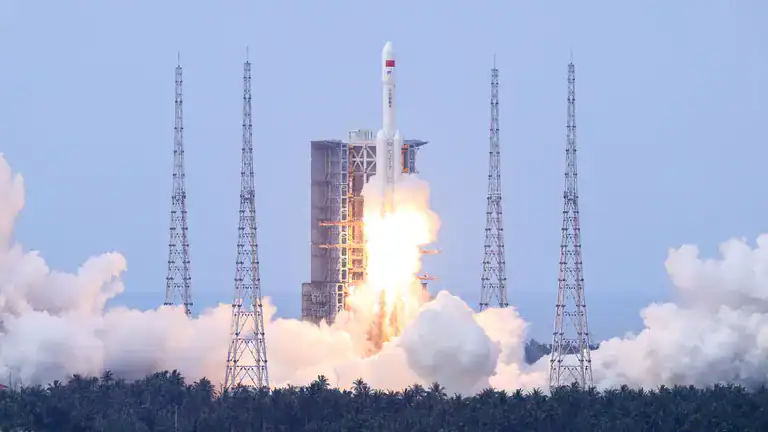 The Tianzhou-10 cargo spacecraft lifted off from China’s Wenchang Space Launch Site on board a Long March 7 rocket on May 10, 2026. Credit: Luo Yunfei/China News Service
The embryo-like structures arrived aboard Tianzhou-10, an uncrewed cargo spacecraft that docked with Tiangong on May 11, 2026. The mission also delivered food, fuel, spacesuits, and other scientific equipment.
The experiment is led by Yu Leqian, a researcher at the Chinese Academy of Sciences’ Institute of Zoology. His team built the models from human stem cells, which can divide and organize in ways that resemble early embryos.
“The human artificial embryo is made of human stem cells as raw materials,” Yu said in a statement. “This is not a real human embryo and does not have the ability to develop into an individual. However, it can serve as a model for studying early human development.”
The samples represent a stage roughly two to three weeks after fertilization. At that point, cells begin arranging themselves into layers that later give rise to tissues and organs. The basic body plan starts to take shape.
The team sent two kinds of models. One was grown on uterine cells to mimic implantation, when an embryo attaches to the womb. The other was placed in a microfluidic chip, a small device that moves tiny amounts of liquid through narrow channels, to mimic the stage when cells begin forming future tissues.
Each model was kept in its own chamber. The samples were prepared the night before launch and delivered to the launch tower 12 hours before liftoff.
×
Thank you! One more thing…
Please check your inbox and confirm your subscription.
No Paper Yet
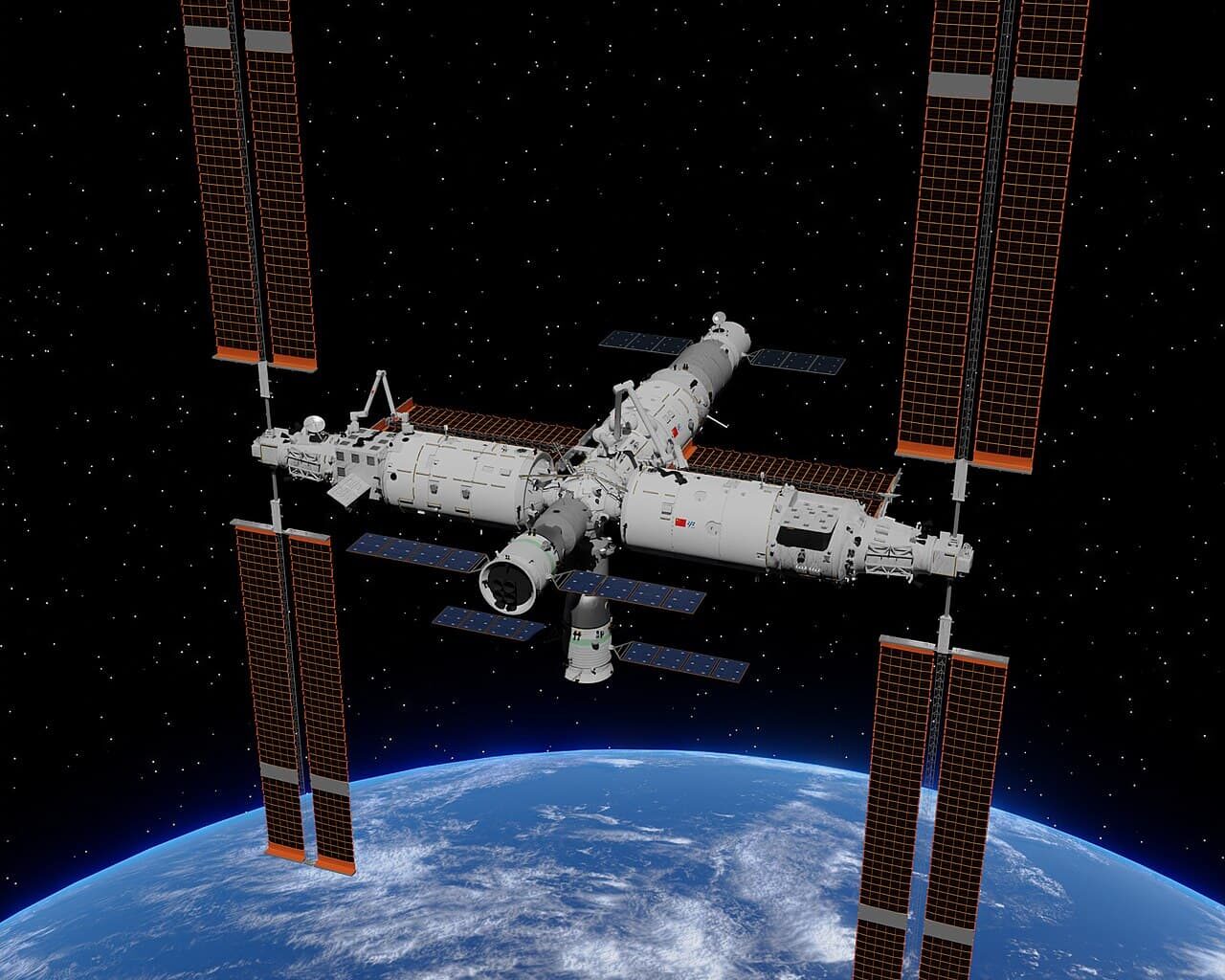
 The Chinese Heavenly Palace (Tiangong) Space Station. Credit: Wikimedia Commons
The embryo models were expected to grow in orbit for five days. After that, they would be frozen, returned to Earth and compared with matching samples grown in China.
“We hope that by comparing the development of space and ground samples, we can identify the factors affecting early human embryonic growth in the space environment, and address the risks and challenges humans may face during long-term space habitation,” Yu added.
No peer-reviewed journal has published findings from this Tiangong experiment. Current reports come from Chinese state media and the Chinese Academy of Sciences.
The question is still open because space changes basic conditions that life on Earth depends on. Microgravity can alter how cells sense direction and force. Radiation can damage DNA. Earlier studies have suggested that sperm may struggle to navigate in microgravity, while mouse embryos have reached early developmental stages aboard the International Space Station.
“[We might] use certain technologies to mitigate the impact,” Yu told the South China Morning Post. “This is our first attempt to answer [the questions]: Can humans survive and reproduce in space? I hope the answer is yes.”
For now, the experiment marks a tentative beginning in answering this question. Its value will depend on what the frozen cells reveal after they come home.