
Published October 11, 2026 09:54AM
SUMMARY
No one would argue that the Ironman World Championship in Kona is physically taxing – but it goes well beyond the traditional post-Ironman fatigue due to the challenging conditions.
Post-race, you’ll not only suffer physiological stress, but also nervous and digestive system stress, which can create brain fog and emotional volatility.
All that stress can lead to a weakened immune system, requiring that athletes take wellness precautions in Kona.
I will never forget how I felt the day after my first Ironman World Championship in Kona, Hawaii, back in 1998. Despite a full night’s rest, I woke up as tired as I was when I went to bed. My face and arms throbbed from sunburn, my movements resembled those of Tin Man in The Wizard of Oz, and no matter how much water I drank, my urine still looked like apple juice.
The funny thing was, I hadn’t even done the race. As a young staff writer for Triathlete, I had spent the day on the back of a press truck tracking the women’s pro field. But this effort alone was enough to leave me wrecked for the next 24 hours. I might not have burned many calories on that flatbed, but it’s the elements that get you in Kona — the simmering lava fields, the glaring sun, and those dreaded mumuku winds — and they got me despite my low step count.
Completing an Ironman anywhere is hard. Simply watching an Ironman in Kona is also hard. At the Ironman World Championship, prolonged physical exertion and a harsh environment combine to produce a post-race hangover like no other.
But what’s actually happening inside your body after Kona that makes you feel so utterly steamrolled? In an effort to answer this question, I scoured the research journals and interviewed experts in medicine, neuroscience, and psychology. What follows is a short list of things you might hear yourself say on “Recovery Sunday” in Kona, and the science behind them.
“My legs feel like they’ve been used as piñatas.”
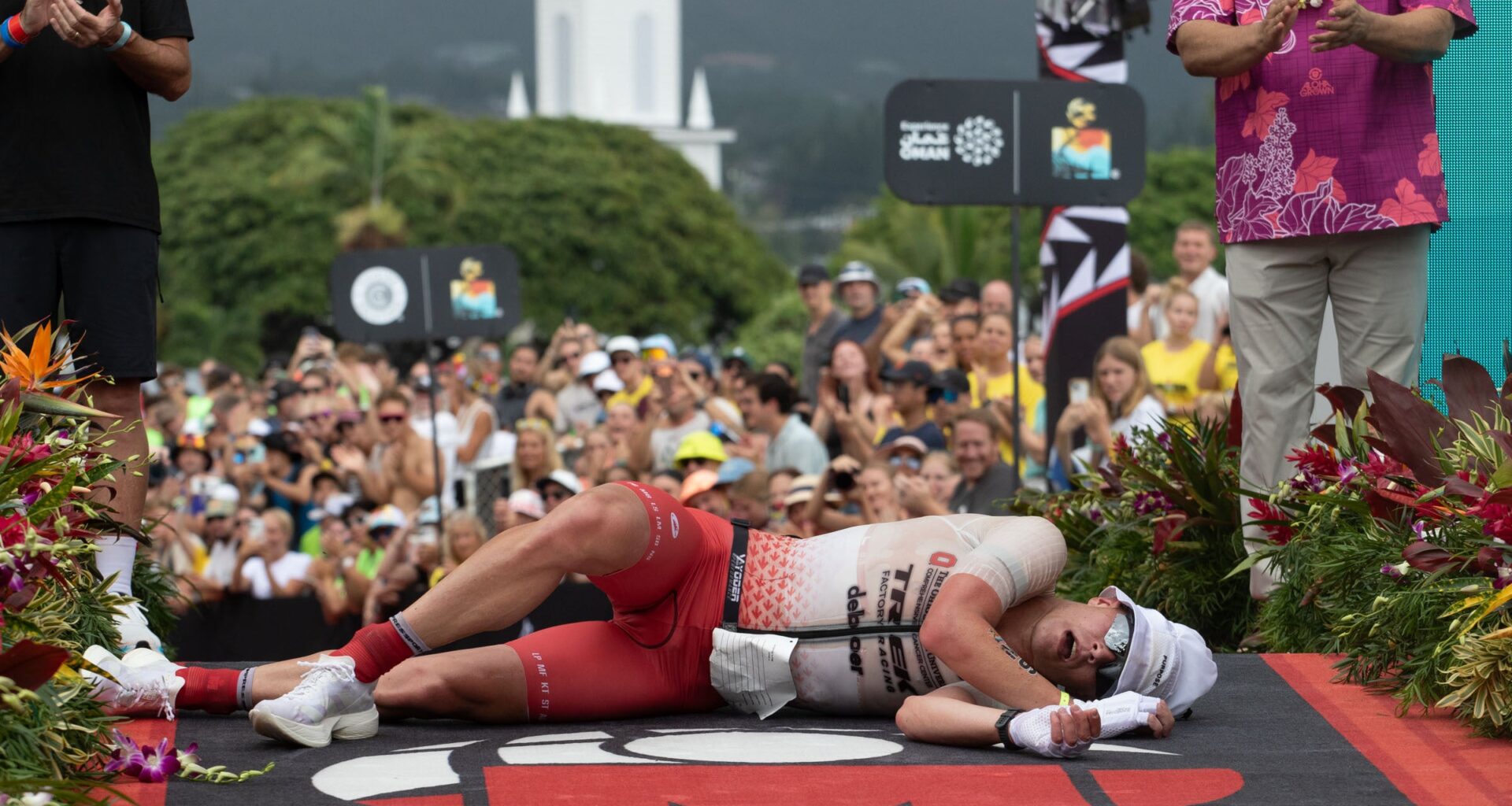
Crossing the finish line on Ali’i Drive is an emotional experience, but when that initial rush of euphoria wears off, the strongest sensation you’re left with is leg pain. And where there’s pain, there’s harm.
“When you put your body through that kind of test,” says Jeff Sankoff, MD, an emergency medicine specialist, triathlon coach, and Triathlete contributor, “you have microscopic breakdown of muscle fibers.”
But that’s only the beginning. “The muscle damage that occurs results in leakage of things that should not be in the serum and the surrounding tissues,” Sankoff continues, noting that the effect is especially pronounced in hot environments like Kona’s. Creatine kinase, myoglobin, and other cellular waste products accumulate around damaged muscle fibers, triggering an inflammatory response that stimulates pain receptors. That’s why your legs hurt even more the next morning, and why the phenomenon Sankoff is describing is known as delayed-onset muscle soreness (or DOMS).
Except in extreme cases, the muscle pain you experience after Kona and similar events is nothing to worry about and will disappear within a few days. Sankoff recommends gentle activities — a casual stroll or a gentle swim or spin — as the best ways to take the edge off your discomfort on Recovery Sunday.
“My knees won’t bend.”
 (Photo: Hannah DeWitt/Triathlete)
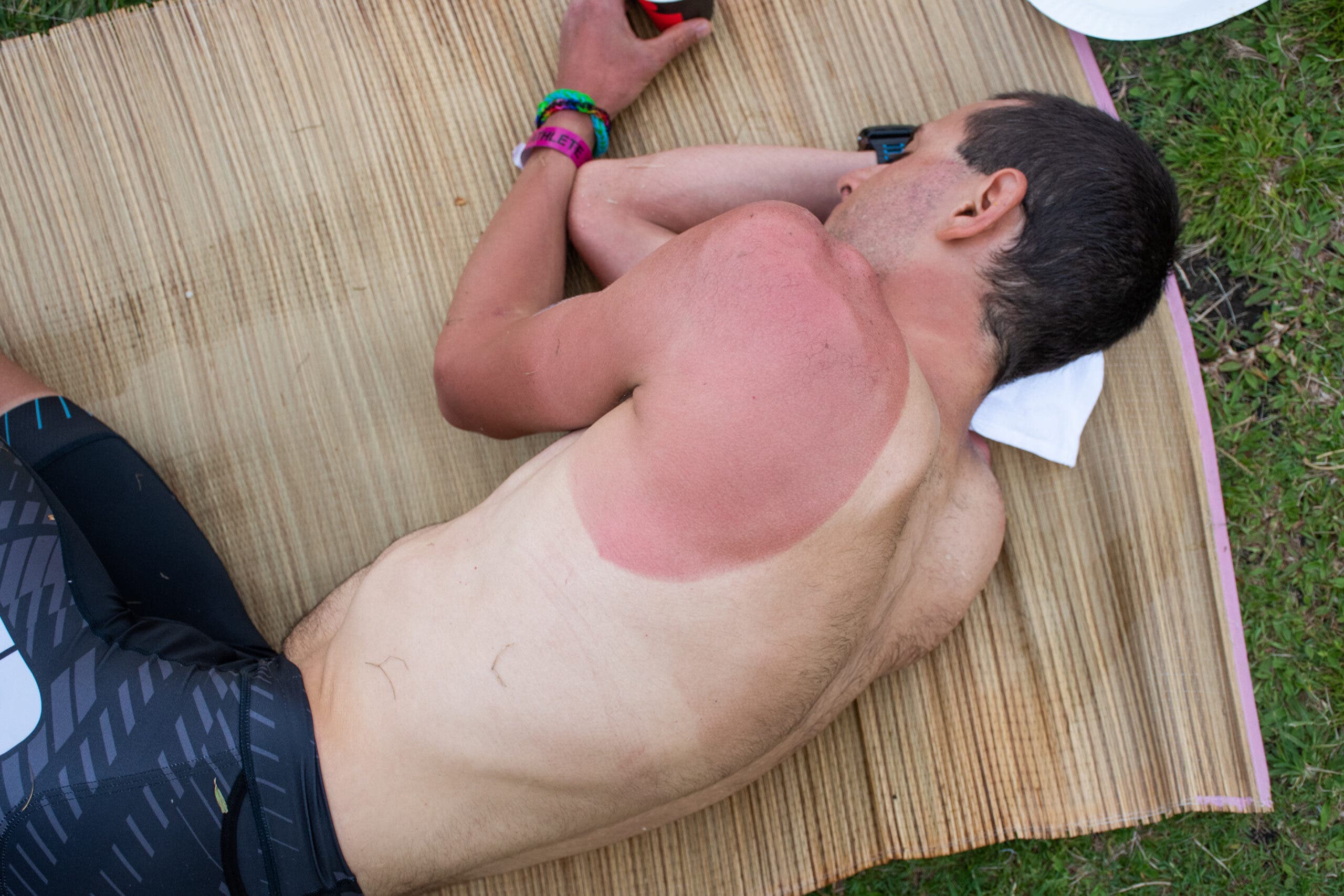
Closely related to DOMS is joint stiffness. According to Sankoff, “The same inflammatory response that causes muscle soreness also creates fluid buildup, so you get localized swelling in the muscles and joints.” The resulting pressure acts like a liquid brace around your ankles, knees, hips, and shoulders, restricting movement. Try not to drop your room key on Recovery Sunday, because you’ll have a heck of a time picking it up!
“I have zero energy. None.”
Nobody is surprised when they feel tired after a long-distance triathlon. The typical athlete burns 8,000 to 10,000 calories during an Ironman while consuming 3,000 to 4,000 calories, leaving them with a sizable deficit when it’s over. Even if you manage to eat a big dinner that night (which isn’t likely, for reasons we’ll get into), you’re still going to wake up the next morning with a depleted body battery, and you’ll feel it.
Here again, Kona’s sauna-like conditions compound the issue. Research has shown that the body’s efforts to maintain a stable core temperature on a sultry day increase the energy cost of exercise. A 2024 study published in the journal Temperature found that soldiers burned 11% more carbohydrate when rucking in a hot environment (98 degrees F) than they did at the same speed in temperate surroundings (68 degrees F).
To keep from overheating, your body sweats, which leads to dehydration, which also causes tiredness. You’re likely to lose 2 to 3% of your body mass through perspiration in the course of completing an Ironman, perhaps more on the Big Island. On top of that, ultraviolet radiation makes you tired even on a cool day by causing skin damage that requires energy to repair. Add it all up, and it’s no wonder you have zero energy on Recovery Sunday.
“I feel like I’m wearing cement boots.”
If you’re like most triathletes, you think of fatigue as something that happens in your muscles, and it does. But in long events like the Ironman World Championship, your nervous system, which drives the muscles, becomes even more fatigued.
“When you push yourself for a long period of time,” says Scott Frey, PhD, a neuroscientist at Cerebral Performance, “the motor system in the brain slowly loses its capacity to drive output.” Electrical signals sent from the brain to the limbs get measurably weaker, and performance declines. In one study, athletes completed a jumping test before and after a long-distance triathlon to assess neuromuscular fatigue. As expected, they lost some of their hops post-race, but the primary cause wasn’t muscle fatigue per se but reduced input to the muscles from a worn-out brain.
If you race in Kona, you know better than to test your jumping ability soon after the event. Yet even if you do nothing more strenuous the next day than stroll around town, you’ll likely feel sluggish, heavy — and clumsy. According to Frey, dexterity and coordination are also compromised when your nervous system is fried. Playing darts may not be the best way to celebrate a successful finish at the Ironman World Championship.
“I can’t string two thoughts together.”
 (Photo: Hannah DeWitt/Triathlete)
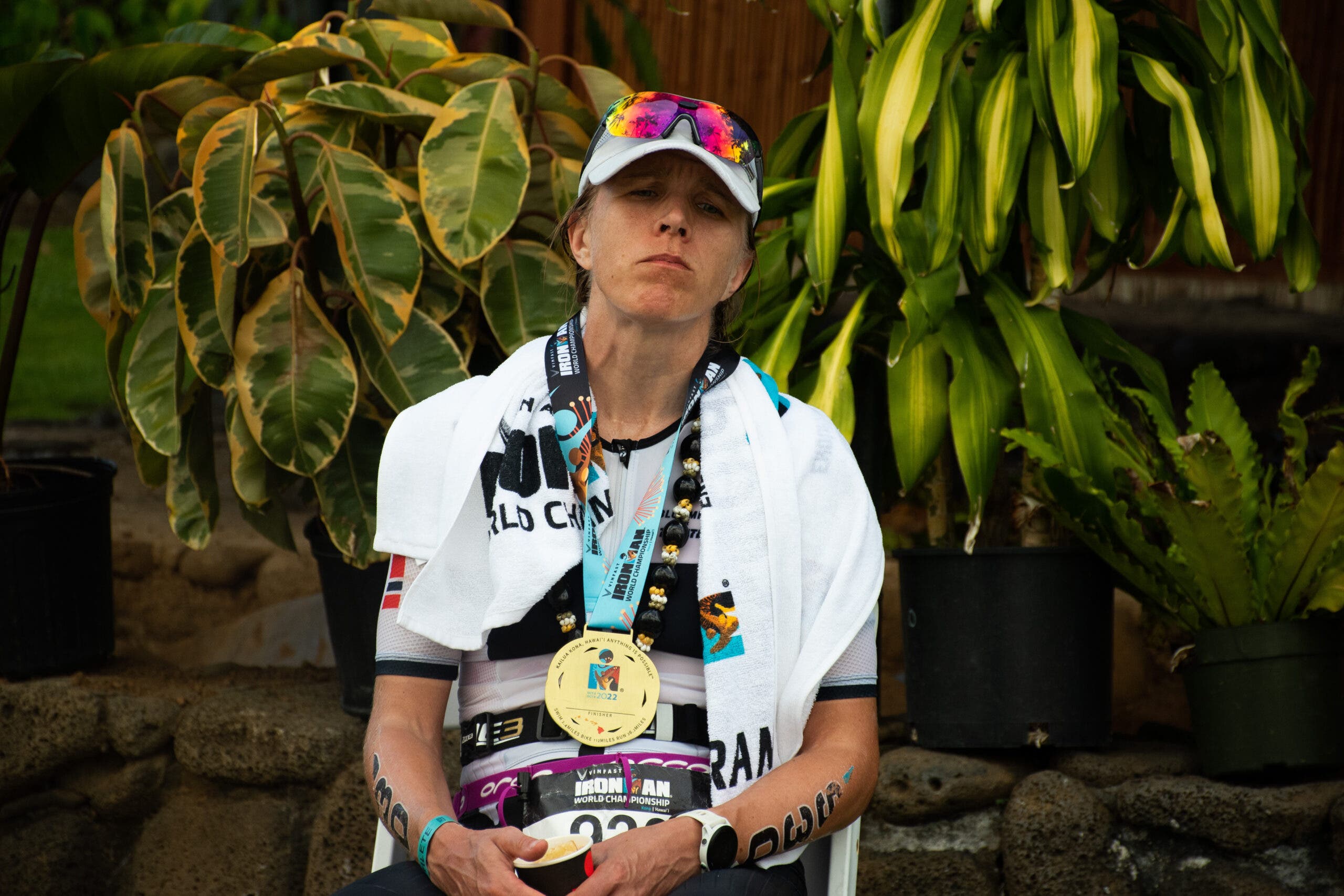
When you participate in events like the Ironman World Championship, your nervous system operates in a state of sympathetic activation, marked by high levels of cortisol, norepinephrine, and other stress-related hormones and neurotransmitters. You need sympathetic activation to stay focused, tolerate pain, and get the most out of your muscles on the racecourse, but it takes a toll on the brain. Studies show that activity in the prefrontal cortex, the command center of the brain, is reduced in the recovery period after long races like Kona, and it’s something you notice.
“When people are in these acute recovery states,” Frey says, “they have issues with what we call executive function or cognitive control. Difficulty making decisions. Brain fog. Poor impulse control.” In another day or two, your gray matter will be back to normal, but think twice before you purchase a timeshare on Recovery Sunday.
“I could eat an entire lasagna – and I don’t even like lasagna!”
In 2002, I completed my first Ironman as an actual participant. That evening I went out to dinner with my family and ordered a mushroom bacon cheeseburger with duck fat French fries. When the food came, I ate two bites and pushed the plate away, not because I didn’t like it but because my stomach wasn’t ready. The following morning, I devoured a three-egg farmer’s omelet with toast and hash browns and couldn’t wait for lunch.
This is normal, experts say. “You’ve diverted blood away from your gut all day long,” Sankoff explains, “and it sustains an injury. Your gut is not able to suddenly handle food right away, especially foods high in fat and protein, which delay gastric emptying.” And in case you were wondering, yes: Heat and humidity exacerbate the problem, making the Ironman World Championship especially hard on the GI system.
Hormonal shifts also contribute to the “no, thanks” feeling you get in the first few hours after an Ironman. GLP-1 — the now-famous satiety peptide — spikes, while ghrelin — a hunger hormone — drops. By the time you wake up, however, your GLP-1 will be down, your ghrelin up, and you just might be in the mood for a hearty breakfast.
“Just go with the flow” is Sankoff’s advice. “When your body’s ready to start making up that calorie deficit, it will tell you.” Obeying your hunger is just about the best thing you can do to boost your recovery the day after an Ironman, Sankoff adds, supplying nutrients vital to replenishing muscle and liver glycogen, repairing muscle damage, and getting your body back to homeostasis.
“I think I might be coming down with something.”
Odds are you won’t get sick while you’re in Kona, but you might. A 2024 meta-analysis appearing in Exercise Immunology Reviews found that the risk of catching a virus rose by 18% in the days following a marathon. Post-Ironman sickness rates have not been studied, but it’s a safe bet they’re comparably elevated.
Scientists aren’t exactly sure why endurance races like the Ironman World Championship open the door to infection. The leading theory is that these extreme efforts deprive immune cells of the energy needed to do their job properly. Environmental factors may also be at play. Being surrounded for several hours by dozens of sweat-basted, mouth-breathing competitors seems like a pretty good way to pick up whatever’s going around.
I don’t mean to alarm you. Doctors like Sankoff don’t see viral risks as a reason to avoid Kona or other big events as long as you’re healthy going into them. To reduce your chances of feeling under the weather on Recovery Sunday, avoid unnecessary social contact, wash your hands frequently, and mask up for extra protection.
“I can’t remember the last time I felt so [fill in the blank].”
The physical effects of racing in Kona are highly predictable. Everybody is tired and sore the next day. The psychological effects, however, are harder to anticipate.
“There is no correct way to feel after a big event like an Ironman,” says mental performance consultant Carrie Jackson, who has seen everything from towering euphoria to deep despondency in her clients after important races. “It totally depends on the person and the experience.” Proud, angry, grateful, regretful, empty — however you feel on recovery Sunday, Jackson assures, your emotions are probably normal and definitely temporary.
A variety of factors feed into the emotions you experience in the wake of a major competition. On the physical side, it’s been shown that brain fatigue impairs emotional regulation, which can bring about what Jackson refers to as “emotional flooding,” where you feel as though you might cry or laugh at any moment without knowing why.
On the mental side, a phenomenon called event centrality plays a role in shaping post-race emotions. “Whether it’s a wedding or an Ironman or some other event,” Jackson says, “when you spend a long time putting a lot of energy into planning and preparing for one important day, it gives you forward momentum and a sense of purpose, and when suddenly it’s over, it’s like now what?”
Some athletes discover a sense of relief in the vacuum that opens up after a big race, while others experience a kind of grief. The biggest races produce the strongest emotional aftershocks, and there’s no race bigger than the Ironman World Championship. Jackson teaches her clients to accept that strong emotions, including negative feelings, are as natural as muscle soreness and other physical effects. Observe them without judgment and you’ll feel better than you will by fighting your emotions.
Totally worth it
Earlier this year, Sankoff attended an awards ceremony at Ironman Kalmar-Sweden, where he watched second-place men’s finisher Matthew Marquardt struggle to climb the podium on shaky legs. “It made me realize that even guys like him,” he told me, “who are so supremely trained, put their bodies through that test and have stiffness and soreness just like the rest of us.”
When you wake up in Kona on Recovery Sunday with screaming quads, raging hunger, and a foggy brain, you aren’t just paying the price for giving everything you had in the Ironman World Championship. These battle scars also mark you as a member of a special tribe of remarkable achievers. Remember that.