
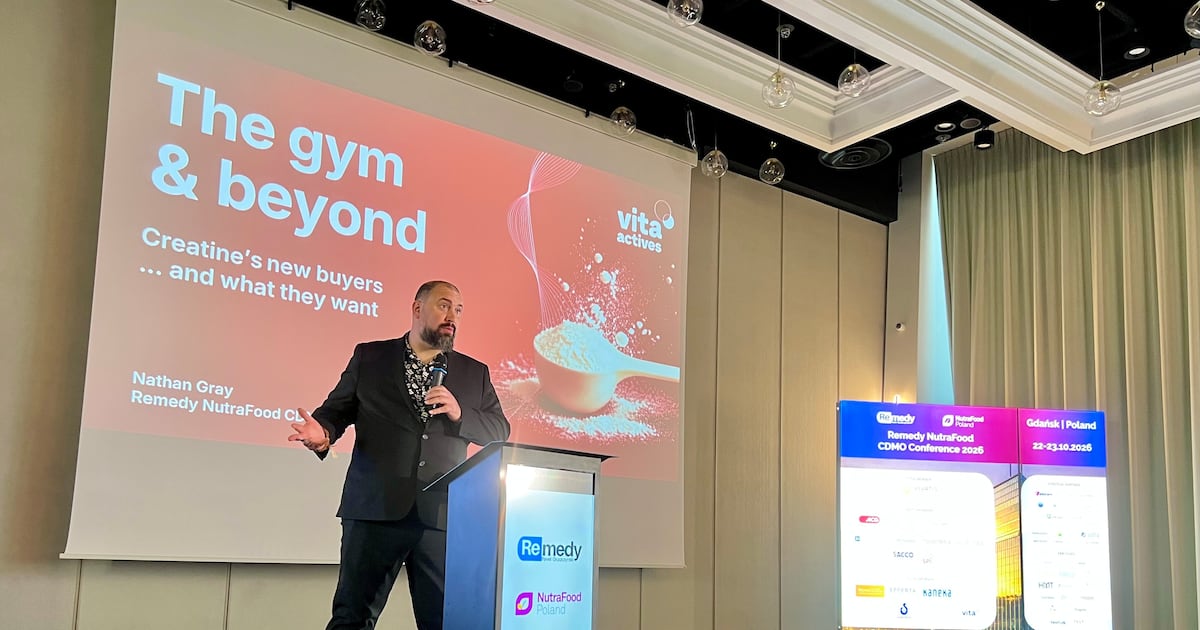
Creatine has grown at three times the wider supplements market rate in recent years (2022-2025) with new products launched carrying this ingredient between January and August up 62% in 2026, versus the same period last year (Innova Market Insights).
Revealing the market data and discussing the product innovation opportunities during the recent Remedy Nutrafood CDMO Conference in Gdańsk, Poland, Nathan Gray, technical and marketing manager at Vita Actives, outlined the importance of value-added formulation.
“The retail price per kilo varies dramatically depending on what is done with the core ingredient,” he informed delegates.
The median price per kilo of plain unflavored creatine powder is €73, rising to €83 for flavored creatine powder. This number triples to €222 for a ‘creatine+’ powder with added bioactives, and rises further to a median price of €275 per kilo for formats which require further processing, such as bars, chews and gummies.
“This means that other formats of creatine are almost four times the price of plain powders,” he said, “so the value here is all about what you do with the creatine.”
Claims beyond the gym
Discussing the growing scientific backing for, and awareness of, creatine’s different health benefits, Gray said most new launches are targeting markets far removed from the traditional muscle building, gym-going demographic.
“I would argue creatine is one of the more interesting ingredients in the longevity conversation because people are starting to think about what products they will use when they are older as well as what they will be using in the gym,” Gray said, adding that launches outside of the conventional gym fuel category are up 194.7%, suggesting these are all appealing to customers brand new to the category.
At the same time, launches of creatine combinations with added bioactives are up 134% YoY, compared to launches of creatine-only products which are up just 52.7%.
He noted the most popular bioactives to formulate alongside creatine are electrolytes for products targeting hydration and recovery, HMB for added muscle support, collagen for bone and joint formulations, magnesium for products targeting the mind, and citicoline for brain health formulations.
The new buyers entering this category are also more interested in quality and transparency than the classic muscle-building demographic, Gray argued, emphasizing that this is particularly important following the much publicized ‘creatine gummies scandal’.
Therefore, a key strategy for standing out in this increasingly crowded category is to provide information and statements which indicate quality, such as exact dosages, purity, ‘micronized’ formulas, third-party tested, and named patented ingredients, Gray noted.
Breaking the monopoly on the market
Until recently, the pure and high quality creatine monohydrate market was dominated by Alzchem’s Creapure, but competitors are now successfully breaking through, largely driven by the explosion in consumer demand.
With that, Vita Actives is building awareness of its 99.9% purity micronized creatine monohydrate branded CreaWin, which is marketed as an ingredient for “daily-use formulations where quality cannot be compromised”.
Aiming to cater for that value-added proposition, the ingredient can be supplied in a fast-melt stick pack format which dissolves directly on the tongue. It can also be formulated into chewable tablets offering 1.67g of creatine per tablet, or into fruit flavored chews which can provide up to 2.5g per chew.
The science of creatine’s role in healthy ageing, and how brands can capture a longevity-minded consumer, will be central to the conversation at Nutra Healthspan Summit 2026.