

Tweaking your daily walk with these tips can help you build stronger legs.
Walking is a powerful form of cardio—but its benefits far exceed heart health. Walking consistently can boost metabolism, improve your overall wellness, and build solid leg strength. Each stride activates key muscles in your lower body, including your glutes, calves, hamstrings and quads.
To bring those benefits to the next level, we spoke with Domenic Angelino, CPT with International Personal Trainer Academy, which offers NCCA-accredited Personal Trainer (CPT) and Certified Nutrition Specialist (CNS) programs, who shares two productive walking techniques that can build more leg strength than going to the gym—especially after 50. Each step you take counts, but if your goal is to build strength and muscle mass in your legs, these tips are stellar additions to your workout.
“Walking is more effective [than gym machines] for improving your aerobic capacity, which is something that makes it easier for you to do long duration activities without feeling tired,” explains Angelino. “The other thing that walking does well is that it translates pretty 1:1 with activities of daily life. You’ll use your muscles in a similar combination as you would when walking around during your day.”
Walking Techniques That Build Stronger Legs After 50
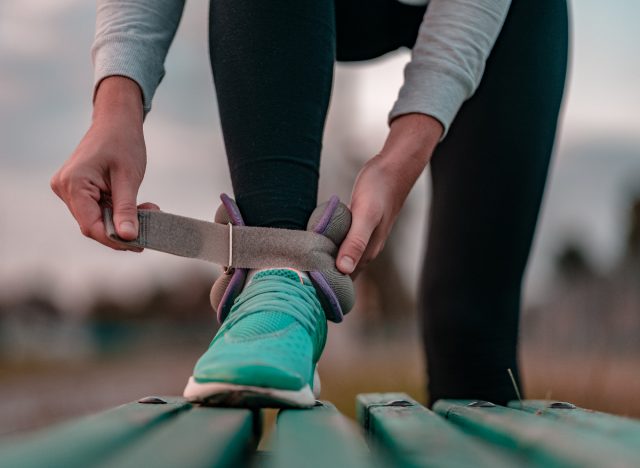 Shutterstock
The best way to boost leg strength is by adding to the resistance your legs need to overcome with every step.
“There are a handful of different ways you can do this safely and effectively. But, they all share one thing in common: they force your muscles to work harder with each step. This is the case because your body adapts to meet demands imposed on it,” he explains.
Pick up the Pace or Walk at an Incline
 Shutterstock
The quicker you walk and the steeper the incline, the more your strength will improve.
“Similarly, you can walk up and down stairs. But, if you do so, be careful—it’s more common than you’d think for someone to trip when exercising on stairs. Reason being that people are pretty confident they won’t trip because they’re normally able to handle stairs without issue. Although this may be true, the likelihood of tripping elevates when those same people are walking up the stairs while fatigued and focusing on speed,” Angelino cautions.
Hold Free Weights In-Hand During Short Walking Bursts
 Shutterstock
While performing short bursts of walking—30 to 60 seconds at a time—consider holding dumbbells or kettlebells.
“If you hold heavy weights in your hands, you can increase the amount of force your leg muscles need to produce safely,” Angelino tells us. “This approach has a built-in mechanism for minimizing the change of distribution of mass across your body. Since the dumbbells have to be held symmetrically to one another, and also force you to keep your hands by your sides instead of swinging them while walking, the change in mass distribution is lower than using light hand or ankle weights.”
Age-Related Changes That Impact Leg Strength
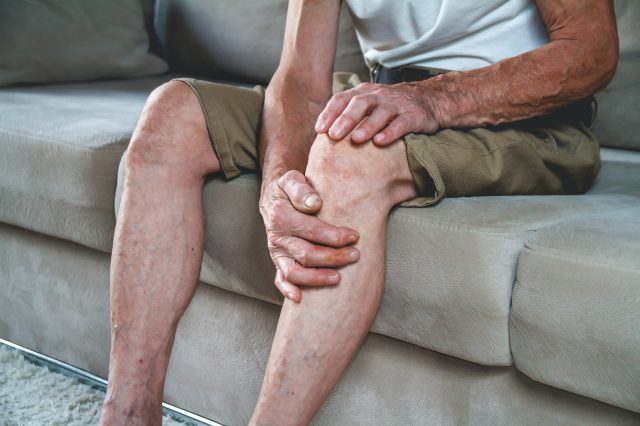 Shutterstock
One of the biggest hurdles you experience with age is the natural loss of lean muscle and strength, a process known as sarcopenia. However, this decline can be addressed to a certain degree by revving up your workouts.6254a4d1642c605c54bf1cab17d50f1e
“You can still be stronger at 55 than you were at 25, but it depends on how strong you were at 25. If you were inactive your entire life, and started exercising regularly for the first time after 50, you’ll easily be able to get much stronger than your younger self, in most cases,” Angelino explains. “The reverse is also true. If you were much more active when younger, and then become inactive in later life, you’ll find the relative amount of muscle and strength loss you experience in your legs will be greater than a version of you that just never worked out at all.”
When strength decreases, power usually follows suit. In addition, suffering from injuries also becomes more common with age, which can greatly impact leg muscle and strength.
“If you spend less time walking around and more time in bed due to a bad hip, an unstable knee, or even a seemingly unrelated condition like chronic fatigue syndrome, your leg muscles will atrophy,” Angelino explains.
Alexa Mellardo
Alexa is a freelance writer, editor, and content strategist based in Greenwich, CT. She has 11+ years of experience covering wellness, fitness, food, travel, lifestyle, and home. Read more about Alexa