
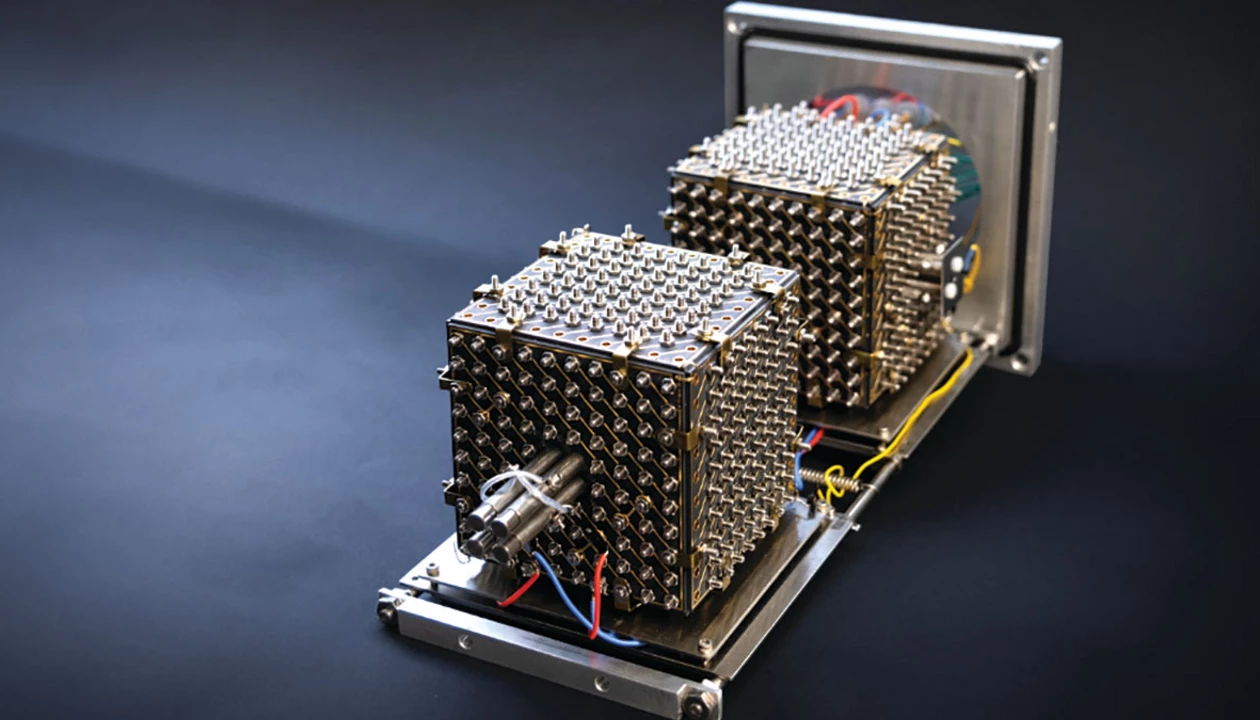
Mass spectrometry unveils a world of proteins, from those in cells to fragments found on fossils, as well as the small molecules made by organisms. But this powerful technique often suffers from limitations in speed, sensitivity, and the ability to capture all possible information. Now researchers, taking cues from biology, have designed a prototype that could address these issues. The approach may help scientists investigate new questions in proteomics, metabolomics, and single-cell analyses, the researchers say (Sci. Adv. 2026, DOI:10.1126/sciadv.aec7048).
When J. J. Thomson built the first mass spectrometer around 1913, “it was a thing of beauty,” says Brian Chait, a physicist at The Rockefeller University in New York City. “You could see everything at the same time.” Since then, these tools have improved—shrinking and becoming more sensitive. Today, “the mass spectrometers are stunningly good,” he says. “But we do everything rather serially.”
Many mass spectrometers rely on ion traps to store and analyze ions. Although there are many types of ion traps, they generally all have one inlet and one outlet. This creates a bottleneck, and researchers have to choose which ions to analyze. It’s like trying to catch a fish from Niagara Falls with a single bucket, Chait says. Molecules, especially ones at low abundance, that might be important can go missed.
Chait and colleague Andrew Krutchinsky were inspired by the oodles of openings that allow molecules to move in and out of cell nuclei. Over some 10 years, the researchers made and tested versions with configurations from 6 ports to over 1,000, Krutchinsky says. One version of the prototype announced this week, called MultiQ-IT, has 486 openings.
Compared with state-of-the-art commercial instruments, the boxlike device was able to trap around 1,000 times more ions, the team reports. Manipulating electrical fields within the device allows an exodus of high-abundance ions that don’t provide much information, boosting sensitivity.
“This approach, in general, is inspired,” says David Clemmer, a chemist at Indiana University in Bloomington who wasn’t involved with the work. “Nature doesn’t stop and select things one at a time to look at. It does things all at once all the time.” This work gets to a “truly parallel mass analyzer,” he says. Researchers would have the “chance for true discovery,” he says, because they wouldn’t have to select what to study.
Parallelization has transformed genomics and computing. Doing the same for fields that use mass spectrometry, such as proteomics and metabolomics, could allow researchers to catch rare but functionally important proteins. “There is no correlation between the amount of a protein and its importance,” Chait says.
The prototype is a proof of concept that parallelization can work for mass spectrometry, Chait says. Future work is needed to figure out how to handle and analyze all the outputs.
The new work is not the only recent advance in mass spectrometry. In October, Waters Corporation launched a charge detection mass spectrometer (CDMS) based on work by Clemmer’s colleague at Indiana University, Martin Jarrold. Jarrold and Clemmer cofounded Megadalton Solutions to commercialize that work, and Waters bought the technology in 2022.
Pairing parallelization with the ability of CDMS to measure enormous molecules, including the protein complexes that are the machines of the cell, could advance the whole field quickly, Clemmer says. “There’s kind of an immediate 10 to 20-year horizon where we start to be able to deal with biological complexity at the next level,” he says. That could enable a more comprehensive understanding of the molecules and pathways involved in life.
Chemical & Engineering News
ISSN 0009-2347
Copyright ©
2026 American Chemical Society