
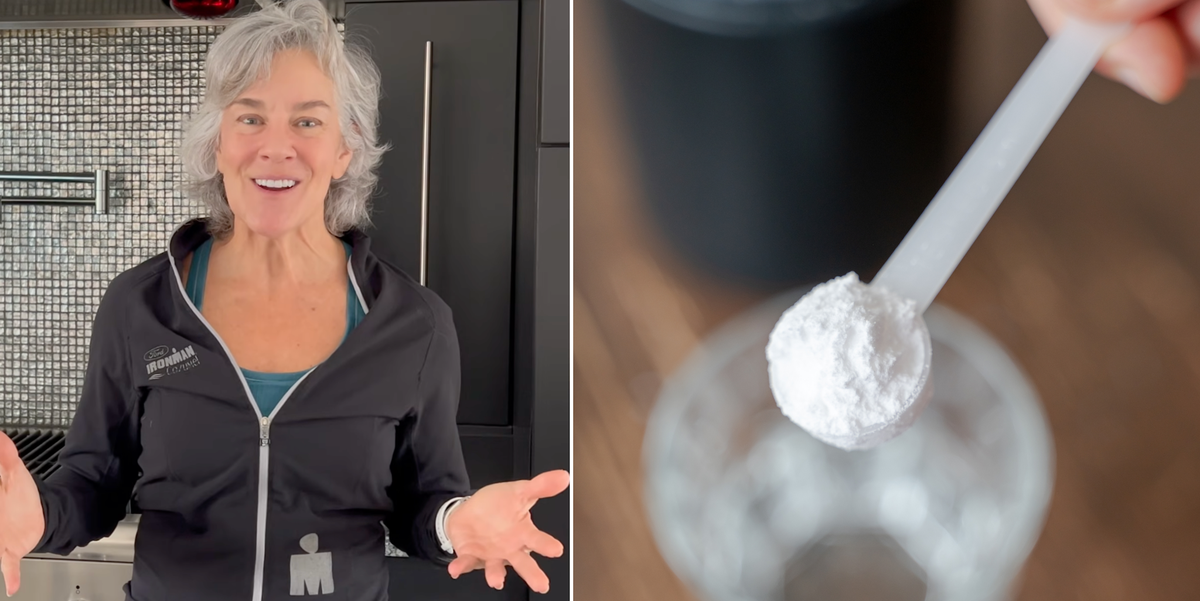
Menopause fitness expert Debra Atkinson, also known as Flipping50, began her creatine ‘super-dosing’ experiment by accident at an industry conference. ‘Every time there was a little sample of creatine… I would dump it in,’ she said in a video reflecting on her experience. ‘So, I was doing about three times [around 21-24g] the normal dose [around 5g].’ She was surprised by the cognitive benefits that followed.
Debra explained that she had initially ‘flirted with creatine back in the 90s and then again a little bit later,’ but that she hadn’t ever really felt a ‘boost’ from it. Likely, she said, because ‘I was doing okay – my hormones were where they needed to be, my stimulus was where it needed to be, my sleep was where it needed to be. Now, I’m five years post-menopause, which is kind of a critical spot.’ In other words, having covered all the important foundation health habits such as strength training and balanced nutrition, Debra was seeking potential ways to ‘get a little edge’, which was the initial reason she started taking creatine again.
Does creatine reduce with age?
Ageing is associated with lower levels of creatine, specifically in the skeletal muscle, with research suggesting that phosphocreatine (a form of creatine stored in muscles that helps rapidly produce energy) regeneration rates following exercise fall approximately 8% each decade after age 30. So, supplementing may become more beneficial with age when muscle and bone density maintenance becomes increasingly urgent. ‘It’s like we’re playing tug of war, and we’ve got to do what we can to win it [muscle] back,’ Deborah explained.
Body composition changes
During Debra’s two-week creatine super-dose, she said she didn’t experience any visible body composition changes. But she wasn’t surprised by this. While you’re unlikely to see any visible muscle growth in as little as two weeks, Debra added that she would be even less likely to, considering she’s already ‘closer to the end goal’. In other words, she’s strength trained and taken creatine consistently for several years already.
Focus and energy
But Debra noticed additional cognitive benefits within the first day. She said that she wasn’t ‘losing my train of thought – or losing my attention span later in the day,’ was ‘able to be attentive and focused and ask good questions and take great notes, and turn around and talk to my colleagues with bandwidth.’ She also wasn’t ‘exhausted at the end of the day.’
Debra added that taking the creatine in the afternoon had also been useful, helping her to stay focused beyond her typical productive hours in the morning.
Recovery
Despite Debra’s busy schedule involving travel across several time zones, she said she felt much better able to cope with the upheaval and jet lag and hit ‘the ground running on both sides.’
Sleep deprivation
Debra also explained that the higher creatine dose supported her through another specific period of sleep deprivation while helping out with her baby grandson. ‘I was there for three nights, four days. I had my creatine and I used it and felt so much better,’ she said, adding that it made her feel more alert and functional.
The science backs her up, with one recent study suggesting that a single, high dose of creatine may help offset sleep deprivation-associated cognitive decline. But as Debra highlights, this isn’t the same as taking a smaller daily dose – it’s more situational. As was the case in the study, where participants took 0.35g/kg of bodyweight (around 24.5g for someone weighing 70kg), the effects likely require a much higher dose – one you wouldn’t necessarily take all the time.
Migraines
Debra also explained that she has struggled with migraines in midlife, which she said could be triggered by harsh lighting and long travel days. However, despite both of those things featuring during this super-dose period, Debra said upping her creatine intake had ‘made a significant difference’ to her risk of getting a migraine. Of course, she acknowledges that this is entirely based on her personal experience, and that there is currently limited scientific evidence.
However, research is increasingly looking into the benefits of creatine loading for brain health, including following a traumatic brain injury, and as a potential supplementary therapy for chronic migraines.
What type of creatine did she take?
Debra shared that she uses creatine HCL, and while most experts say creatine monohydrate is the gold standard as this is what most of the research tends to be based on, it’s about finding what works for you. ‘I didn’t necessarily have any issues with monohydrate before menopause,’ she explained. ‘Post-menopause, I can feel a little more bloated – our hormones change, our gut microbiome can change.’ Anecdotally, Debra said she has found HCL doesn’t cause bloating and is easier to digest.
For those wishing to try a supplement, in the video Debra recommends starting gradually to improve tolerance – ‘Start at 3g, increase to 4g, and then finally get yourself to 5g.’
If you’re considering trying creatine (or significantly increasing your dose), we would always advise consulting a medical professional beforehand.
Related Stories