
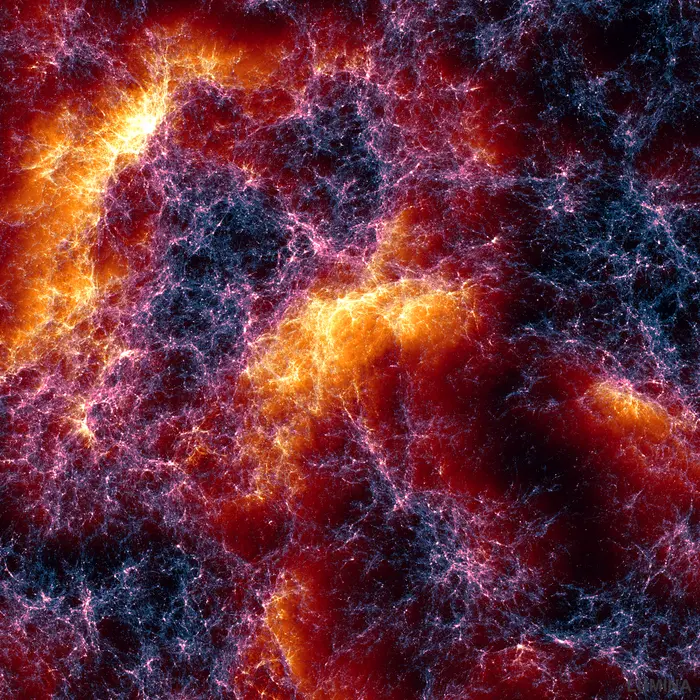
 A rendering of the cosmic web about 650 million light-years across, produced by the Lumina simulation. The fine filaments represent dark matter, and the warm orange and yellow tones highlight where gas is moving the fastest between galaxy clusters.
Credit Oliver Zier, Center for Astrophysics | Harvard & Smithsonian
Researchers at the Center for Astrophysics | Harvard & Smithsonian (CfA) have introduced “Lumina,” a massive cosmological radiation-hydrodynamics simulation designed to model the universe’s first two billion years
Published in the Monthly Notices of the Royal Astronomical Society, the computational model simulates the interactions between dark matter, ordinary baryonic matter, and ionising radiation during the epochs of cosmic dawn and reionisation.
The platform provides a theoretical framework to interpret observational data gathered by NASA’s James Webb Space Telescope (JWST) and the upcoming Nancy Grace Roman Space Telescope.
Technical scale and computational architecture
Executing Lumina required over 15,000 graphics processing units (GPUs) running on the Frontier supercomputer at Oak Ridge National Laboratory in Tennessee.
By leveraging exascale computing, the CfA team built a virtual volume roughly 100 times larger than previous comparable radiation-hydrodynamic models.
Key structural and technical parameters of the simulation include:
Spatial volume:
Models a cubic region spanning approximately 1.5 billion light-years on each side, matching the spatial observational scales of modern space observatories.
Dual reionisation integration:
Lumina is the first simulation of its scale to dynamically capture helium reionisation as it occurred, allowing its thermal feedback to directly influence the surrounding intergalactic medium (IGM) in real time.
Multi-scale physics resolution:
The model tracks large-scale cosmic web filamentary structures while simultaneously resolving individual luminous objects, including early star-forming galaxies and supermassive black holes.
Theoretical applications and synthetic predictions
Led by ITC Fellow Dr Oliver Zier and Assistant Professor Dr Aaron Smith (University of Texas at Dallas), the research team designed Lumina as a testbed for evaluating cosmological theories against direct observations.
Observational validation:
By comparing JWST and Roman Space Telescope spectra against Lumina’s synthetic predictions, astrophysicists can verify current models of star formation, galactic feedback, and cosmic structure evolution.
IGM gas dynamics:
The model provides detailed tracks of how pristine neutral hydrogen and helium gas transitioned into ionised states across intergalactic space, reshaping how light travelled through the early cosmos.
Anomalies and new physics:
Discrepancies between Lumina’s predictions and physical telescope observations will help identify potential gaps in current astrophysics, guiding future research into early galaxy assembly and dark matter properties.
Editor’s Recommended Articles