
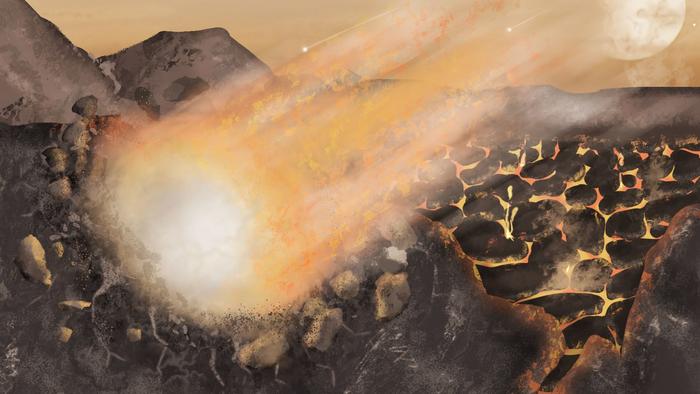
 Illustration of cometary impact.
Credit Scarlett White
A new study led by researchers at the University of Cambridge suggests that comets were highly unlikely to have delivered the organic building blocks necessary for life on early Earth
Published in Scientific Reports, the computational modelling study demonstrates that the extreme velocities and entry angles of cometary impacts would almost certainly vaporise fragile prebiotic molecules upon atmospheric entry or surface impact, making cometary delivery a “one-off fluke” rather than a reliable delivery mechanism.
Impact dynamics and prebiotic molecule survival
For nearly a century, planetary scientists hypothesised that comets acted as spaceborne delivery vehicles that rained carbon- and nitrogen-bearing molecules onto the early Earth. The Cambridge research team evaluated this hypothesis by integrating recent advances in comet-atmosphere entry physics, impact dynamics, and Solar System orbital evolution models.
Key physical and chemical findings from the study include:
Thermodynamic vaporisation:
Most comets enter Earth’s atmosphere at high speeds and steep trajectories, generating extreme heat that destroys complex organic compounds, such as hydrogen cyanide (HCN), before they reach the surface.
Concentration deficits:
Even in rare simulations where HCN molecules survived an impact, the delivered material’s concentration dissipated too quickly to sustain the rapid, multi-step chemical reactions needed to initiate life.
Temporal window
The frequency of cometary bombardment declined sharply within Earth’s first 500 million years, leaving at most a handful of statistical opportunities for successful, non-destructive molecular delivery.
Alternative prebiotic pathways and Martian implications
Because cometary delivery appears statistically improbable, the researchers point toward alternative origins for Earth’s prebiotic chemistry:
Asteroid impact synthesis:
Asteroid impacts occurred far more frequently than cometary strikes on early Earth, generating localised energy and shock chemistry that could synthesise organic building blocks directly from atmospheric and surface compounds.
Endogenous terrestrial synthesis:
Prebiotic chemical precursors may have formed entirely through native terrestrial processes, such as deep-sea hydrothermal vent activity or atmospheric lightning discharge, without extraterrestrial delivery.
Comparative dynamics on Mars:
The study noted that Mars was slightly more favourable for cometary delivery early in its history because of its lower mass and weaker gravity. However, researchers emphasise that an endogenous or asteroid-driven origin remains more plausible for both planets.