
These days, their cows produce 700kgMS, with an average liveweight of 550kg.
By focusing on cost control, pasture management and strong herd performance, the Burgesses consistently rank in DairyNZ’s platform DairyBase’s top 20% for operating profit per hectare among farm owner-operators.
“We haven’t been chasing high production,” Michelle said.
“We just think, if we get all the animal health and nutrition right, the rest should fall into place.”
Michelle has been interested in genetics since she was young.
Her parents, John and Maria Numan, were dairy farmers too. They had Numans Lord Nelson, one of the first crossbreed bulls marketed by agritech and herd-improvement co-operative LIC.
Michelle is on the external affairs committee for the New Zealand Holstein Friesian Association and has been a member of the farmer advisory panel for NZ Animal Evaluation for several years.
She is also the founder of the Facebook group The NZ Dairy Genetics Network.
Their herd’s breeding worth (BW) sits in the top 10% for the country.
Everything is DNA-tested and parent-verified, and they register some cow families with the NZHFA.
The Burgesses started with a crossbreed herd, but have been working towards a full F16 animal to match their goal of lower stocking rates with high per-cow efficiency.
They also find that a Friesian herd gives them more options with their calves, especially as they are using more sexed semen on their top cows and beef semen on any cows from which they don’t want replacements.
The couple began building their herd in 2008 by buying 250 empty cows and sending them to grazing while contract milking for Peter and Tracey Thompson in Te Awamutu.
The empty cows got pregnant at grazing. The following season, the Burgesses began leasing a farm in Ruakura.
They bought more cows to reach a total of 480.
The Burgesses found that a Friesian herd gave them more options with their calves. Photo / Stephen Barker, Stephen Barker Photography
“I’m pretty fussy, so we bought good cows with good breeding, mostly from people retiring from farming,” Michelle said.
After their first season, they increased cow numbers to 600 before increasing to more than 700 two seasons later.
Since then, they have bought their farm in Te Poi, near the Kaimāī Range, kept their top 320 cows and transitioned to autumn calving.
The couple changed to balance their lifestyle and to reduce the strain of dealing with pugging in winter and heat-stressed cows in summer.
They aim for capacious, easy-care cows that don’t have many health troubles and have strong udders and good fertility.
After challenges with udder longevity because of the high production, they looked to a wider gene pool.
“Even though we’d spent years nominating bulls with good udder traits, we were still finding a lot of cows were blowing their centre udder ligaments after two to four calvings, and their udders were no good after that,” Michelle said.
“So it was a big waste factor in our system.
“In 2020, we decided to try using some overseas Holstein genetics in our breeding programme.”
They took a conservative approach initially, as Michelle was aware of the challenges of having overseas bulls recognised in the New Zealand genetic evaluation system.
As they don’t typically have many daughters milking in New Zealand, there hasn’t been robust data to verify their breeding values (BVs) and accurately determine their breeding worth.
Michelle spent time learning to read international genetic data and translating it to New Zealand breeding values and breeding worth.
However, NZ Animal Evaluation’s continuous improvements have led to better genetic information conversions for overseas bulls.
Michelle was impressed with the options available.
“The genetics companies now seem to be selecting bulls that are well-suited to New Zealand farms,” she said.
“They’re moderately sized, not too big, efficient grazers and cope with our seasonal calving systems.”
Michelle enjoys exploring the range of bulls available to pick her team of four or five for the season.
“I’m very passionate. I can spend hours reading bull catalogues and playing with spreadsheets,” she laughed.
“Bill and I work together on any strategic decisions, but he leaves me to deal with the details when it comes to picking bulls.”
Michelle Burgess is on the external affairs committee for the New Zealand Holstein Friesian Association. Photo / Stephen Barker, Barker Photography
They lease a neighbouring support block to graze their youngstock, keeping up to 110 heifers each year.
And they have a good market for surplus heifers and beef calves.
On the farm, pasture is their key focus.
They keep a close eye on round lengths and residuals to ensure optimal use.
The cows are on 24-hour grazing, going into a fresh paddock at night.
After the morning milking, Michelle or their 2IC, Phillip Boshoff, checks the paddock to assess feed availability and co-ordinates with Bill to adjust the supplements as needed.
They use the feedpad daily.
“Pasture comes first, and then, depending on pasture availability, we adjust what’s fed on the feedpad accordingly.
“Early in our farming career, we would measure and analyse as much as possible, adjusting feed, changing stocking rates, drying off at different times, and as we’ve built our knowledge and skill.”
Towards the end of lactation and over the dry period, when they don’t need as much grass, 20 hectares of the farm is planted in maize.
They also grow 4.4ha of lucerne.
Bill spent years refining the herd’s diet, balancing cost and availability with the herd’s nutrient requirements.
Now he has a simple process, using a base of maize with palm kernel expeller (PKE), molasses and, depending on the time of year, some soy hull and lucerne.
They also feed a couple of kilograms of dried distiller’s grains (DDG) through in-shed feeding, which helps cow flow.
“We use an automatic gate release so the herd come in before milking to the feedpad,” Bill said.
“They’ll have their feed, then get milked and back to their paddock.
“It doesn’t take long to clean up afterwards, too.
“We like to keep it simple.”
“We never have problems with body condition in our cows,” Michelle laughed.
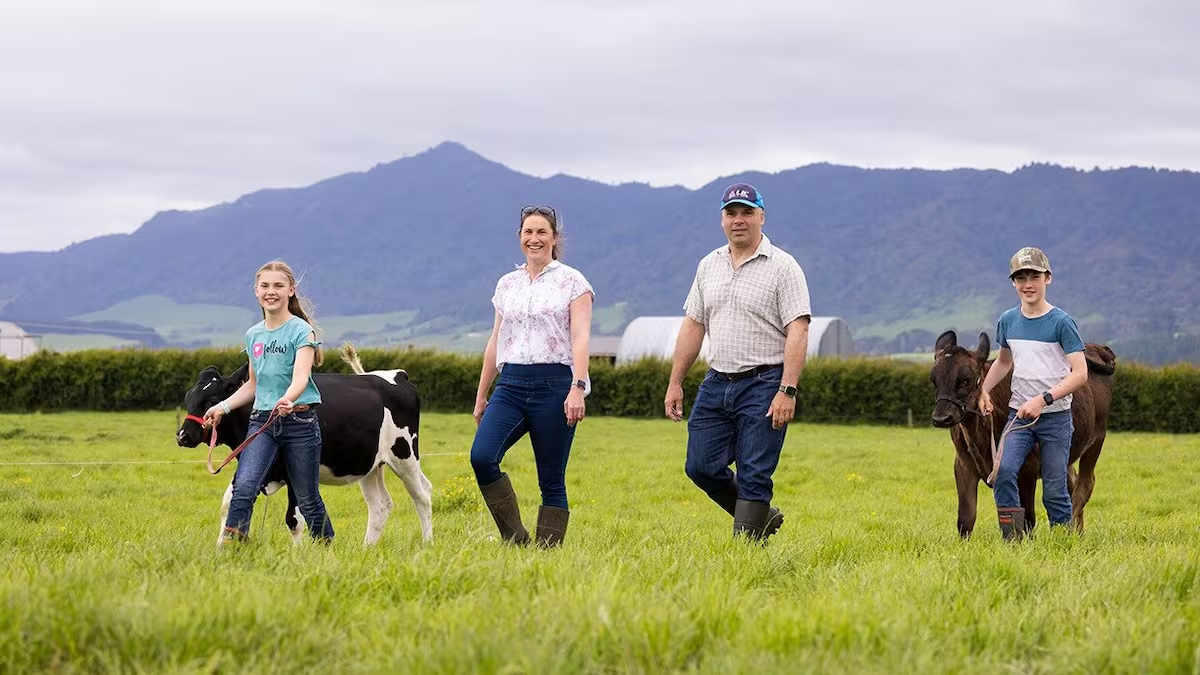
The love of cows seems to be flowing into their children, Sophie and Alex, who are excited about Calf Club.
Bill and Michelle are proud of their herd and what they have achieved.
“I think it’s exciting times for the Friesian breed in New Zealand and look forward to seeing the evolution over the next wee while.
“Genetics is a continual process, always analysing the herd’s performance to see what’s working best.”
Originally published in Inside Dairy by DairyNZ