
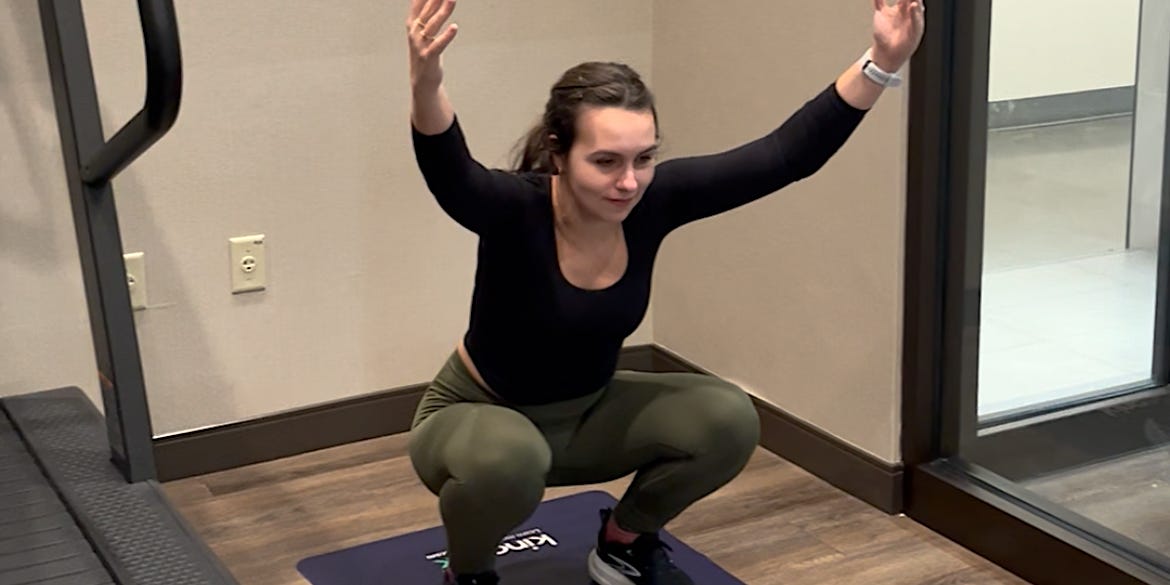
I got a 3D scan that measured my flexibility last August, hoping the predictably subpar results would finally inspire me to stretch more.
Then, I did basically nothing.
Even knowing my shoulder rotation movement was in the “red” zone — needing serious improvement if I wanted to avoid future pain — it wasn’t enough to get me to devote three minutes of light stretching before my cardio and strength workouts as suggested by trainers I had spoken with.
The only thing I changed about my routine was signing up for two reformer Pilates classes a month, motivated solely by wanting to join my friends. (I never went more than that because I could only stand to feel embarrassed by my winded lunging twice a month.)
So when I got re-scanned nearly half a year later, I wasn’t exactly expecting miraculous results. When Donovan Stewart, the Life Time trainer who conducted my first scan, said it’d be a good idea to do another one to see my biggest pain points, I dreaded the moment he summoned me over to review the results.
“You’ve improved since last time,” he said. “By 13 points.”
My mobility improved by 13 points above my baseline, according to a Kinotek scan.
Julia Pugachevsky/Kinotek
I was now in an overall “good” mobility range, with improvements in every area and nothing in the red zone. I guess even the bare minimum of mobility work could make an enormous difference in my overall health.
Even sporadic Pilates stretched me out more
Pilates is a full-body workout, developed by Joseph Pilates during World War I, that uses controlled movements to enhance core strength, breathing techniques, and balance.
It has direct flexibility benefits because it prioritizes hip mobility, core strength, and shoulder engagement. I noticed that my body felt more sore after one reformer Pilates class than after any other workout I had tried.
If gingerly lowering myself to my seat the next day was any indication, I was activating new muscle groups.
My biggest area of improvement was in my shoulder rotation.
Julia Pugachevsky/Kinotek
My trainer used Kinotek, launched in 2022 as a standardized movement assessment that scans the body to detect range of motion. It uses 3D visuals to highlight issues such as asymmetry or excessive flexibility, which can destabilize joints.
Competitors DARI Motion and Kinetisense offer similar services with their FDA-cleared medical motion-analysis devices. (Kinotek is registered with the FDA, which means that the company can sell its product in the US, but hasn’t been officially reviewed by the agency.)
According to my latest scan, my biggest improvements were in my shoulder movements and my squat:
My shoulder flexion, or raising my arms overhead and lowering them, went up by 14 points, going from a “needs improvement” range to a “good” range;My squat improved by 15 points, also moving from “needs improvement” to “good;”My shoulder rotation, or holding my arms at a 90-degree angle while rotating them, went from a red, “poor” score to one that needs improvement, up by 22 points;And I had milder improvements in my leg hurdles and in balancing on one leg while stretching out the other. Still, each one also went from “needs improvement” to “good.”
My leg hurdles could use more improvement.
Julia Pugachevsky
Reformer Pilates taught me more body awareness
When I told Stewart that the only thing I did was the occasional Pilates class, he wasn’t surprised. Even though I wasn’t super consistent, he said, I was increasing my “body awareness” — getting myself in the habit of even noticing my body’s stiffness in the first place.
Reformer Pilates, which incorporates machinery for deeper stretches, made me realize how tight my hips and shoulders felt. Originating as an apparatus to help wounded WWI soldiers exercise while lying down, the Reformer machine evolved in the US throughout the 20th century, eventually being adapted by dancers and athletes.
Reformer Pilates, which incorporates machinery for deeper stretches, helped me better feel how tight my hips were.
Thing Nong Nont/Getty Images
Equipped with straps and springs of varying resistance, the machines helped me stretch deeper than before. The light cracking sound from my hips when I lengthened into a wide stretch was like the opening of an ancient crypt. I became obsessed with that feeling. Before class began, I started putting my legs into the straps and stretching myself out on my own.
When I was at home, I began sitting on the couch differently, putting my feet together and pushing my knees apart to open my hips more. I also felt a little more aware of when I was slouching over my laptop, self-correcting and trying to sit up straighter when I caught it.
It’s a reminder to stretch whenever I can
When I was scanned last year, my shoulders were stiff because of the hours spent at my desk.
Corrie Aune for BI
While spontaneous Pilates classes are better than none, Stewart recommended going to them once a week to “yield amazing results for mobility and, of course, body awareness.” Even though I improved, I was still very uneven in my leg hurdles — something Pilates could improve by individually strengthening both sides of my body.
As someone who really struggles with pre-workout stretching (it’s just so boring!), it’s nice to know that mobility isn’t an all-or-nothing endeavor. I don’t have to choose between completely neglecting stretching and doing it every day to be more flexible.
More importantly, I don’t have to view mobility as a chore; I can pick more fun options, like a pop playlist-enhanced Pilates class. Sometimes the biggest changes happen when you’re too engrossed in a bridge pose to notice.