
The new administration provider for one of Australia’s largest superannuation funds is on the brink of collapse, less than a year after its service agreement began.
Grow Inc, which looks after member services for superannuation funds including HESTA, has been burning through cash.
Its most recent financial report indicates it is insolvent, with a shortfall of nearly $21 million.
That is because it has nearly $45 million worth of debt and only about $24 million in assets.
The auditors for Grow, which has financial backing from AirTree Ventures, Five V Capital, ASX, Citi and Hitachi Ventures, stated in previous financial reports that there was “significant doubt” about Grow’s ability to “continue as a going concern”.
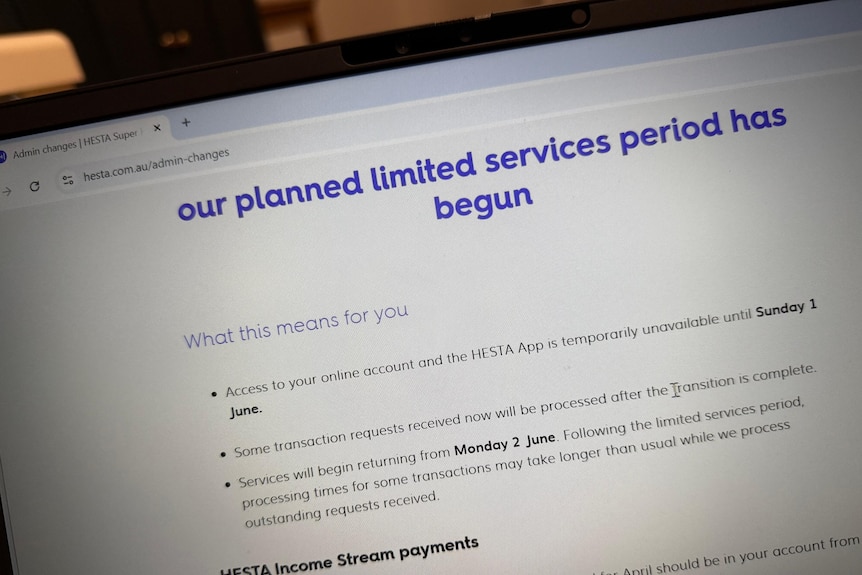
HESTA super members were first locked out of online accounts in April. (ABC News: Stephanie Chalmers)
HESTA purchased a minority stake in the admin provider in January.
Industry experts are now concerned there could be more trouble for HESTA members, after they already faced a prolonged member services outage as the fund moved to Grow last year, leading to action from the financial regulator.
Loading…
It comes at a time of upheaval for HESTA, with chief operating officer Stephen Reilly announcing this week he would be resigning from the fund in June, weeks after CEO Debby Blakey announced she would be retiring from the top role, after 11 years as chief executive.
Super fund offers lifeline
HESTA is not the only client to financially support Grow.
NGS Super, which has about 115,000 members, entered into a debt facility with the admin provider when it also signed on as a client, lending Grow $30 million.
Of that amount, $20 million was drawn down in September last year.
“The most cause for concern is the fact that for their last two major client on-boardings, [Grow has] required some form of financial support from those clients,” said Ryan Dufty, who is a financial services lawyer and former senior regulatory manager for Vanguard’s US internal audit division.

Ryan Dufty says HESTA’s move to Grow Inc has not put its members first. (Supplied: Ryan Dufty)
In a statement to the ABC, a spokesperson for NGS Super said: “As a start-up, Grow has been aided by capital raising to continue to develop its technology platforms in a high volume, low margin operating environment, which continues to benefit members through improved services”.
Since changing admin providers, NGS Super has increased its admin fees by 7 basis points from 0.10 to 0.17 per cent, which Mr Dufty said was “a catastrophic increase” when dealing with such large pools of money.
In a statement, an NGS spokesperson said changes were made to “the balance between the administration and investments fees”.
Why is a seven-week super outage acceptable?
“While the administration fee component increased from 0.10 per cent to 0.17 per cent, investment fees for most decreased, resulting in total fees for the majority of members decreasing, and for others, the fees are broadly comparable,” they said.
A HESTA spokesperson said the super fund “does not have plans to increase admin fees”.
“Last year, we lowered investment fees across most super investment options and secured a new insurance contract with our partner AIA, which will deliver better value for our members,” they said.
Debt outpacing revenue
As Grow’s client base increases, so too does its debt.
Despite winning big-ticket names like HESTA, NGS Super, and Vanguard Super Australia, Grow’s total liabilities increased by more than $35 million between the 2023-24 and 2024-25 financial years.
In 2017, Grow entered the market as a startup super fund. Then, by 2020, its offering changed to focus on superannuation administration software.
While Mr Dufty said limited cash could be “quite common for new FinTech startups”, the sheer volume of debt, as well as the business history of Grow, was concerning.
“It’s a significant reputational risk for HESTA or for any client to change administration providers, particularly to a relatively untested startup,” he said.
“In particular, you look at the history of Grow, they started as Grow Super and they were not able to make that business a success.
“If they couldn’t succeed as a super fund, why are we certain or sure that they can succeed as an administration service provider?” he said.
But the Association of Superannuation Funds of Australia (ASFA) said Grow taking on big-ticket clients like HESTA created healthy competition between the admin providers.

Mary Delahunty says administrators are critical service providers to the super sector. (ABC News: Simon Tucci)
“It is a difficult and complex business, and administrators need to invest heavily in technology to meet the understandable rising expectations of Australians engaging with their super,” said ASFA chief executive Mary Delahunty.
“Competition … is healthy and important to the ongoing sustainability of the world’s fourth largest pension system.”
Grow Inc did not respond to questions from the ABC.
In a statement to the ABC, a spokesperson for HESTA said: “In the case of Grow, our choice was informed by external advice, due diligence and recognition of the critical importance of modern, secure and future-ready technology to member experiences over the long-term”.
Tech landscape always changing
David Bell, executive director of the Conexus Institute — an independent research think tank focused on improving retirement outcomes for Australians, said capital had never been more important.

David Bell says technology is always improving and companies need enough capital to continue investing. (Supplied: David Bell)
“There’s going to be this constant change that comes through from a regulatory perspective, this constant need to update, improve,” he said.
“You may have cutting-edge technology today, but we’ve seen in other areas that edge could decay reasonably quickly unless you keep reinvesting.
“Today’s cutting edge could in five years’ time be a bit of a laggard.”
A spokesperson for HESTA told the ABC: “Ahead of HESTA’s switch to Grow, we also had first-hand experience of its technology, having merged with Mercy Super in late 2022.
“Mercy was already on the GROW platform, and we saw the potential for the technology to better support members.”
Mr Bell also said HESTA’s position as a client and shareholder of Grow could create a conflict of interest.
“Is there potential for one party’s interest to compromise their judgement, decisions or actions? This is an issue for both HESTA and Grow to consider,” he said.
While not uncommon or detrimental, he said there would be risks to look out for.
“A simple example might be where Grow prioritises its development program in areas that align with HESTA’s interests or areas which align with its existing and potential clients,” he said.