
“The physical challenge was bearable,” he says. “It was the weight of processing my thoughts that proved the hardest. And that’s exactly why I’m walking.”
For Anderson, 44, the march north with dog Missy is not just distance. It is a confrontation with guilt, memory, and the long shadow of a life once spent as a warrior.
“I don’t know how to talk about these things,” he tells the Herald. And then he does exactly that.
Shane Anderson and Missy at the start of their 3000km trek. Anderson is marching for mental health, wanting those who served in the military to be recognised – and to find peace.
Anderson was 22 when he joined the New Zealand Army in 2005, older than many recruits arriving for basic training at Waiouru.
Those few extra years of life experience pushed him naturally into a leadership role. Unofficially at first. Later, the stripes on his arm marked his progression.
The Army had long been on his mind. “It was like a boyhood thing coming true,” he says. And while others might sign up to learn a civilian trade, Anderson chose the infantry. His trade would be war.
He was posted to 2/1 RNZIR, the 2nd Battalion of the Royal New Zealand Infantry Regiment. Its soldiers march under a single-word motto: Onward.
The word captures the essence of the infantry creed: advance, close with the enemy, finish the fight.
For the past two weeks, that has been Anderson’s direction of travel.
What happens after the fighting stops is harder to measure. There are no reliable figures on how many veterans New Zealand has. There are no comprehensive records of mental health outcomes or other war-related injuries. There is no official count of suicides among veterans.
In Australia, when the number of veteran suicides became known, it led to the announcement in 2021 of a royal commission of inquiry.
Here, the picture is far less clear. Anderson is one data point in a dataset that doesn’t exist.
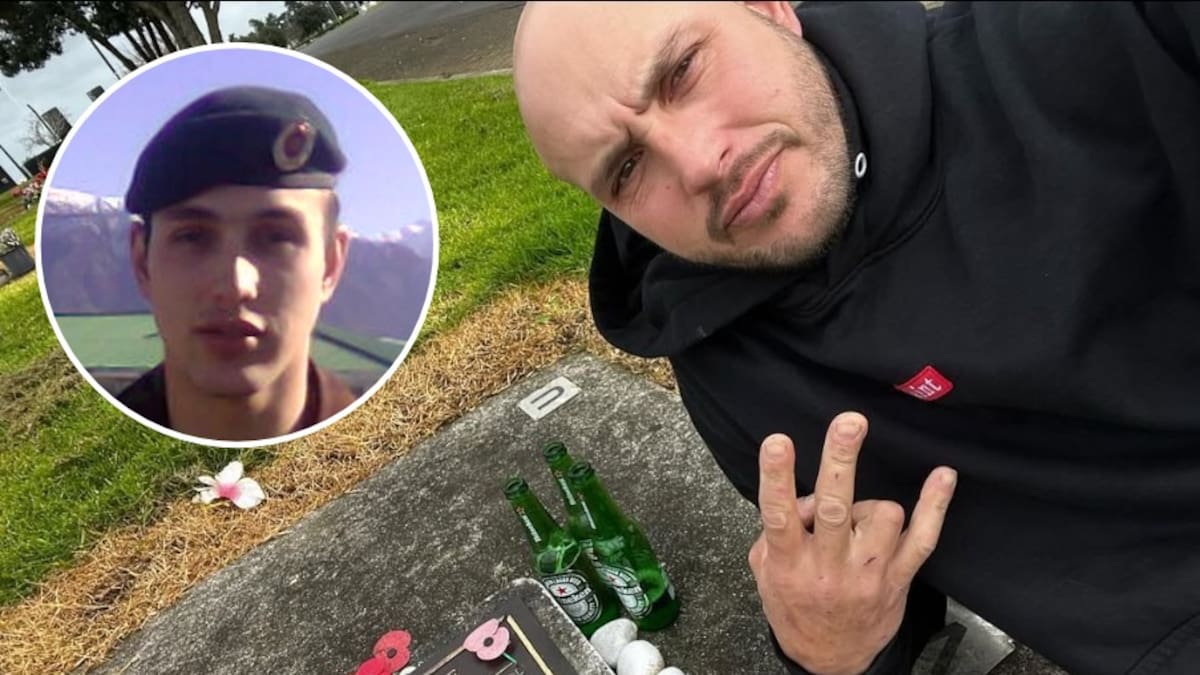
As his journey progresses, he will walk the story of his life. And, he hopes, find a way to come to terms with the deaths of many friends, and particularly the death of Lance Corporal Rory Malone.
Becoming a soldier
Anderson grew up in Ōtaki, largely outdoors in the bush and rivers around the Kāpiti Coast town.
Although ethnically Fijian, he was whāngai’d to a Māori family and grew up around marae, speaking te reo.
His first trip to Fiji felt strange. “It was confusing, to say the least.”
Life shifted again when the family moved from rural market gardening to the city. Anderson attended St Peter’s College in Auckland, leaving school around the time his parents split.
Soon, he was working the doors at Karangahape Rd club 420, the centre of Auckland’s hip-hop scene. He describes himself at the time as a “hooligan”; at some stage, concerned parents intervened, and he left for Fiji, where he worked as a diver.
Eventually, he returned to Auckland and, not long after, joined the army.
Basic training began in Waiouru before shifting to Burnham Camp outside Christchurch.
Jared Collet and Shane Anderson in Kaikoura in 2005 during a stopover on the bus ride from Waiouru to Burnham, only three months after Anderson signed up for the NZ Army, aged 22.
His transformation into a soldier took place across the open country around Tekapo and the rain-soaked bush of the West Coast.
Anderson laughs as he recalls the name the soldiers gave it: the “Wet Coast”.
Humour stitched together the bonds between soldiers grinding through days of cold, mud and exhaustion.
It was a band of brothers, and sisters, bound by the knowledge that survival depended on each other.
“You look to your left and your right. The guy next to me wants me alive more than I do.”
Anderson’s career progressed steadily: training, promotion and overseas deployments.
In 2006, he was among those sent to Tonga after riots in Nukuʻalofa left six people dead while large parts of the capital burned.
New Zealand troops were there to protect infrastructure, patrol the streets and help stabilise a tense situation.
“There were 160kg Tongans burning and rampaging through the city. You can call it what you like, but it was f***ing wild.”
Shane Anderson on his way north out of Southland with dog Missy.
Then Anderson deployed to East Timor on a six-month stabilisation mission after unrest in the young nation.
That led to further training and a promotion to corporal.
Afghanistan loomed next. For soldiers like Anderson, such deployments were the natural evolution of training.
He didn’t get there. And what happened to those who did? That’s part of the reason he’s walking.
Walking with ghosts
There are cemeteries along the route of Anderson’s long walk.
Soldiers often look around after a few years and realise how many who began the march beside them are gone. It is different for civilians. A soldier’s life is one shaped by violence and chance.
The first stop will be Yaldhurst Cemetery in Christchurch. There lies Clinton-John Henry Botha.
Botha was Anderson’s second-in-command in East Timor. He died aged 21 after complications from surgery in Christchurch in March 2009. An inquest later identified missed opportunities to save his life.
Anderson’s route north is marked in this way. In Kawerau Cemetery lies Corporal Luke Tamatea, killed in Afghanistan.
In Hamilton Park Cemetery at Newstead lies Private Kirifi Mila, who died after a Humvee rolled, also in Afghanistan.
Shane Anderson on a previous visit to the grave of Kirifi Mila, who died aged 27 in Afghanistan. The hand signal denotes 2/1 – 2nd Battalion of the Royal New Zealand Infantry Regiment.
Rory Malone rests at Manukau Memorial Gardens in South Auckland. Kane Te Tai, who died fighting in Ukraine, is buried in Waikumete Cemetery in Glen Eden. In the north, Corporal Dougie Hughes lies at Pakotai, near Kaikohe.
“Part of my journey is to stop and pay my respects to the boys. There’s a few of them.”
The ripples of grief extending from each of those deaths still cause pain in the lives they touched.
For Anderson, that’s particularly the case with Malone, who died in the 2012 Battle of Baghak in Afghanistan, a firefight that also killed Lance Corporal Pralli Durrer and wounded six others.
The extent to which friendly fire contributed remains debated. The New Zealand Defence Force (NZDF) conceded it contributed to two of the six injuries.
Anderson didn’t get to Afghanistan, and there’s pain in that. He asks if it would have been different if he had. Malone took the spot Anderson had hoped for. Now Malone is dead, and Anderson walks with ghosts.
A soldier’s life
He sighs. “Everyone thinks we’re peacekeepers.”
There’s such a distance, he says, between soldiers and society.
Most civilians wouldn’t understand, but an infantry soldier has learned a trade: warfighting. It’s not necessarily a trade our modern world has comfort with, because it involves learning how to dominate and kill your opponent.
That trade is drilled until it becomes instinct. Each soldier knows exactly what the others will do when it matters.
Anderson explains it through a scene from the film 300. When a group of Arcadian soldiers offers to join the Spartans, King Leonidas asks of their professions: potters, blacksmiths, carpenters.
Shane Anderson and Missy are walking from Bluff to Cape Reinga.
Turning to his own men, Leonidas asks: “Spartans, what is your profession?” The answer comes back in a thunderous chant. “Hoo! Hoo! Hoo!”
Leonidas says to the Arcadian leader: “I brought more soldiers than you did.”
For Anderson, this is what he wrestled with when deployments were made to Afghanistan. Instead of sending the tight groups of infantry soldiers who had trained together for years, the NZDF mixed personnel from different trades and services into a cohort intended to carry out infantry tasks.
He feared that infantry soldiers, drilled to operate instinctively together, were being separated, and worried what it would do to their precision.
“With my instinctive fighters, I know exactly what they are going to do.”
Missy is walking the length of New Zealand with Shane Anderson to raise awareness of the vulnerabilities of veterans.
He told the Herald he raised those concerns with commanders.
Then he lost his chance at Afghanistan anyway, after punching a drunk private.
“I was removed from the patrol because of the altercation I had with the private, but it felt like they were trying to quieten me down.”
NZDF disputes that, saying combined-arms units are standard practice.
A spokesman told the Herald it was best military practice to have a combination of skills and attributes available for commanders on the ground.
A spiral downwards
By the time the Battle of Baghak unfolded in August 2012, Anderson had left the Army and was working at a marina in Papua New Guinea.
When news arrived that Malone was dead, he was crushed.
“That was a bone-cruncher that took me straight to the bar.”
Fifteen days later, Tamatea was killed by a roadside bomb along with Corporal Jacinda Baker and Private Richard Harris.
Lance Corporal Luke Tamatea feeds a baby in Afghanistan.
“I drank and drank, and I failed to regulate myself for a long time after that. Being hit with that tidal wave was crippling.”
The spiral led him to Perth and then to prison.
Already serving a sentence for stalking, burglary and drug possession, he was sentenced to almost five years after an encounter that left a 24-year-old with serious head injuries.
He accelerated his car and braked suddenly to remove the intoxicated man from the bonnet, then left him in a coma on the roadside after stealing his phone and bank cards.
He was later convicted of dangerous driving causing grievous bodily harm, and failing to stop and report the incident.
The routine of jail “triggered a military response”, he says. “I created order in chaos.”
He swept the yard, taught te reo Māori and imposed discipline.
In 2021, he was deported to New Zealand as a 501 returnee, his crimes meaning he no longer met the character test for an Australian visa.
Back home, he found work with Slab Specialists, a concrete foundation company run by Quentin Stevenson, who often takes on those unlikely to be employed by others.
“When you get them one-on-one, they’re not bad bastards,” Stevenson says. “I just hear sad stories.”
Anderson worked hard. Once, Stevenson recalls, he ran 45 minutes back to a job site after finishing because he felt he had not done enough that day.
But he couldn’t outrun his grief.
“The plasters were coming off. I felt in a totally shit situation mentally.”
Anderson says he planned his long walk half to isolate himself from stupidity and half “to work through a few things. So long as I’m physically tired at the end of the day, my mind stops racing and I can have some peace”.
The walk north is part therapy, part mission. He hopes his story resonates with other veterans.
He carries guilt, too.
“I wasn’t there in Afghanistan with [Malone]. He had taken my spot. I feel guilt about that, not being there.”
The military court of inquiry into the incident found issues with command, communication and situational awareness, and problems with training and preparedness. That included gaps in pre-deployment training.
A firefight in Afghanistan. Lance Corporals Rory Malone and Pralli Durrer were killed and six of their colleagues wounded.
It also said the training gaps did not contribute to Kiwi casualties, saying the troops had been together for four months and had become a cohesive unit in that time.
The Red Diamond Club
The walk may be therapy, but it is also Anderson’s statement about the lives he believes soldiers return to after the Army.
He says it took years after leaving the military before he even realised there was a veterans’ support agency in New Zealand.
Like many contemporary veterans, he says he struggled to find where he fitted once the structure of military life disappeared, and the weight of loss bore down.
He believes organisations meant to support veterans need to do more to stay close to those who served, and find ways to lend a hand when one is needed.
The Returned and Services Association community, he says, was created to serve generations of veterans, but it needs to evolve to meet the current generation of service people.
“We have to honour the stewards … Those spaces are still there. We just need to shift the use of them to spaces where soldiers – veterans – can go.”
He hopes his walk will encourage soldiers to speak openly about the burdens they carry.
“That’s my whole journey. It’s about truth, down to the level of men standing up and saying they have got things to deal with. I’ll do it, and hopefully I can drum some courage into other men.”
Shane Anderson (far right) goofing around with fellow 2/1 infantrymen after training in Germany.
He speaks from the south side of Mt Linton, with 10km left before reaching Telford Hut.
Ahead lies Tekapo, where he once trained. Then the “Wet Coast”. It’s 14 years since he left the Army – although he laughs at that. “You never really leave.”
The distance between soldier and civilian life can be vast.
“The camaraderie, the brotherhood … you’re running around with guns and grenades, you’re young, dumb and full of come.
“You couldn’t get those memories anywhere else.”
He pauses, then sums up the fraternity he believes soldiers belong to: the Red Diamond Club, so named because of the colour and shape of 2/1’s tactical recognition symbol, an emblem instantly recognisable on the equipment and uniforms of those associated with the battalion.
It is a badge of honour, of pride. “We are the minority on the planet.”
Then he shoulders his pack and continues north. Onward.
Shane Anderson is tracking his march here.
Helplines
Veterans’ Affairs: NZ 0800 483 8372 (0800 4 VETERAN)
NZDF4U (Defence Force wellbeing line): 0800 693 348
Crisis & mental health – Need to talk? Call or text: 1737
Lifeline Aotearoa: 0800 543 354
Samaritans NZ: 0800 726 666
Emergency: 111
David Fisher is based in Northland and has worked as a journalist for more than 30 years, winning multiple journalism awards, including being twice named Reporter of the Year and being selected as one of a small number of Wolfson Press Fellows to Wolfson College, Cambridge. He first joined the Herald in 2004.
Tags:
- 3000km
- 501
- across
- among
- and
- anderson
- awareness
- became
- contemporary
- country
- david
- deportee
- drinking
- fellow
- fisher
- from
- grief
- growing
- hes
- his
- into
- jail
- length
- loss
- new
- New Zealand
- News
- NewZealand
- NOW
- number
- NZ
- raise
- reports
- returned
- sent
- shane
- soldier
- soldiers
- spiralling
- stories
- telling
- the
- their
- until
- veterans
- violence
- walk
- walking
- WHO
- zealand