
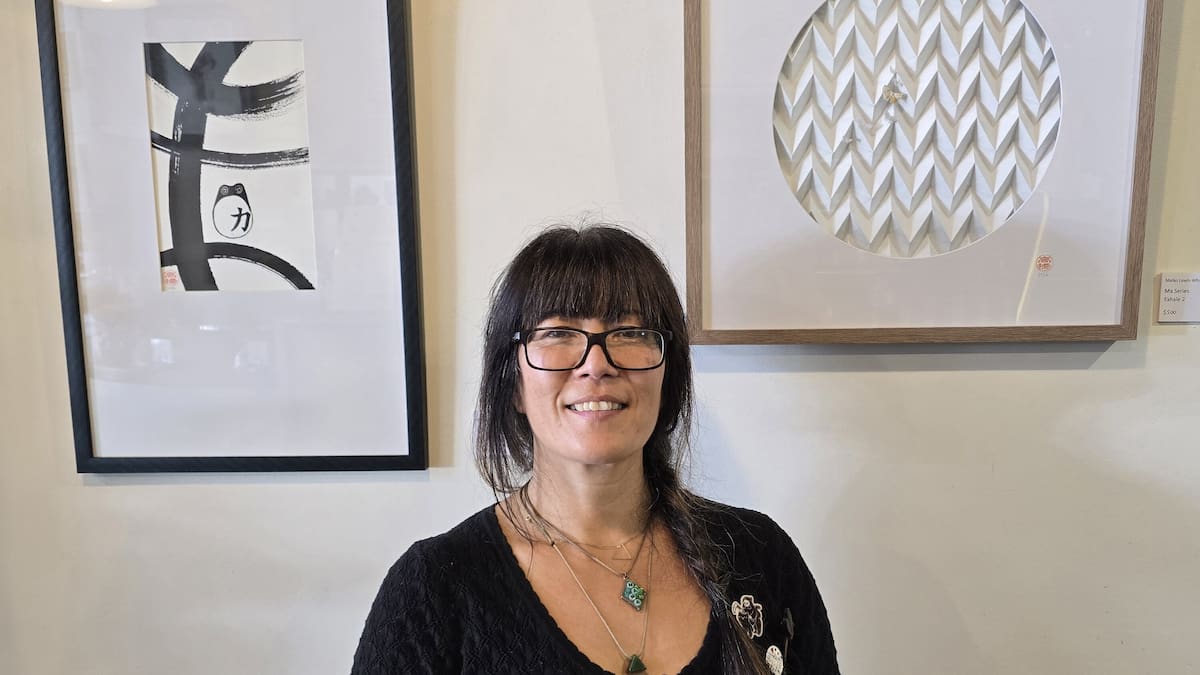
“Life feels incredibly busy and full of noise and constant information, and my art has become a place to step away from that.
“It’s a space where I can slow down, breathe and be fully present in the moment.”
Through the exhibition, Lewis-Whaanga offers a quiet reminder of how important it is to create that sense of Ma in our own lives.
“To find small moments of stillness, to pause and to simply be. It’s in those spaces that we reconnect with ourselves, with each other and with what really matters.”
Lewis-Whaanga has been creating and developing the artworks over the past few months, giving enough time to allow the process to “unfold naturally, without rush”.
“I’ve really enjoyed creating this body of work. The folding, in particular, feels very meditative.”
Lewis-Whaanga is a specialist teacher at Te Wharau School, where she teaches mindfulness and self-regulation.
“I love my job and how it aligns closely with my art practice. I choose not to work Fridays as it is my day to slow down and create.”
She works with a mix of materials, including Fabriano paper, rice paper and tracing paper, along with Japanese sumi ink. She incorporates lino printing into some of the pieces.
Each work is finished with her Japanese family hanko stamp or takahashi.
Many of the pieces have origami butterflies on them – a symbol of transformation.
Many of artist Maiko Lewis-Whaanga’s pieces feature origami butterflies, which symbolise transformation and “a strong connection to transience – the fleeting nature of life”.
It’s also connected to the soul and to a sense of elegance and femininity.
“For me, they also hold a strong connection to transience – the fleeting nature of life. They are a reminder to slow down, to notice and to feel gratitude for the moments that pass so quickly.”
Lewis-Whaanga works across different stages of the artworks, rather than focusing on just one piece at a time.
Over a few months, she slowly folded her butterflies, flowers and did the larger Miura folds, characterised by a pattern of parallelograms.
“Then I’ll spend a couple of days focused on large sumi ink brushstrokes on big sheets of paper. This is one of my favourite parts of the process.
“I usually begin with a short meditation and take a mindful breath before each brushstroke, letting it move intuitively, rather than trying to control it.”
In the final weeks, once all the individual elements are created, she moves into composition.
“I work with the frames, selecting parts of the brushstrokes that speak to me and then adding the butterflies or flowers.
“It’s a very intuitive process and guided by what feels right in the moment. The way I create these works is really a reflection of Ma – the space, the pause, the in-between.”
The exhibition runs to the end of April.