
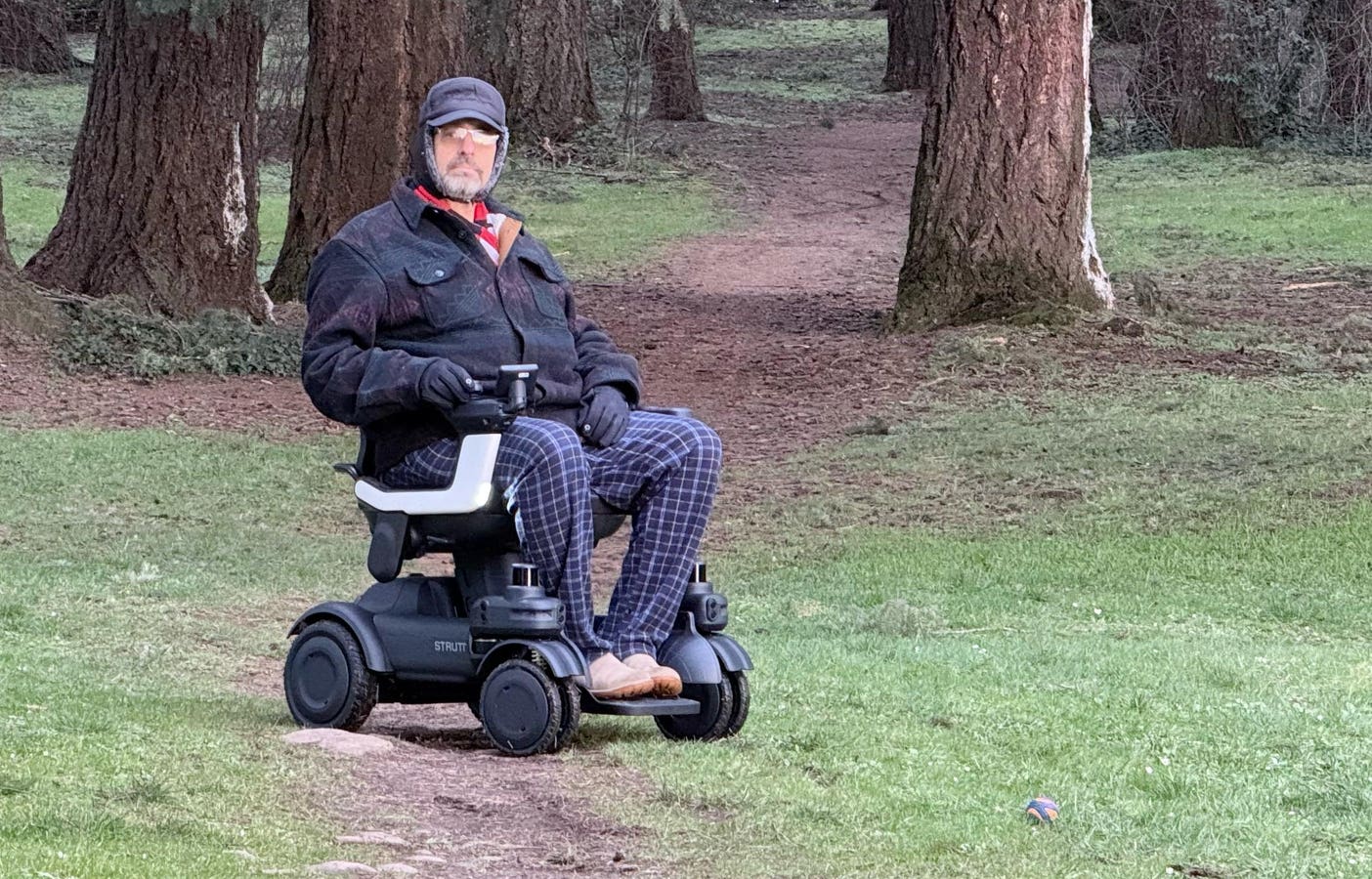
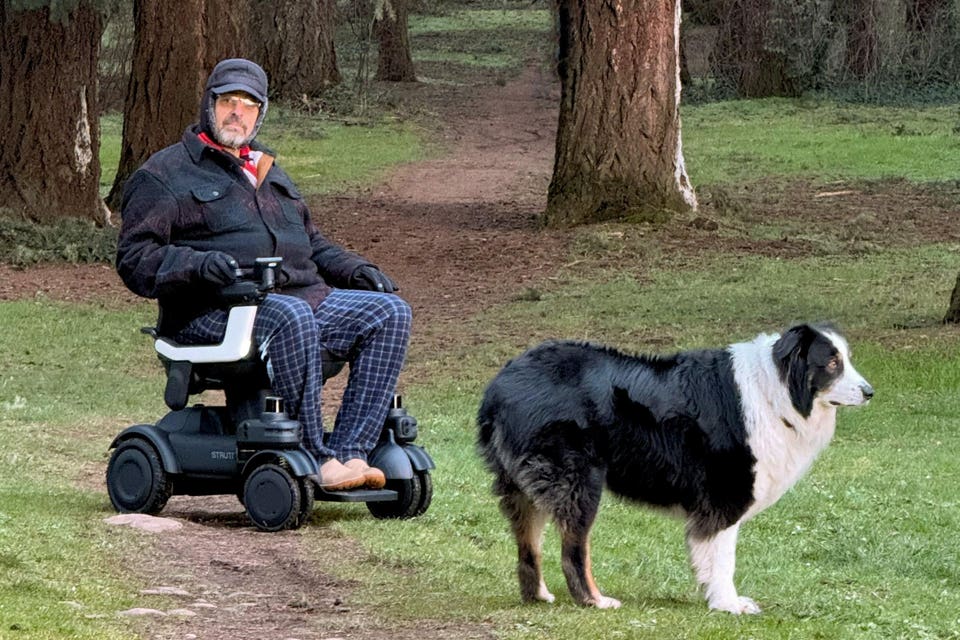
Yours truly in Strutt-powered dog-walking mode. The ability to drive the EV1 chair off-pavement expanded where I could go and what I could do. Yes, it was cold out.
William Roberson
This may seem like an unusual choice for a review, but stay with me, it’s worth it. Back in October, while on assignment reviewing the new electric motorcycles from Stark Future for another publication, I had an unplanned dismount while riding off-road. As motorcycle crashes go, it was pretty minor, but I ended up with two fractured ribs – and a terrifying surprise. A CT scan for internal bleeding revealed something unrelated to the crash: A very large aortic aneurysm in my heart that had been slowly growing over the decades. If it were to rupture for any reason, my chances of survival would be low.
After my return to the U.S., I underwent a 9-hour open-heart surgery to remove the aneurysm and repair numerous other congenital heart problems discovered in the lead-up to the surgery. A long, slow recovery lay ahead. If you’ve never had this kind of procedure, just know that you go from living your life as normal pre-surgery to being essentially turned into a fully dependent adult toddler post-op. I could barely breathe or talk, let alone do anything “normal” like walk, climb stairs, or do the barest of household chores, let alone remount a bicycle or motorcycle. That will happen in time, but my recovery will take most of this year. I will come out of this with much improved pulmonary capacity and the chance at a much longer life, so I’ll happily trade being off bikes for a short bit. But suffice to say, I was wholly unprepared for how difficult the initial recovery period would be.
Rolling with the Strutt EV1
The Strutt EV1 looks simple and has many unique features that do indeed make it simple to operate and transport.
Strutt
By chance, just before my surgery, I was contacted by Strutt, a Singapore-based startup behind the $6,999 EV1—a mobility chair integrated with sophisticated self-driving technology and advanced safety features. While I initially hesitated to review the device, I reconsidered as my surgery date neared and the reality of my recovery process became clear. After all, mobility is my beat, and this device represents a significant advancement in the field—one that was about to become deeply personal for me.
Strutt offered to deliver and set up one of its latest EV1 prototypes (above), which was essentially production-ready. The Strutt team continues to sand the rough edges off the software and operating system ahead of series production. Once set up by the Strutt team, the EV1 was ready to roll, and I was thankful for the opportunity to give it a go during recovery. It had the potential to help me resume being somewhat productive without needing to walk or drive. Hopefully, the Strutt would allow me to take on light errands like going to the corner store and walking the dog. Heck, just getting out of the house to go for a ride on anything and give my partner a break from caring for me, gloomy Oregon winter weather be damned, was a compelling reason to review it.
What The Strutt EV1 Is – And Isn’t
For those sidelined by an illness that takes away their ability to walk, the Strutt EV1 returns a measure of independence to travel.
Strutt
As I mentioned, the Strutt EV1 is not designed like a typical powered wheelchair. It is not a custom medical-grade device; it’s designed for regular consumers who have issues that prevent or limit walking, or, like me, are in recovery and can’t walk very far. It is certainly a close cousin to the modern powered wheelchair, yet it is still quite different.
First off, it quickly breaks down into three separate “modules” for easier transport. No tools are required, and the design is ingenious. Strutt team members who delivered the EV1 to my home said that friendly competition on the development team had reduced assembly time to nearly 10 seconds. For most people, assembling the device at a normal pace should take less than a minute. Once together, the rider/driver of the Strutt EV1 sits in a comfortable seat with two movable armrests and an adjustable backrest, much like a typical powered wheelchair.
The Strutt’s controls are simple and easy to learn. The small touchscreen is showing what obstacles the EV1’s LiDAR and radar sensors ‘see’ around the device. It’s between two cars.
William Roberson
A small touchscreen, a large, automotive-style round puck-type joystick, and a few buttons are on the right armrest (production units will likely be configurable for lefties as needed).
The battery is easily accessible on the back of the Strutt EV1. The wide, bright LED taillight is just above it.
William Roberson
A sealed modular battery pack with a handle clips easily in or out of the back of the EV1 (above – I was given two batteries). The EV1 features two small LED headlight/marker lights up front, a big rear brake light, and reverse lights! A number of custom-fit bits and accessories are in the works to carry cargo and tailor configurations to users’ needs.
The two LiDAR modules that map the area around the EV1 sit above the front wheels. Also visible are small radar sensors front and side, plus the front suspension.
William Roberson
The EV1 is packed with sensor tech, including two prominent LiDAR modules above the front wheels, radar and proximity sensors all around the device, and several cameras, including a rear-facing camera that displays a rear view on the screen (above) with guidelines when going in reverse, much like a modern car. The larger rear wheels are independently driven, and the front wheels include motorized steering elements for navigating around obstacles while it is driving itself.
That’s correct: The Strutt EV1 can drive itself. The Strutt fuses LiDAR data with GPS in an AI-assisted mode called CoPilot Plus to map a safe path, and the more you drive it, the more it learns about what’s on the routes you’ve traveled. The LiDAR and radar systems constantly build a map of the terrain around the chair, and it can then steer itself around obstacles on the way to a destination that riders can input on the touchscreen, either by typing an address or selecting a spot on a GPS-generated map with their fingertip. The same tech also prevents riders from accidentally crashing into obstacles when the rider is in control. The joystick buzzes with urgency if you get too close to an obstacle and won’t let you hit it in CoPilot mode. It can also be driven off pavement on fairly smooth grass, gravel, or dirt.
A nice little splash of robotic know-how: In Follow Mode, the EV1 trails close behind while you walk ahead of it.
Strutt
Another feature was especially relevant to me: My heart procedure recovery regimen includes walking short distances (which need to get longer as time goes on), and the Strutt EV1 has a “follow” mode (above) where it trails behind the rider (who is walking) so they don’t have to do any out-and-back walks that might turn out to be too long. After this kind of heart procedure, stamina/endurance is low, so “too long” a walk can be very short – and dangerous. The follow mode – even if you head off pavement – is very helpful in that regard. Using an app, the Strutt can also be piloted remotely if need be. But even with all the automated features, the Strutt EV1 can also be piloted manually with the joystick like a traditional powered chair.
The Strutt EV1 has five speed settings, 1 through 4, plus an “S” mode for “Sport,” which tops out at about 10 mph – about as fast as most people can run. For a motorized chair, that’s quite fast. I usually operated the chair in Mode 3 or 4, but S mode made trips to the grocery store – over 2 miles away – go pretty quickly. In manual mode, the LiDAR and radar remain active and buzz the joystick controller when they detect an obstacle. While in manual mode, the rider can press and hold a small button on the joystick to instantly jump into CoPilot mode for quick automated assistance. Release the button, and it returns to manual control. It is a simple and intuitive system to operate.
Riding Experience
My friend, Kabir, who had polio as a child and uses a custom medical mobility chair, takes the Strutt EV1 for a ride on a forested path.
William Roberson
I invited a friend of mine, Kabir (above), to try out the Strutt as well, since he uses a medical-grade motorized chair to get around. Kabir grew up in Afghanistan and contracted polio as a child; there were few, if any, vaccination programs in Afghanistan at the time. As a result, he lost most use of his legs early in life. A father of two and a hard worker, Kabir uses a custom electric mobility chair that costs about $30,000 and, on occasion, uses crutches. He also rides a hand-powered recumbent bicycle.
On a quiet weekend day, we drove both motorized chairs to the campus of a local high school and put them through their paces. The Strutt EV1 goes about as fast as the custom chair at maximum speed, but it has longer range on a charge, and the quick-swap battery system allows for even more range – just bring another battery (I had two). The custom chair has larger pneumatic main drive wheels and tires and a very sophisticated suspension system, so it had the edge in ride quality. It can also raise the rider 18 inches by elevating the seat, so riders can reach items on shelves and the like. However, the custom chair has no self-driving tech, no rear camera, no radar, no LiDAR, no headlights or taillights (as stock), no regenerative braking, and it does not go as far on a charge as the Strutt EV1. It’s also over four times as expensive and has a limited service life of about five years per medical guidelines. It’s very nice, to be sure, but the Strutt is no slouch and has the speed, range, and most of the features of the custom chair without the used Lexus price tag.
On rough ground, the Strutt EV1 dials back speed and warns of uneven terrain.
William Roberson
Rolling around my neighborhood on the Strutt EV1, I found the ride a bit rough over uneven pavement, and the smaller front wheels jolt when hitting a raised section of sidewalk or other sharp-edged obstacles. But on balance, on smooth pavement, the ride from the Strutt, which has suspension at all four wheels, is smooth and very comfortable. And yes, I drove it off the pavement numerous times, across lawns, dirt, and gravel walking paths, where the suspension was up to the task as long as the ground wasn’t too muddy or uneven. If you do venture onto uneven ground, the control haptics buzz, “uneven terrain” appears on the screen, and the chair may dial speed back in CoPilot mode, if just a bit. I was actually impressed with how it could surmount fairly rough ground.
The EV1 features twin LED headlights for nighttime navigation, and the brightness is adjustable in a menu.
Strutt
Hit the brakes hard at full speed, and the Strutt pitches forward slightly, but you don’t feel you’re going to come out of the chair. While braking or heading downhill, the motors switch to regenerative mode (it reads “degenerate” on the display; Strutt may want to rethink that wording), and the Strutt slows predictably. Keep in mind that the top speed is about 10 miles per hour, so you’re not doing e-bike speeds, which is fine. The Strutt’s top speed is still triple that of walking – more like running speed for most people. It’s plenty fast.
Put the EV1 in reverse and a familiar grid guide overlays the rear view camera display.
William Roberson
And like any good mobility chair, the Strutt EV1 can handle tight spaces. It can perform tank turns, and for narrow passages, the LiDAR and radar sensors help it navigate tight spots – or a crowd of people. With CoPilot or CoPilot Plus engaged, the Strutt’s active sensor system won’t allow the rider to hit an obstacle, no matter how much the rider pushes on the joystick. You can crash into things all you want in full Manual mode, but the sensors remain active and warn through ever more panicked haptics that danger lies ahead.
I used the Strutt EV1 for several weeks while I built up my stamina to walk again. Beyond its utility, it was also just fun to drive around the neighborhood while giving my partner a needed break from caregiving.
Who is the Strutt EV1 For?
As noted earlier, the Strutt EV1 is not a medical-grade custom mobility device. Think of it as a (much) more affordable, smarter, and more convenient mobility device for anyone who has trouble walking, whether in general or as part of a recovery regimen. It was the perfect choice while I was unable to walk, or at least unable to walk any meaningful distance. It enabled me to walk the dog, run simple errands, go outdoors on short outings with my spouse and friends, and just toot around the neighborhood during breaks from care and recovery at home – a great psychological boost that I believe helped with healing while I was unable to enjoy my cars, motorcycles, e-bikes, and other wheeled fun machines.
Got hills? The EV1 can surmount most reasonable inclines.
Strutt
If I could change anything on the EV1, I’d like to see a bit more robust suspension (especially for heavier users like myself), the ability to easily carry another battery in some way, and maybe a tick brighter headlights when set to maximum.
While it may look like a typical powered mobility chair, the embedded tech and software enable the Strutt EV1 to do things and protect riders in ways that much more expensive custom-made medical-grade devices can’t. It gives real mobility to people who can’t afford a custom chair, amplifying their freedom of movement, improving their lives, and yes, having some fun. You can’t ask much more from a mobility device. Highly recommended.
Thank you for reading. Subscribing to Forbes.com allows you to leave comments and supports contributors like myself. You can also follow me on Facebook and LinkedIn.