
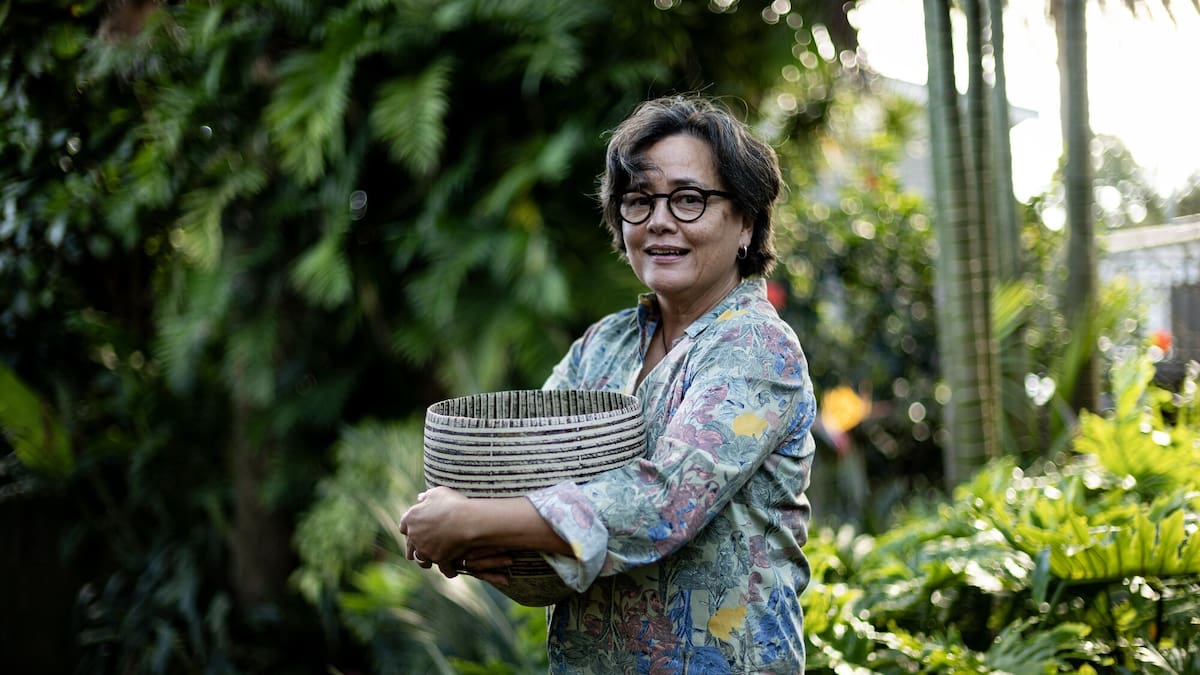
What’s it like to quit your career post-50? Kim Knight talks to Phil Brooks, the interior designer who became an award-winning ceramicist.
“Do not use,” says the note taped to the oven.
It’s a precaution against electrical overloading. For the next 12 hours, the pottery kiln takes priority.
What’s inside
the kiln?
“It’s either going to be beautiful, a disaster, or a beautiful disaster,” says Phil Brooks. “The last would be the best.”
Life as a series of happy accidents?
Not really. Brooks was 53 years old when she made the very deliberate decision to leave a long career as an interior designer and retrain as a potter.
A decade later, and she’s standing down the back of a room wondering if she’s really just heard her name being announced.
Brooks was, in her own words, “knackered”. She didn’t want to go out that night; husband Chris had to convince her the opening of the Ceramics NZ 61st National Exhibition might be fun.
And now she was being called to collect the Premier Award.
“It was lovely. Really, really lovely, actually. Because I’d never won anything before. But in terms of it being validation? I shouldn’t say this, because I’ll never get a prize ever again …
“It’s wonderful for the moment. Telling people about it and sticking the certificate up on the fridge. But what was important was that it led to the next lot of work – feeling some confidence that there was a positive reaction, not just to the pot, but to the idea of it.”
The winning work was called Coddle. The idea was “a child yet to find its feet”. It was a pot that needed another pot for support.
Potter Phil Brooks shares a studio with Stuart the dog. Photo / Dean Purcell
The collection that came out of that piece is called Fledge – 16 pieces sitting on her West Auckland work bench, waiting to be bubble wrapped and shipped to Milford Galleries Queenstown, for a solo show that runs from July 18 to August 17.
When Brooks is feeling flash, she calls herself a ceramicist. A more accurate description, she thinks, might be “art potter”.
These are not salad bowls or vases – even if their shape sometimes suggests functionality.
“They are recognisable. Hopefully nice shapes, welcoming shapes. The art side of it is what I then do with that shape. How I interact, intervene and alter it to make it more than just a vessel or a surface to decorate … it becomes inhabited, saying something about space and enclosure or freedom or all sorts of things.”
Brooks, 63, graduated from London’s Architectural Association School of Architecture in 1992. As an interior designer, she lived and worked in Singapore for several years. In New Zealand, she worked for Jasmax on projects as diverse as the retail shop for Te Papa and the refurbishment of Auckland’s Town Hall and Civic Theatre (she’s particularly proud of the huge, swagged and tasselled velvet curtains designed for the latter).
Ten years ago, she signed up for an Otago Polytechnic Diploma in Ceramic Arts and Design distance learning course delivered at Auckland Studio Potters.
“Making something three-dimensional with your hands – seeing it right through, the glazing and the firing and having those magic moments of transformation out of the kiln. There’s nothing like it, really, for someone who had been drawing everything.
“I took pride in it, I love drawing, but the act of just producing the drawing wasn’t enough …”
Coddle, the pot-within-a-pot work by Auckland-based ceramicist Phil Brooks that took the premier award at the 2025 Ceramics NZ National Exhibition.
What’s it like to navigate a midlife career change?
“You stop one job, and you do something else, and people say ‘you’re brave to have changed’. But it’s not that at all. It’s just a continuation.
“It sounds pretentious, but it’s just about finally feeling good about where you’ve got to and knowing it’s the right place.”
A huge caveat: “I’m lucky I could do that – I have a husband who kept working. It’s a privilege. Sometimes you cannot make the choice. Your life is just too hard to do that.”
Brooks’ mother was born in China. Her maternal grandparents met on their wedding day, a woman from a wealthy family matched with a well-educated man. They had 10 children – only six surviving into adulthood. Ultimately, her mother ended up in Canada, where she met Brooks’ father, an Englishman working as a graphic artist for an advertising agency.
For the past 30 years, Brooks has lived in the West Auckland home she designed. But in the first half of her life, she counted more than 20 houses in six different countries. Born in England, she started school in Milan and added French to her Italian when her father thought his next job was in Belgium.
“And then Dad got sent to Malaysia …”
He was a creative director with Ogilvy & Mather, too left of centre to really enjoy the expat lifestyle, says Brooks, “but Mum was in her element! Maid, gardener, driver and speaking her own language for once. Though we were sort of at the bottom of the ladder. Kids would come round and say, ‘You’ve only got one servant – is this possible? You haven’t got a swimming pool – is this possible?’”
Brooks was preparing to join her older sister Jacqui at high school in Britain when the family moved again. Malaysia wanted its own people in managerial roles; her dad was offered a transfer to Adelaide or Wellington.
“August 1975, we touched down at Wellington airport. The windiest day you could ever imagine. My mother – who was great most of the time – was horrified …”
She pauses. “Do you need all this detail?”
No. And yes. Brooks answers her own question when she says: “The trajectory of a life, and all the things, they’re not even chapters, they just all kind of blend together. It’s important not to look at experiences as being bad or good, because they’re all, in a way, good. They’re all meaningful.”
Accept that, she says, “and you’ve got more of a chance of getting to that place where you feel like you really belong”.
She was bullied at her first Wellington high school, enjoyed her second one, but saw her seventh form out in Auckland when the family shifted (again). Her parents separated. A boyfriend drowned at Anawhata. She does not go into detail but says, simply, “It was really, really difficult”.
Heading to London to study architecture was something tangible. “One of those things you think really saved you at the time, you know?”
“The AA” was infamously conceptual in its focus. She recalls a class trip to Liverpool port in the mid-1980s to look at derelict grain silos.
“The project was to design a tango dancehall – in this incredible void, on top of these silos.”
Today: “My work, I hope, is a lot about space and not only about surface.”
Phil Brooks (and Kipper the cat) in the house she designed and now works from after a mid-life career switch to pottery. Photo / Dean Purcell
Brooks called her first exhibition “pots I couldn’t draw”. Her fork in the career road reaction to decades spent designing things other people physically brought to life.
She builds her pots from coils of clay, scraping, cutting and smoothing in a studio shared with Stuart the dog, to a soundtrack delivered by an Auckland Libraries BorrowBox audio book subscription (her playlist is heavy on “gentle British detective writers”).
Husband Chris is a jazz musician and music teacher, and they’ve been married 26-and-a-half years.
“He invited me to an album launch, but he didn’t think it through. He didn’t realise that he’d be on stage and he wouldn’t be able to talk to me. So, yeah, I met someone else there. But he persevered!”
He hired her to design a house he never lived in and they honeymooned in Samoa with the $2000 he paid for the plans. In 2001, after a series of miscarriages, they began working through Child Youth and Family services to adopt a baby from southern China.
“Because of my heritage, and my Mum was still alive at the time, it seemed like a really positive thing to do.”
Brooks describes becoming parents to Sasha in 2005 as “magical and difficult at the same time”. There is a sense that phrase might capture more than just the early years. Now?
“She’s studying, doing really, really well, and she’s been living away from home for a few years. We are incredibly proud of her – and I think she quite likes us!”
Ceramicist Phil Brooks builds her pots with layers of coiled clay. Photo / Dean Purcell
Fledge, the show that’s heading to Queenstown, is about growth and support.
“A mother or father bird, the protection of a nest. Letting the bird in and out, becoming freer over time. At one point it leaves altogether, but there’s a range of time when it keeps coming back and being fed and supported and nourished and taught how to survive.”
Too easy. It’s about her only child leaving home?
The artist is her own muse.
“That’s the whole story, isn’t it? I’ve got to this point because of everything I’ve been and seen and made and cried about. So it has to be me. But it’s also important that it’s still got a sense of humour – that it doesn’t always take itself too seriously.”
Fledge by Phil Brooks shows at Milford Galleries Queenstown from July 18 to August 17.
More on art & design