
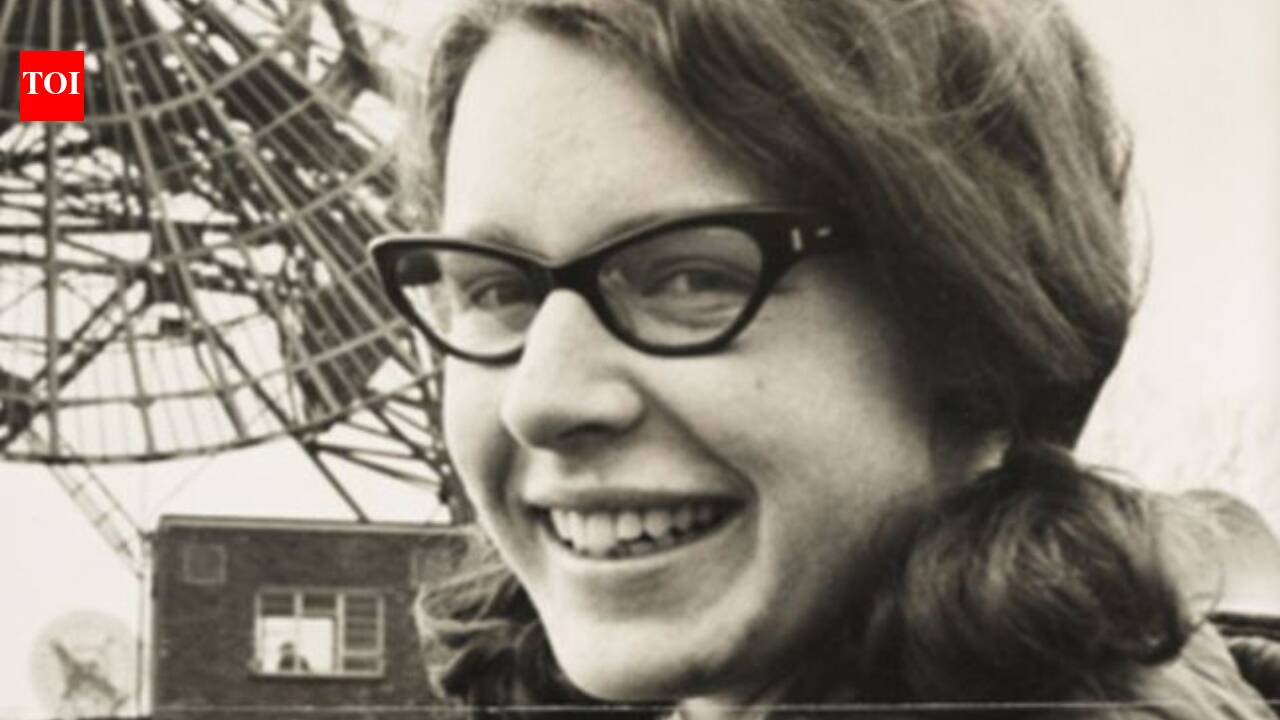
 In 1967, Jocelyn Bell Burnell found pulsars but watched her supervisor receive the Nobel. Back in 1967, a young physics student staring at thousands of feet of paper charts noticed something that almost everyone else might have missed: a tiny, strangely regular signal coming from deep space. The signal appeared as pulses arriving at remarkably precise intervals.Now, that tiny, oddly regular blip showed up in the radio telescope data she had helped build as a 24-year-old PhD student at Cambridge. She was the one poring through endless records, fingers ink-stained, eyes bleary. When that strange pulse appeared, always at the same point in the sky, she flagged it with her supervisor, Antony Hewish.Who is she? She’s Jocelyn Bell Burnell.What came next would end up rewriting astronomy: Bell Burnell had found the first pulsar, a neutron star whipping around so fast it sent out beams of radiation like a cosmic lighthouse.
The discovery in focus
Back then, Bell Burnell was working at Cambridge’s Mullard Radio Astronomy Observatory, where, according to the University of Cambridge’s official website, she had helped build a huge radio telescope made from miles of wire and cables spread across an area equivalent to about 57 tennis courts.The telescope had been designed to study quasars, not pulsars. But while examining the mountains of chart recordings, Bell Burnell spotted an unusual mark: a tiny signal occupying only a fraction of the data. She initially called it “scruff”.What was unusual about the signal? For starters, it seemed to come from a fixed point in the sky and occasionally appeared again. So, Bell Burnell went back through previous recordings to figure it out. Eventually, on 28 November 1967, she saw something extraordinary: pulses arriving approximately every 1.3 seconds.The regularity of the interval was so striking that she, along with her team, first thought that they had stumbled upon an artificial signal. In fact, they jokingly labelled the source “LGM-1” (Little Green Men 1) before the extraterrestrial explanation was abandoned. The signal was coming from a previously unknown type of astronomical object.
What exactly are pulsars?
Now, for the unversed, pulsars are nature’s precision timekeepers: city-sized, superdense leftovers from exploding stars, spinning with such steadiness that the signals arriving on Earth become beacons for science.So, what’s the big deal about pulsars? Their clockwork pulses don’t just reveal weird stars; they’re tools that let scientists test the laws of gravity, study matter under crushing density, and probe the edge of physics.
The debate over the Nobel Prize
The discovery was published in 1968, with Antony Hewish and Jocelyn Bell among the authors. Six years after publishing the discovery, the Nobel Prize committee handed the 1974 Physics award — not to the 24-year-old student who first spotted the signal and followed her gut, but to her supervisor and another well-known astronomer, Martin Ryle. The Royal Society later summed it up: Bell Burnell’s discovery was celebrated, but the honour went to her male boss. That decision still sparks debate over fairness, over gender, over how science hands out recognition. Bell Burnell, to her credit, never reduced it to simple resentment. She’s pointed out that Nobel Prizes almost never go to every person involved, and she’s consistently refused to cast herself as a victim.Still, the question lingers: if one scientist puts the pieces together, from the alertness and tracking to the final “eurekah!” moment, shouldn’t that count for more in the history books?
The following years and more recognitions
Over time, though, Bell Burnell did win remarkable recognition. The Royal Society gave her its Royal Medal in 2015 for her crucial work on pulsars. In 2018, she collected the $3 million Special Breakthrough Prize in Fundamental Physics not for the headlines, but for real, lasting impact in her field. Instead of pocketing the windfall, she gave all the prize money away to support new PhD students from groups underrepresented in physics. That’s how she chose to handle the “Nobel oversight”: helping others more than looking back.As for pulsars, they’re now textbook astronomy. Thousands have been spotted, and they’re central to how researchers study the toughest questions in space science. Still, Bell Burnell’s story is bigger than the objects themselves. It’s about how scientific glory gets divided, about how countless people, from students and technicians to supervisors, do the work, while history remembers only a few names. Even after decades, leaving her off the Nobel citation still matters because it asks, if not her, then who?In hindsight, maybe the most important thing Jocelyn Bell Burnell did was also the simplest: she decided not to ignore the “scruff” in the charts when everyone else might have. That stubborn curiosity of paying attention when there’s no guarantee anyone will listen is at the heart of science.