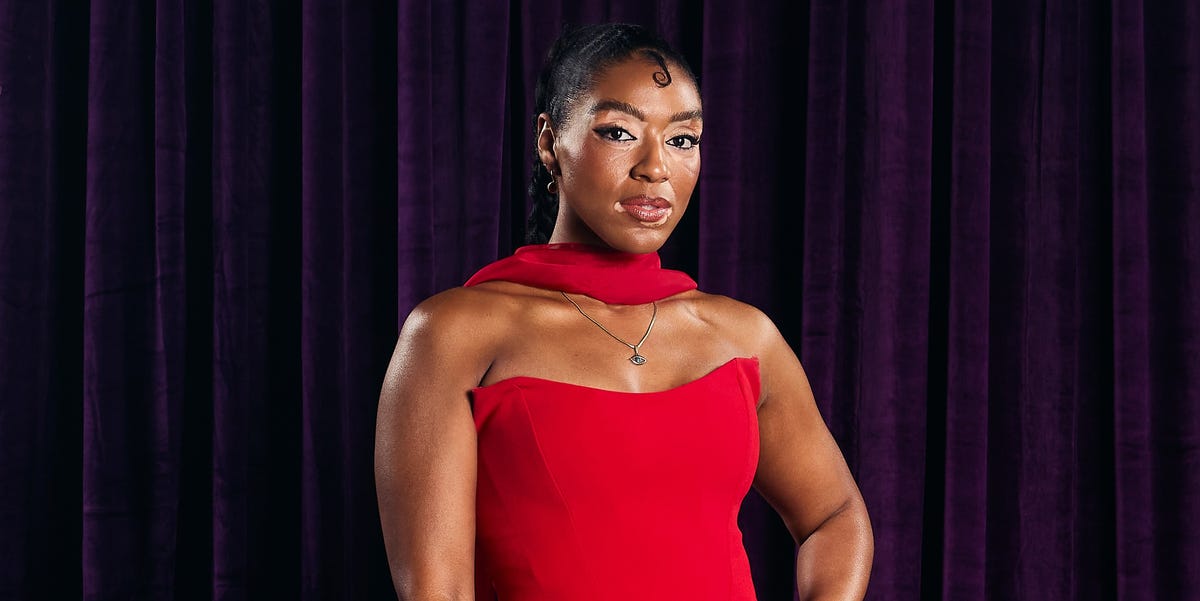
For Yasmin Toseafa, star of Love Is Blind UK season 3, beauty has never been as simple as finding the “right” shade. As someone with a multi-heritage background (Egyptian-Lebanese-Ghanaian) and vitiligo, her relationship with appearance has been shaped by a whole spectrum of experiences – from learning to understand skin that doesn’t always behave predictably, to navigating the assumptions that come with not fitting neatly into one box. And if there’s one thing we know about beauty, it’s that the boxes are rarely big enough.
On the Netflix show, Yas opened up about the parts of herself that make her, well, her. Here, she delves deeper, talking to Cosmopolitan UK about identity, representation and beauty rules she’s happily unlearning; why seeing yourself reflected matters; and how she’s arrived at a place where beauty is less about covering up – or as she puts it, “camouflaging” – and more about figuring out what makes you feel like yourself.
Because the more varied beauty we see on screen, the more we understand that it doesn’t have to fit a conventional mould.
You’ve spoken about growing up with vitiligo, but what was that experience like? Did your vitiligo ever affect the way you felt about your identity and African heritage?
I developed vitiligo when I was eight years old, so I was quite young, although I had grown up for a little while without it. It was difficult to readjust. I started camouflaging – or covering it – with makeup almost as soon as I received the diagnosis. Every morning, I spent around 40 minutes applying the cream and trying to use powders to blend everything together, which was a tiresome activity.
Like anyone who wears makeup every day, I knew it could look different from one day to the next. That was frustrating because I felt as though so much was at stake. You want to make sure you look really good and that the vitiligo doesn’t show through, so when it didn’t work, it was frustrating.
Sometimes, when people can’t place where I’m from – fair enough, I’m from a mixture of cultures – I wonder whether my vitiligo throws them off. They might not be able to tell where I’m from, or perhaps they’re unsure because the vitiligo changes their perception. Ultimately, those things don’t really matter. I don’t need someone to look at me and say, “She’s from here” or “She’s from there.” Me telling them should be enough. My vitiligo isn’t the only part of me, but it is an important part of me. I’m glad that I eventually embraced it. It took me a while to get there, but I’m glad I did.
Everyone’s clicking on…When looking back at old pictures of yourself on the show, you said you were “camouflaging”. Was there a certain point when your relationship with your vitiligo changed?
Absolutely. One of the biggest catalysts was Winnie Harlow appearing on the scene. She’s a huge supermodel with vitiligo, and seeing her gave me the confidence to consider leaving the house without camouflage. Before then, I wouldn’t even open the door to the postman. I would rather miss a parcel than collect it and let him see my vitiligo. Her example encouraged me to do more and more small things without camouflaging.
When I went on holiday with a friend, we had had a long journey, showered when we arrived and were starving. We wanted to go out for dinner, so I got out my makeup and started applying it. My friend asked, “Are you really going to make us wait 40 minutes for this?” and said, “Come on, let’s just go without it.” She’s my best friend, but I couldn’t even look her in the eye. I kept my head down because I couldn’t bear anyone looking at me.
Then I got COVID. At the beginning, you had to isolate for so many days, and people were dying from it. Luckily, I was fine, but being in a room for so long gave me a lot of time to think. I thought, “If something bad happened and I passed away, is this the legacy I wanted to leave? That I was so afraid and ashamed of my vitiligo, and had so much self-hatred, that I couldn’t even leave the house?”
I thought, “If the thing that scares me most about my vitiligo is people finding out about it, why don’t I take that fear away and tell everyone? Then it’s out in the open.” I took a picture without my camouflage and posted it on Instagram, Facebook and all my social media, along with the story I’ve just told you. I wrote, “This is me. Take it or leave it.”
I put my phone away for about five hours because I couldn’t bear to look at it. When I finally checked it, the response was phenomenal and incredibly supportive. I remember my dad messaging me: “I’ve got a tear in my eye. I’m so proud of you, my daughter.” I thought, “My God, I can’t believe it took me 20 years to do this. I’m so glad I did, because it completely changed my life. Look at me now!”

netflix//Netflix
What has your relationship with makeup been like? Did it ever feel like something you had to use to conceal your vitiligo, rather than something you chose to use for self-expression?
It has definitely changed. There’s nothing wrong with covering your vitiligo if you want to, but for me, it wasn’t a choice; it was, “I have to do this. I cannot leave the house without it.” Sunny days, especially summer, were horrible because I was constantly reapplying my makeup. People used to say, “Yasmin, you’re so vain. You’re always looking in the mirror.” I used to think, “If only you knew what I was really going through.”
Once I stopped camouflaging completely, my relationship with makeup changed. It was a gradual process. After I made the post – I sometimes refer to it as “coming out” – I still wore camouflage to work or social events. The last time I camouflaged was probably two years ago, and I think I’ve forgotten how to do it. I’m very happy to have forgotten.
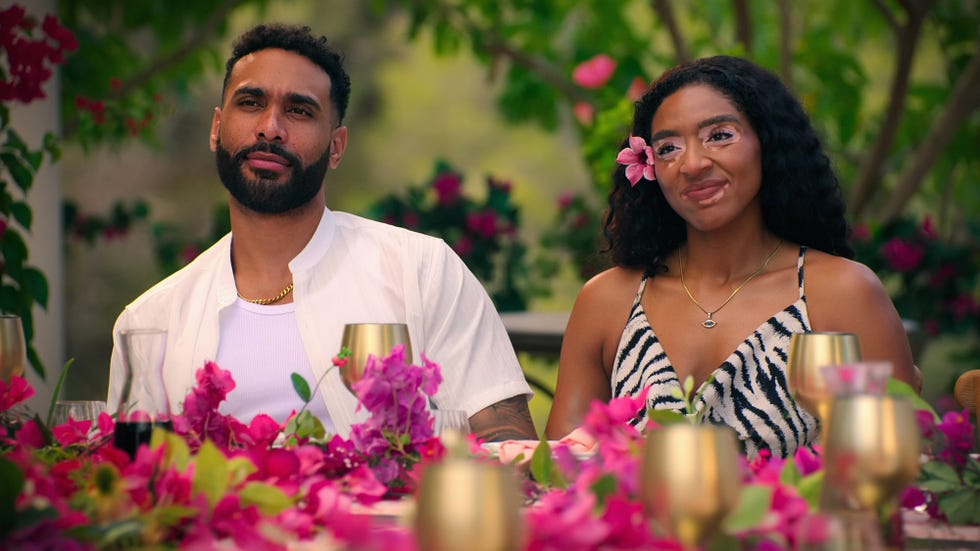
Now I use makeup to accentuate my vitiligo. Sometimes I put little gems around the edges so that it really pops. Makeup is much more fun now that I’m not trying to conceal who I am; I’m simply embracing it.
Has not wearing makeup made you assimilate more with another part of beauty?
Skincare and nails are a big thing for me. My nails are quite plain at the moment because my nail technician didn’t have time to do what I wanted, so come back next time, and I’ll show you! I express myself much more through really good skincare, different types of nail art and even the jewellery I’m wearing.
Given your experiences with your appearance, what was it like taking part in an experiment where you find love sight unseen? Did you find it liberating, nerve-wracking or a mixture of both?
It was all of the above. It’s a really intense experience with so many emotions involved. It’s nerve-wracking, especially the reveal; that was one of the most nerve-wracking things I’ve ever done. A big part of it, though, was that we were so open and vulnerable with each other. When you’re in the pods, it’s just the two of you. You forget that billions of people will be watching you afterwards, and you’re able to be your true self and speak deeply and openly with the person on the other side of the wall. That can be liberating.
Most people went on there and said things that were difficult to say and shared things that were hard for them. The pods create a sense of safety with the person on the other side of the wall, regardless of all the people who will see it afterwards.
Black and multi-heritage women already face such narrow beauty standards. What do you think the beauty industry still gets wrong when it comes to representing non-white people, especially those with visible skin differences like vitiligo?
I think we’ve come a long way in normalising vitiligo and seeing it in mainstream media. But I don’t want people to be included in campaigns as a form of sensationalism, as if brands are saying, “We’re committed to diversity, so we’ve included you.” Of course, it’s nice to be included, but I would love it to be treated more simply: “This is a beautiful model who happens to have vitiligo.” I want it to become so normal to see people like this that it’s no longer a big deal when someone has a visible skin difference. That would be nice to see.
If you could speak to the younger version of yourself – or a young Black girl with vitiligo who might be watching you on the show – what would you want her to know about her beauty?
I would tell her not to waste another second thinking she isn’t beautiful enough. She deserves to take up just as much space as anyone without vitiligo. Believe in yourself, because the freedom of being your true self is second to none.
Follow Lia on Instagram.