
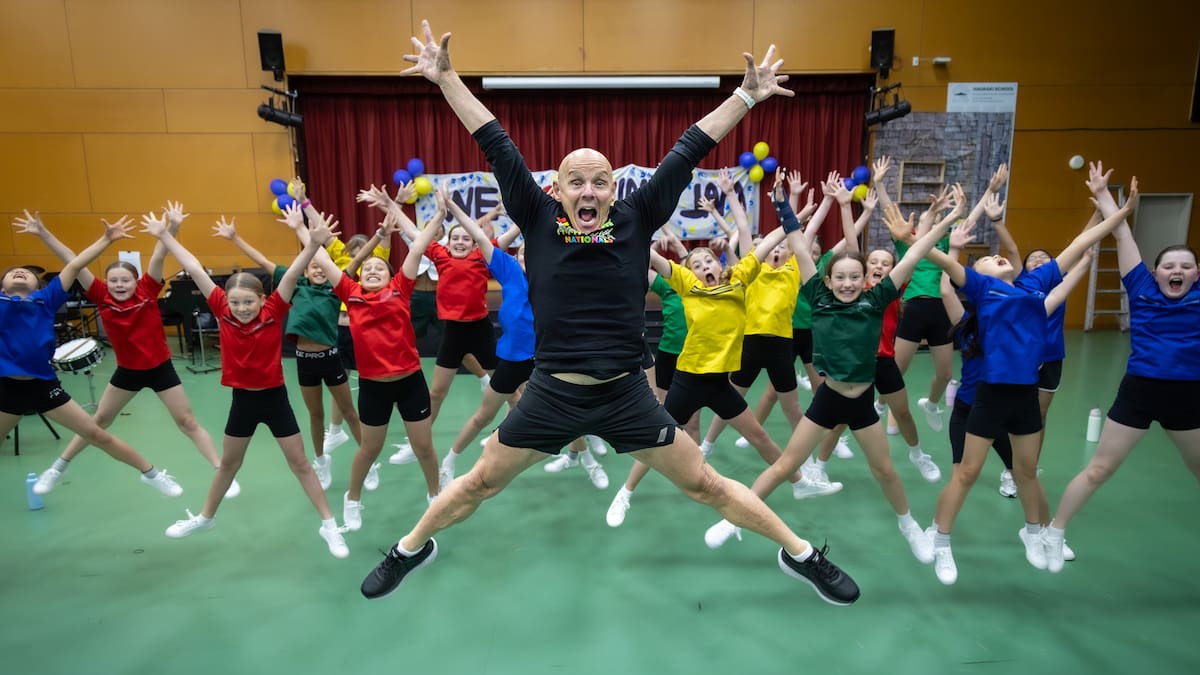
Now parents tell him they took part when they were young.
“I knew it was going to be popular, but it’s really nice to enjoy hearing the stories of people really enjoying it, and reminiscing about what Jump Jam meant to them when those songs come on,” the former national aerobics champion says.
He’s a recognisable face as the star of instructional videos that taught the Jump Jam routines for decades. Splitting his time between Tauranga and Auckland, he’s continued to travel the country to coach routines in person since the programme’s inception.
“I could be on a holiday in Rarotonga, and someone says, ‘Are you the Jump Jam guy?’ and it brings back memories for them.”
Brett Fairweather travels up and down the country teaching Jump Jam. Photo / Michael Craig
25 years of Jump Jam
The concept of Jump Jam is simple: a movement programme for primary and intermediate school students (ages 6-12) that combines dance, aerobic exercise and music to foster a love of being physically active.
Fairweather, 63, started it in 2001. The idea came to him in 1996 while he was working on Maraerobics, a te reo children’s TV show.
When Maraerobics lost its funding, he realised he enjoyed working with children and choreography.
“I thought, well, the funding’s run out, what am I going to do? I think I’ll try and create my own programme.”
In a previous career, Fairweather ran Les Mills’ Body Attack programme with young adults and was a world aerobics champion.
In Jump Jam’s early stages, he leveraged his experience, sending flyers to schools to promote himself so educators knew who they were dealing with.
The teachers talked, and word got out.
Schools used to buy licensed resource kits made by Fairweather containing music, video files with training tips and simple-to-learn fitness/dance routines and choreography notes.
He has stopped producing new kits, and these days, the focus is on competitions and student development workshops instead.
Those competitions are a big deal for participating schools, which see teams perform for regional and national titles. They began in 2005 with trials in Tauranga and Christchurch. The first national final was held in 2006.
Twenty-five years on, about 350 teams an d more than 5500 students take part in the regional competitions each year. Up to 100 will head to this year’s national Jump Jam Challenge finals in October and November, hosted at Cashmere High School in the South Island and Bethlehem College in the North.
Don’t need to be the star
Jump Jam is a New Zealand invention from a New Zealand creator. It’s not based on any existing programmes worldwide, but there have been attempts to expand.
“We did get Jump Jam going in Perth. It got quite popular over there, and then Covid came along, and we lost the momentum … And the same thing happened in Singapore,” Fairweather says.
“In New Zealand, it’s still going because it’s been going for 25 years. The roots are very long, so it’s survived.”
Brett Fairweather says he knew Jump Jam was going to be popular. Photo / Michael Craig
He credits the longevity to innovation. As the years passed, creativity became a factor, with students and teachers creating their own moves and routines based on Fairweather’s advice, rather than copying him.
He still spends about four months a year visiting 400-odd schools across the country.
During playtime, just before school, or during lunch, you’ll see children train for the highly competitive Jump Jam competitions. Students pay an entry fee – between $40 and $50 each – and get a branded T-shirt.
But Fairweather says it’s not a get-rich-quick scheme.
“If you want to get financially rich, this is not the industry. However, the rewards from seeing children’s lives change are incredible and worth it 100%.”
And today, he “doesn’t have to be the star any more”.
That title belongs to the kids.
“I’ve inspired them to the point that it’s now, ‘right, show me what you can do’. And it’s better because it’s really their journey and their growth. I used to think it was all about fitness, but now I understand that it’s also just as much about confidence.”
Making new friends, getting fit
“Time to puff, should I be easy on them or tough?,” Fairweather asks Hauraki School teachers Ivy Bright and Sarah Annan with a grin.
There’s a brightly decorated “I Love Jump Jam” poster hung on the back wall of the North Shore school’s hall. It’s 8am, and a group of girls aged about 11-12 are Jump Jam-ing to Bruno Mars’ hit Uptown Funk.
It’s loud, as the girls are shouting along to the song while adding their own synchronised chants as required by the Jump Jam competition rules. Vocals and chant are just one part of what makes a successful routine.
The girls are concentrating hard, but the smiles never leave their faces.
That judging criteria is strict, Fairweather explains later.
“On the presentation side, are they looking confident? Do they know it? Are they all moving the same way? Are they performing?
“Do they have [engaging] facial expressions? Do they have interesting things that they vocalise, or that they’ve added in? It’s the confidence plus the technical side.”
For many, the memories of Jump Jam are most strongly associated with the music. The songs, an eclectic mix of old and new hits, were selected by Fairweather based on trials and what he thinks people will respond to best.
Early on, the resource kits contained new-release, top 40 hits like Five’s Keep On Movin’ and Who Let The Dogs Out by Baha Men. While they are still around in the competitions today, newer songs like Bruno Mars’ 24K Magic and Taylor Swift’s Shake It Off also soundtrack routines across the country.
“If they sing along to them or they know them, and I think they’re going to be popular, I’ll just throw some moves together and I’ll trial it.”
Fairweather spends about half an hour with each school he visits, providing advice and coaching before the competitions. At Hauraki School, teachers Bright and Annan write down every word of advice so they can help the team prepare.
His impact on the kids is clear.
“Brett is a very energetic and fun teacher,” says team member Charlotte Brown.
Another student, Madeline Brown, says her favourite things about Jump Jam are “making new friends and getting fit”.
Brett Fairweather hopes to still be doing Jump Jam at 80. Photo / Michael Craig
The competitions, he says, help the kids learn all the skills that go into working in a team.
“Turning up for training, being there on time, perfecting, going away, coming back, performing on a stage with lights in front of an audience. It’s a whole new big deal for them, and they get so much more confidence when they go through that process.”
Fairweather’s goal has always been the same: try to make exercise fun. And in his eyes, he’s achieved that.
“I think when you’ve got music and movement, and it’s a dance, and it’s a repetition, if it’s fun and it’s enjoyable, you do it.”
And as for another 25 years of Jump Jam? Fairweather sure hopes so.
“It’d be hilarious, wouldn’t it? You know, the Jump Jam guy comes in, and he’s 80,” he says.
“It keeps me fit, it keeps me energised, it keeps me young when I’m with the children. I don’t feel 63. I’ve had a full knee operation … but it’s not stopping me. I still go out there and give it everything I’ve got.”
Mitchell Hageman joined the Herald’s entertainment and lifestyle team in 2024. He previously worked as a multimedia journalist for Hawke’s Bay Today.