
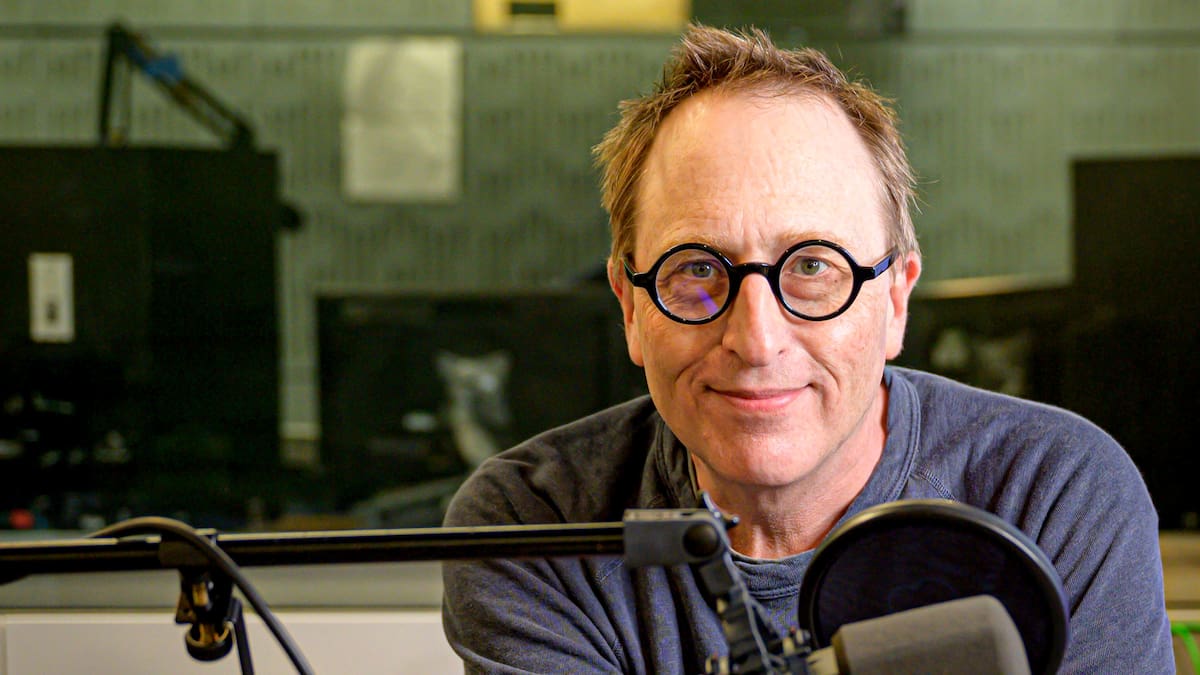
A man is seated alone on a bench at his local park on a weekday. He is trying desperately to will a new idea into existence, to think of a fresh thing he can do to earn his way.
But as he sits, a dreadful thought overwhelms him instead:
if no new idea comes, if inspiration fails, he will not be a man having ideas at all. He will just be a man sitting alone on a bench at his local park on a weekday.
It is the kind of tragicomic scene one expects to find in the work of Jon Ronson, the British-American journalist, broadcaster, podcaster and author of bestsellers including The Men Who Stare at Goats and So You’ve Been Publicly Shamed. Indeed, this very scene can be found in his latest excursion into the margins of human experience in his new book, The Castle.
However, the man on the bench is not another kind of goat starer. It is Ronson himself. A man who has lived his whole life with the “thrum of anxiety” about the need to keep busy, to keep working. And to do that work, he has to perform that most difficult of tricks for any writer: conjure up a great new story.
“It is the hardest part,” he tells the Listener from his home in upstate New York. “And for me, it only gets harder.”
Every time he covers a subject or investigates a new world, he does not want to go back there. “You’ve got all of these writers who do the same thing over and over again. They re-explore all the time. But I can’t do that. I feel like my journey is over when I’ve solved the mystery or understood a world that I didn’t understand. So I can’t go back. Not knowing something is the wind behind my sails.”
Ronson is faced by the fact, too, that the older he gets – he is 59 – and the more stories he tells, the more it feels as if there are fewer stories left to find. So it was mighty great luck he did not have to go looking for the bizarre tale that begins The Castle. It found him. Not sitting alone on a park bench, as he sometimes does, but while he slept in his bed beside his wife.
In the summer of 2023, he woke one morning to find he’d received a flurry of text messages overnight from his adult son Joel, who, with friends, had driven to Woodstock, Connecticut, after being invited to a party.
The three-hour journey had taken the quartet from the shiny canyons of New York City to a winding forest road and finally up to an odd if imposing set of gates. Behind the gates was something that might have been summoned from a dream or a nightmare, a mock Gothic castle studded with spires, towers and turrets.
No less unnerving was the welcome. Waiting on the castle’s drawbridge was the man ‒ the very middle-aged man ‒ who had invited them to the party. His name, they soon learnt, was Chris Mark, and his very strange world would soon become Ronson’s newest mystery.
Human stories: Jon Ronson seeks to shed light on forgotten outsiders and those set adrift by change. Photo / Getty Images
Chasing the weird
Almost from the beginning, Ronson has been a man in search of “the other”. Long before the internet and social media made the extremities of human thought and behaviour just another float in life’s passing parade, he sought to discover and understand those dwelling at the fringes.
He has said many times that, as a boy systematically bullied at school in his hometown of Cardiff, he felt himself an outsider from an early age. Being on the edges of the playground looking in, he later realised, was good training for what he was to become.
Timing, as well as talent, played its part in turning the young outsider into a going media concern. As British television loosened up in the 1990s, holding up those considered outré by mainstream society to public scrutiny(and as freak-show entertainment) became a thing. Ronson and his great rival Louis Theroux were among the leading exponents.
Seemingly locked in a death match to see who could platform the biggest weirdos, both had a faux-naïf interviewing style which was simultaneously comic and effective. Theroux may have had more longevity on the box in the decades since, but of the two, it was Ronson who proved he could write bestsellers with wit, style and resonance.
His breakthrough, Them: Adventures with Extremists, published in April 2001, set out his stall. The book was a march past by many of that period’s bogeymen: neo-Nazis, Islamic fundamentalists, Ku Klux Klansmen, the American conspiracy theorist Alex Jones, and English author and broadcaster David Icke, a believer in giant, inter-dimensional lizard men.
Ronson’s talent was not just in finding out why these disparate extremists thought what they thought, but in discovering the hidden connective tissue between them – the shared belief that a tiny, evil cabal was secretly running the world.
In an article for The Conversation to mark Them’s 25th anniversary in July, University of Sydney lecturer Alexander Howard said the book still felt relevant because Ronson rejected the reassuring assumption that extremist or conspiratorial thinking falls outside the bounds of ordinary life. “[Ronson] grasped that bizarre ideas do not emerge from nowhere,” Howard concludes.
The linking together of apparently bizarre or extreme ideas across time and place has been a foundation of Ronson’s work for more than 30 years. This includes the excellent Things Fell Apart, his two radio series for the BBC (they are available as podcasts), which deftly contextualise and join up key battlefronts in the culture wars by unearthing their origins and finding the forgotten outsiders whose fringe ideas evolved into pandemic-era conspiracy theories.
Key, too, to Ronson’s success has been his mining of the gap between how these outsiders see themselves and how the world sees them.
“Someone described my work as chronicling the breakdown of our shared reality,” he tells the Listener. “I’ve always been interested in the way something changes on high, big decisions are made by faraway people on high, and how it trickles down and affects regular people in ways they don’t even realise.”
His 2011 book The Psychopath Test: A Journey Through the Madness Industry did this by examining how arguable clinical definitions and diagnoses of psychopathy made from on high have moulded the world. His last major volume, 2015’s So You’ve Been Publicly Shamed, explored, with some prescience, the disastrous, toxic effects of social media.
“It is the same with The Castle,” he says. “It’s about how huge societal changes are having impacts on men and their inner lives.” Men like Chris Mark.
The “great garish shriek”: Ronson’s assessment of Chris Mark Castle, complete with moat and drawbridge. Photo / Supplied
King of the castle
It is a fact that no one does bad taste quite like rich Americans. And Chris Mark is a rich American. The scion of a Gilded Age family who made their fortune in steel, Mark, in his early 60s, is an heir to an intergenerational fortune, but also to a proud heritage of hard work and success.
The family patriarch, Clayton Mark, a 19th-century industrialist who built his own village, Marktown, for his steel workers, was also a philanthropist and civic titan. A century later, great-grandson Chris, an ostensible insider, has used his share of the Mark fortune to turn himself into the opposite: an outsider.
Not long after his son’s late-night adventure – and just 16 days after bowel surgery – Ronson, intrigued by what Joel had told him, arranged to meet Mark at his bonkers castle. The multimillion-dollar folly is set on a 30ha estate, with a moat, 12 fireplaces, an underground auditorium and a cinema.
How tasteless is it? “It’s a weird mix,” says Ronson. “Some of the ceilings have got clouds and frescoes. There are stalactites and geodes, a waterfall. So it’s a kind of strange mashup of genres. It feels like it was designed by somebody whose brain was working a little bit too fast.”
According to the UK’s Independent, Mark began building what Ronson calls a “great garish shriek” in 2003 (it was completed in 2011) after Mark’s daughters asked him, “Daddy, why don’t you build us a castle?” Mark’s elder daughter Christina, a putative social media influencer, later began documenting her “life as a princess”, which mostly involved dressing up and parading her apparently affluent lifestyle on TikTok and Instagram.
In the age of the Dubai influencer, none of that might seem particularly noteworthy. What piqued Ronson’s interest was the real reason his son and female friends were invited to the wacky castle that summer’s night. They, along with mostly younger women, were lured there to take part in what Mark claimed was a reality TV show he was making called 101 Princesses.
The concept, more or less, was for the “princesses” to compete to be Mark’s live-in “queen”. This began with the women invited to select princess dresses from the castle’s basement to parade before King Chris, who planned for them to compete later in cookery and dancing competitions.
It sounded dodgy and unlikely. But this bizarre beauty pageant for a TV show that would never happen was not Mark’s central fantasy. That, Ronson discovered, was emulating Hugh Hefner, the late Playboy founder. “I thought, this guy is trying to be Hugh Hefner at the worst moment in human history. You can’t lord it over your princesses in your castle like it’s the 1970s any more.”
The implausibility of creating and keeping a harem in the age of #MeToo America made Ronson laugh. But it made him wonder, too. “There’s all kinds of things that men used to be able to do that we can’t do any more. That felt like a wider world to explore. I felt like I had a book.”
Chris Mark: King of his own castle and in search of a harem. Photo / Supplied
Author as character
There is something of the affable tour guide about Ronson. With his work, you often find yourself walking beside him as he, with wonderment, bemusement or sheer delight, points out the high points of your journey. He’ll be doing exactly this in person in Auckland later this month with his new multimedia show, Enter The Castle with Jon Ronson.
Does making himself a character in his journalism just happen? Is it deliberate? Is it about authenticity? “I think it’s all of those things. But also, it’s an easy narrative device. I’m a little bit like Sam Spade. I’m, like, taking on a case.”
But his presence in his narrative journalism has to have added something, he says. “In The Castle, I’m fragile. I’m just out of hospital, and so I’m very aware of my own fragilities, and suddenly I’m feeling purposeless. I go to this castle to meet a man who’s also fragile and purposeless. So this is a perfect use of myself in this book.”
Ronson’s British sense of humour is part of his tour guide charm: it relies on irony, is almost never cruel and often self-deprecating.
“We’re all fucked up, you know,” he says. “We’re all a mess, and I’m as much of a mess in my own way as the people that I’m writing about. If you’re going to point out somebody else’s absurdities, you have to point out your own. And if you do that, then you just automatically become more empathetic and understanding of people’s behaviour.”
What seems the least British thing about him, or at least the most American (he has lived in the US since 2012) is his apparent lack of self-effacement, which is to say he’s more than happy to tell you how good he is.
“I’ve just written this story – I went to the cage fight at the White House – for GQ magazine,” he says. “And I wrote it really well. It’s so funny, and I was so proud of it. I spent an afternoon just rereading it over and over again, and I was thinking to myself [about] the happiness I’m feeling right now because I managed to do this well.”
The happiness he gets from his work he doesn’t find anywhere else, he says. And work ‒ the value of it, the lack of it and the changing face of it for men ‒ is a major theme in The Castle.
“I decided I’d broaden my investigation,” Ronson writes. “I’d continue to uncover whatever I could about Chris, while also exploring this wider landscape of men losing their footing in the world, falling out of time – mostly because I was, to be honest, very scared of becoming one myself.”
I empathise with men who feel tossed around in this kind of turbulence as to what being a man means.
Jon Ronson
He cites an astonishing statistic: by 2022, one in six American men aged 25-54 did not work. More worryingly, he found, two-thirds of those men were not even looking for jobs – a total of 6.7 million given up and retreated from the world.
So much has been written and said about the rise of the so-called manosphere, but Ronson believes it’s largely a sideshow. It is actually the worklessness and purposelessness exhibited by men like Mark and those 6.7 million that’s the more worrying phenomenon of our age.
“I definitely empathise with men who feel tossed around in this kind of turbulence and conflicting ideologies as to what being a man means. All the old things that made men feel secure in the world are dying.”
Here is another astonishing statistic: according to the US data and insights firm Luminate, 39% of Americans now identify as online content creators.
“That’s such a giant shift in society,” Ronson says. “Somebody said to me the other day, ‘Did men start to unravel because of #MeToo?’ And I said, ‘No, I think men started to unravel because of deindustrialisation and the death of institutions and the death of offices.
“And now, tech bros are telling us, ‘Well, okay, we may have cut you adrift from the world, but there’s a new Wild West you can conquer. You can become a content creator.’ So you’ve got untold millions of people becoming these personal brands, these institutions of one.”
Ronson contends that those set adrift by this tech-driven change either withdraw into themselves or lash out. “It’s like the Soviet Union. Everybody hated all the lining up for toilet paper. But get rid of it and people are sitting on the sidewalk in despair. And I think that’s what’s happening to us. There’s a lot of despair, and it comes from purposelessness.”
As he writes, these unmoored, underemployed men’s attempts to find new purpose in the “false promise” of being a content creator – increasingly with AI chatbots whispering in their ears about how amazing they are – are a vain attempt to fill a void that their fathers, in many cases, never had to grapple with.
“Everybody in the book, in a way, is trying this brave new world of content creation. But unmoored from these old industries, it’s doing something to our heads.”
Job for life
For a man who sometimes sits alone on a park bench on a weekday worrying he might never have another idea, Ronson is a busy content creator himself. He has been working non-stop for years, he says.
While researching and writing The Castle, he was preparing his elaborate stage show to accompany it, working on a third series of Things Fell Apart (going to air in January) and, of course, filling up what remained of his time reporting on the likes of UFC (Ultimate Fighting Championship) punch-ups on the White House lawn.
It was a lot. “[I felt like] I was just trudging through treacle,” he says. So he decided to take a month off.
Yet there he was, seated on the deck of his home in the Hudson Valley on a warm summer’s afternoon in August, admittedly with a bottle of Sapporo beer in hand and with hummingbirds zipping around him, still at work, not writing perhaps, but on a Zoom call promoting the book and live show to someone half a world away.
He is a worker, just like his father. But during his childhood, his dad lost his job and his son discovered him crying in secret. Things turned out all right in the end, but Ronson says the anxiety of being a man out of work has followed him ever since.
He knows it isn’t healthy but understands what is less healthy – being out of work.
With nearly 40 years of successfully documenting outsiders and their shadowy worlds, it seems to have been an unreasonable fear, but the horror of being a man who doesn’t work is not his only motivation.
He’s competitive, too, and freely admits a main driver since his first book has been to be better than any other non-fiction writer. He certainly is one of the most successful.
But most of all, this playground outsider who turned himself into a media brand knows this: he feels at his most contented when he has, once again, like Sam Spade, taken on a case.
“I once asked [singer-songwriter] Randy Newman, ‘Why do you write songs?’ And he said, ‘It’s how I judge myself and how I feel better’.
“And somewhere along the line, that’s what happened to me, too.”
The Castle, by Jon Ronson (Penguin, $40) is out now. Enter The Castle with Jon Ronson, Bruce Mason Centre, Auckland, October 25; tickets from Ticketmaster. Image / Supplied
SaveShare this article
Reminder, this is a Premium article and requires a subscription to read.
Copy LinkEmailFacebookTwitter/XLinkedInReddit