
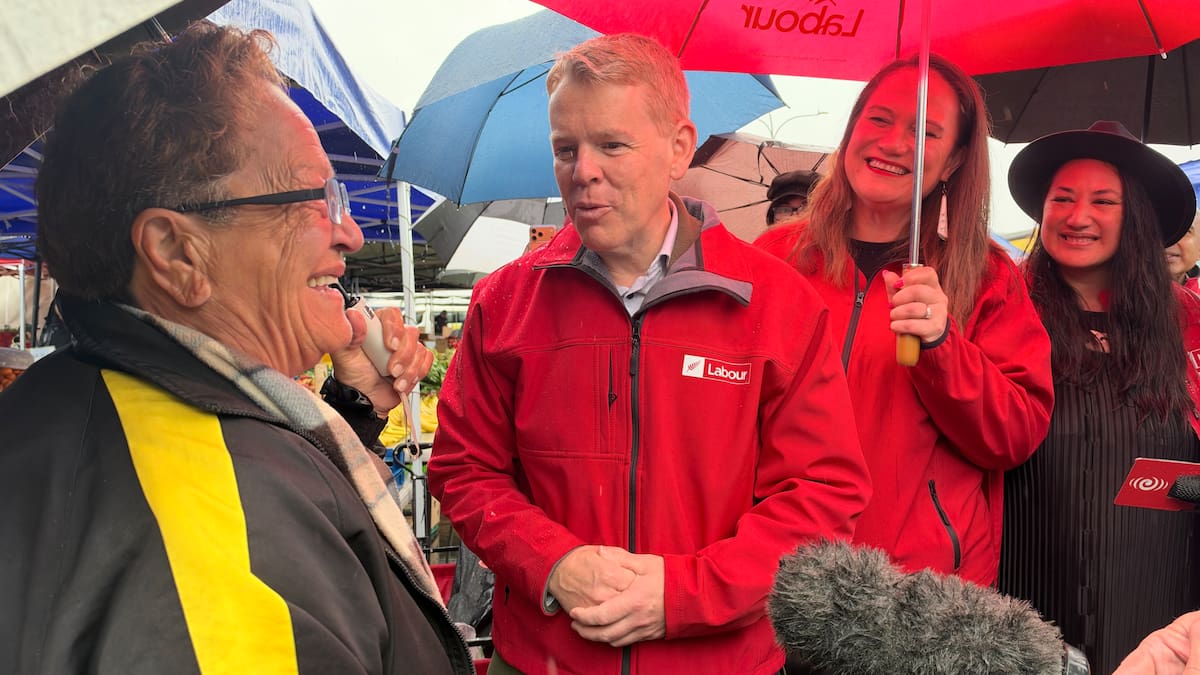
Labour couldn’t say how many people would receive a pay bump, or how much its pledge would cost the Crown and private sector.
A spokeswoman for the party told the Herald the change would be implemented over time and “managed by relevant agencies through their normal budget and baseline processes”.
This could require agencies to make cuts to find the money to pay the living wage.
“We expect the number of workers affected to be relatively small, given many public sector service workers are already paid at or above the living wage,” the spokeswoman said.
“It does not change the overall fiscal settings or allowances set out in our fiscal plan.”
Real wages, or nominal wages adjusted for inflation, have been falling over the past five years, according to an internationally comparable measure used by the OECD (which differs from measures preferred by some economists domestically).
The drop in New Zealand has been the most severe of 37 countries in the OECD.
Meanwhile, Living Wage Aotearoa said high fuel prices were putting workers under further financial pressure, especially those who had no choice but to drive to work.
Economist Cameron Bagrie recognised people were doing it tough. But he feared that jacking up wages without increasing productivity could cause inflation to rise, hurting those Labour was trying to help the most.
“All the debate around the cost-of-living crisis is masking the real crisis, which is an income crisis.”
Bagrie said the problem is “you don’t just solve an income crisis by ratcheting up people’s wages without having the productivity strategy”.
“Because all that’s going to take place is that it flows into inflation, and then you end up in a cost-price spiral, where wages go up, so costs go up and inflation goes up and you have to force wages up again,” he said.
“That just ends in tears. Central banks will stomp all over it,” Bagrie said, referring to how the Reserve Bank would have to lift the Official Cash Rate if inflation rose too much.
New Zealand’s labour productivity is among the weakest in the OECD, as Kiwis are both working less and producing less per hour worked.
“Where people get a bit lost is that they think you can artificially conjure up lifts in wellbeing by throwing a lot of money at it. There is no free lunch. Wellbeing needs an economic base, first and foremost,” Bagrie said.
Employers and Manufacturers Association chief executive Alan McDonald noted many of his group’s members paid the living wage. But he believed this had to remain voluntary.
McDonald noted the gap between the minimum wage and the median wage in New Zealand was already compressed. Making the living wage mandatory in parts of the economy would reduce this gap even more.
He said the dynamic was seeing employers opt to pay slightly more to hire people with experience, concluding that this would be more valuable than taking on someone who needed training.
McDonald went so far as to say he believed the compression of the gap between the minimum and median wage, thanks to the rapid rise in the minimum wage under the previous Government, had contributed to the rise in the number of young people not in employment or training.
The gap between the minimum and median wage in New Zealand is the fourth-smallest in the OECD.
McDonald also feared that the Government setting the living wage as the baseline could be an impediment to small businesses bidding for government contracts.
“Whether you mean to or not, you create an artificial barrier,” he said.
“You might be a little start-up cleaning business, first-time contractor, you want to nail a contract like that, but you simply can’t.”
Jenée Tibshraeny is the Herald’s Wellington business editor, based in the parliamentary press gallery. She specialises in government and Reserve Bank policymaking, economics and banking.
Stay ahead with the latest market moves, corporate updates, and economic insights by subscribing to our Business newsletter – your essential weekly round-up of all the business news you need.