
Consider two slices of Ploughmans Farmhouse Wholemeal bread. Together they weigh 84g and provide 6g of fibre, 8.2g of protein and about 193 calories.
Now take an 18g suggested serving of Ceres Organics No Added Salt Brown Rice Cakes. It provides just 0.6g of fibre, 1.4g of protein and about 71 calories.
The rice cakes are lighter, but they’re also a much smaller amount of food, with substantially less protein and fibre.
“It’s important not to confuse fewer calories with better nutrition,” Dietitian NZ’s Julia Sekula says.
Rice cakes can be useful, particularly if you want a light, crunchy base or need a gluten-free alternative. But a few plain rice cakes aren’t necessarily a nutritional substitute for a substantial wholemeal sandwich.
And unless you add something to them, you may find yourself hungry again well before dinner.
Some crispbreads really do deliver
Not all crackers are created equal. In the Herald’s comparison of supermarket products, several stood out for their fibre content.
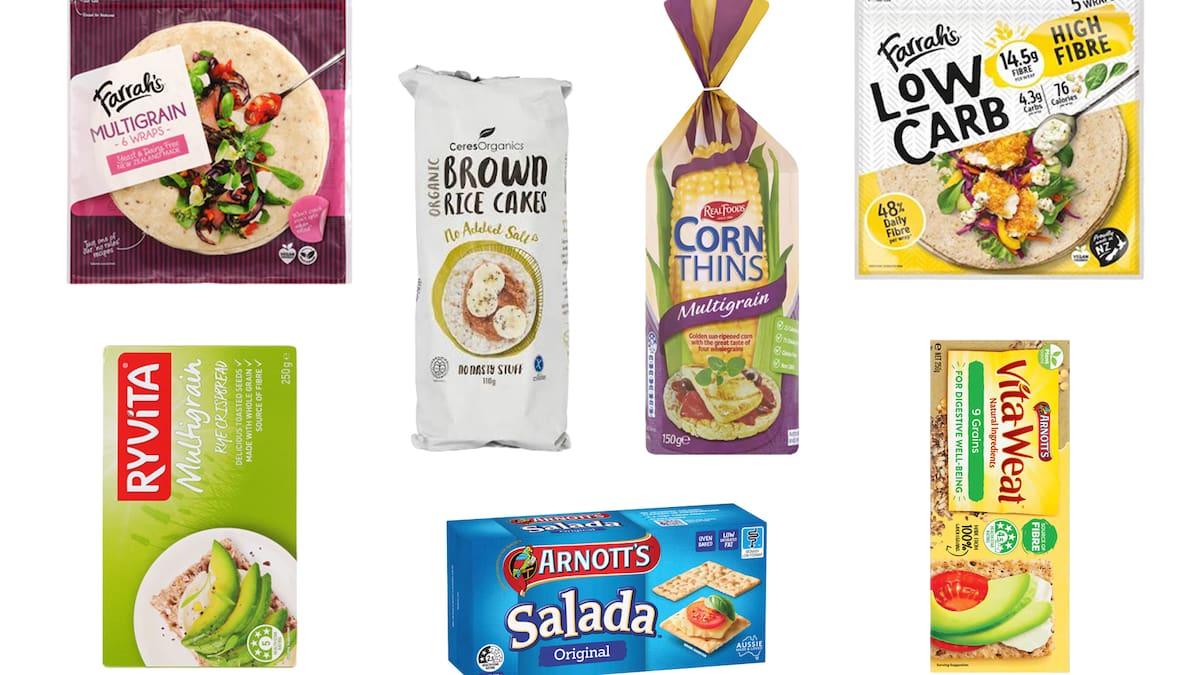
Ryvita Multigrain Rye Crispbread is particularly impressive, with 17.2g of fibre and 240mg of sodium per 100g. Its wholegrain rye-based recipe also contains seeds and rye bran, making it a strong option for those wanting a more substantial cracker.
Arnott’s Vita-Weat 9 Grains is another contender, with 13.6g of fibre per 100g, 426mg of sodium and a recipe containing 86% wholegrains.
For something lighter and crispier, Real Foods Corn Thins Multigrain contains 6.8g of fibre and 259mg of sodium per 100g. It provides a useful base for cottage cheese, tuna or avocado.
Ceres Organics No Added Salt Brown Rice Cakes stand out for a different reason: just 1.4mg of sodium per 100g. But its fibre content is a more modest 3.6g, making the toppings you choose especially important.
At the other end of the spectrum, Arnott’s Salada Original contains 850mg of sodium per 100g, compared with Ryvita’s 240mg. Salada can form part of a nutritious lunch, but it starts with considerably more sodium before any cheese or spreads are added.
The distinction is clear: crackers can be a good choice, but the type you buy makes a big difference.
Reading the nutrition panel far outweighs front-of-pack claims when it comes to choosing your wrap.
The wrap trap
Wraps have a healthy image, especially varieties labelled wholemeal, multigrain or vegetable.
But Farrah’s Multigrain Wraps illustrate why the name doesn’t always tell the whole story. Despite their assortment of grains and seeds, the multigrain blend accounts for just 3.6% of the product.
The wraps contain 2.5g of fibre per 100g, or only 1.6g in a 64g wrap. Compare that with 6g in two slices of Ploughmans Farmhouse Wholemeal.
“Seeded and multigrain crackers can be great choices, but the on-pack marketing and appearance alone don’t guarantee they contain more fibre or wholegrains,” Sekula says. The same principle applies to wraps.
A spinach wrap isn’t necessarily a meaningful source of vegetables just because it’s green. Some vegetable wraps contain only a small proportion of the ingredient responsible for their colour.
Yet wraps have genuine advantages, particularly for assembling a substantial lunch.
“Wraps can be a great alternative to bread, as their shape makes it easy to pack in plenty of nutritious fillings,” Henderson says.
A wholemeal wrap with chicken, hummus and salad could make an excellent lunch. Just don’t assume the wrap itself is healthier than bread.
What about pita and low-carb versions?
Pita and flatbreads can be equally practical alternatives, particularly for stuffing with falafel, salad, beans or leftover meat.
Their main advantage is versatility rather than any inherent nutritional superiority. Some contain substantial amounts of wholemeal flour, while others are made predominantly from refined flour.
Then there are the speciality products, including high-protein and low-carbohydrate options.
Farrah’s Low Carb High Fibre Wraps contain 14.5g of fibre in a single 45g wrap. That’s a substantial contribution towards the recommended daily intake, although the formulation relies partly on added oat fibre and modified wheat starch rather than wholegrain flour.
Such products can be useful for particular dietary needs, but most people don’t need to avoid ordinary carbohydrate-rich foods to eat well.
Wholegrain bread provides fibre, vitamins and minerals alongside carbohydrate.
Seed and nut crackers with avocado dip. Picture / Babiche Martens
How to make crackers a proper meal
The advantage of a sandwich is that it often arrives as something resembling a complete lunch. With crackers, you may need to be more deliberate.
Wholegrain crispbreads topped with hummus, boiled eggs, tomatoes and avocado provide protein, fibre and healthy fats. Alternatively, a platter of grainy crackers, cheese, carrot sticks, cherry tomatoes and leftover chicken can be just as substantial as a sandwich.
Rice cakes or corn thins topped with cottage cheese, tuna or nut butter are other possibilities, depending on whether you’re after something savoury or sweet.
The important distinction is between a few crackers eaten on their own and crackers forming the base of a proper meal.
Are they better value?
That depends on more than the packet price.
Crackers often last longer than fresh bread, which can make them economical for occasional lunches. But you might need several, with more substantial toppings, to replace a sandwich.
A large wrap may be convenient but not necessarily cheaper per meal. Meanwhile, wholemeal bread remains an affordable option and freezes well, reducing waste.
“You don’t need to buy premium or specialty products to eat well,” Sekula says.
There’s no nutritional prize for abandoning sandwiches. Wholegrain bread, rye crispbreads, wraps and pita can all make excellent lunches.
As Henderson puts it: “The best guide is whether your lunch provides enough nourishment to keep you comfortably satisfied and energised throughout the afternoon.”
Herald contributor Nikki Birrell has worked in food and travel publishing for nearly 20 years.