
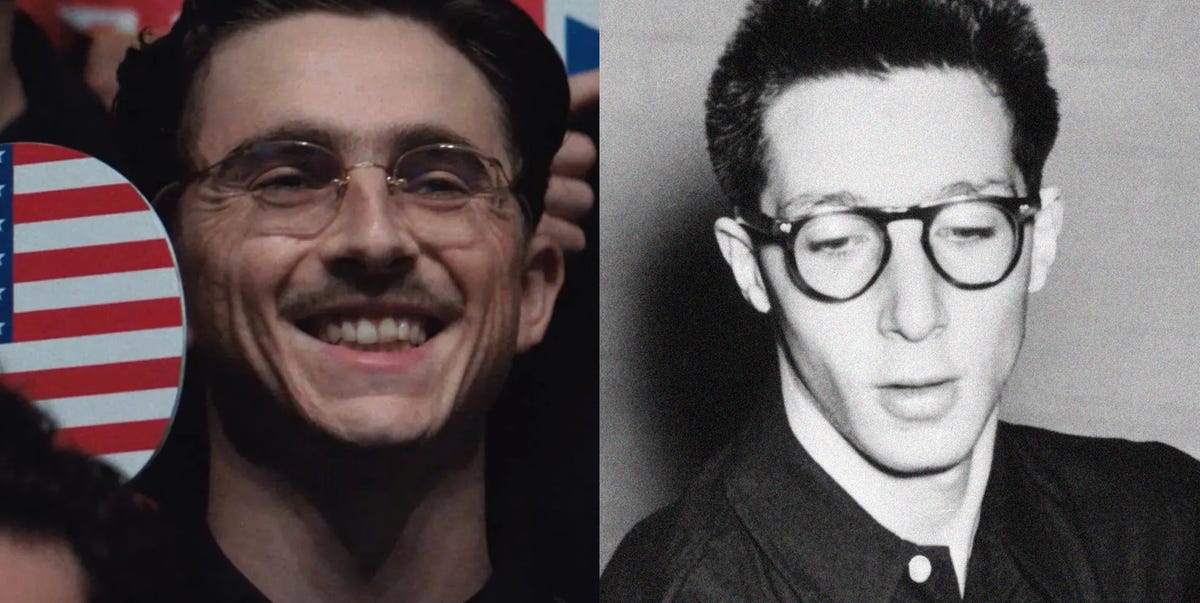
Timothée Chalamet has been doing a stun-ning job of promoting his new film Marty Supreme: we’re talking custom outfits, a casual rap collab with EsDeeKid and a befriending of Britain’s Got Talent star, Susan Boyle. Plus, the project was even enticing enough to lure Gwyneth Paltrow out of retirement, so you already know it’s gonna be worth a watch.
Based on the life of an eccentric ping-pong star, known just as much for his hustling prowess as his talents at the table, it’s said that Marty Supreme is loosely based on a true.
But who was the real-life table tennis champ, Marty Reisman? Let’s take a deep-dive!
Everyone’s clicking on…Is Marty Supreme based on a true story?
Short answer: yes, kinda, sort of.
Marty Supreme isn’t a straight up biopic like Chalamet’s previous role as Bob Dylan in A Complete Unknown was meant to be, but it is loosely inspired by a real person. Marty ‘The Needle’ Reisman was a legendary table tennis player who fought his way out of poverty, thanks to a combination of sporting prowess, hustle and being a larger-than-life character.
He was known for wearing flamboyant outfits, having quick wit and the ability to break an opponent’s cigarette in half from his side of the ping-pong table.

 Neville Elder//Getty Images
Marty Reisman, holder of 18 international and US national table tennis titles, pictured at age 77
Rather than sticking rigidly to facts, Marty Supreme uses Reisman’s life and general ‘out there’ vibes as a springboard, blending real events with fictionalised elements (AKA Marty’s affair with Gwyneth’s character, Kay Stone).
Interestingly, the real Reisman’s life has already been explored elsewhere on screen: a 2014 documentary, Fact or Fiction: The Life and Times of a Ping-Pong Hustler, looks at his rise to success. Its director, Leo Leigh, said recently while speaking to The Smithsonian that Marty Supreme’s director, Josh Safdie, reached out to him to ask about the real Reisman.
Who was the real Marty Reisman?
Marty Reisman was born in New York City in 1930, the son of a taxi driver, and grew up facing tough times during the Great Depression (spanning 1929 to 1939). By his teens, Reisman was reportedly sleeping rough while making a name for himself playing high-stakes matches in underground clubs, back rooms and pool halls.
Often, he’d dupe an over-confident, wealthy opponent and pocket the cash after trouncing them. Speaking about his money-making techniques years down the line at the age of 75, Reisman told Forbes, “Just get them to the table is my philosophy.”
He added, “I could tell at a very young age that I was gifted and that because of that gift, I would be able to carve a very interesting life out of table tennis.


Patrick McMullan//Getty Images
“I had a nervous breakdown when I was nine years old and ended up in Bellevue Hospital. Ping-Pong was the ultimate escape. My racket became a sensuous connection between the ball and my brain.”
By the 1950s, Reisman was a known force in the sport and he would go on to win multiple national championships, earning a reputation not only for his skills but for his iconic trash-talking of opponents and eccentric approach to the game.
When describing Reisman back in 2005, journalist (and friend) Sir Harry Evans said, “It’s not just that Marty has a legendary forehand or the greatest drop shot ever seen on the face of the earth.. He has all these things, but he’s also a master raconteur and rhetorician. His wit is as delicious as his drop shot.”
“If you had to name the ten greatest players the game has ever seen, Marty would without a doubt be one of them.”
Reisman died in 2012 at the age of 82, leaving behind his wife, Yoshiko, and their daughter, Debbie, along with several grandchildren, according to his New York Times obituary.
Marty Supreme is out in cinemas from 26 December
Related Stories

Jennifer Savin is Cosmopolitan UK’s multiple award-winning Features Editor, who was crowned Digital Journalist of the Year for her work tackling the issues most important to young women. She regularly covers breaking news, cultural trends, health, the royals and more, using her esteemed connections to access the best experts along the way. She’s grilled everyone from high-profile politicians to A-list celebrities, and has sensitively interviewed hundreds of people about their real life stories. In addition to this, Jennifer is widely known for her own undercover investigations and campaign work, which includes successfully petitioning the government for change around topics like abortion rights and image-based sexual abuse. Jennifer is also a published author, documentary consultant (helping to create BBC’s Deepfake Porn: Could You Be Next?) and a patron for Y.E.S. (a youth services charity). Alongside Cosmopolitan, Jennifer has written for The Times, Women’s Health, ELLE and numerous other publications, appeared on podcasts, and spoken on (and hosted) panels for the Women of the World Festival, the University of Manchester and more. In her spare time, Jennifer is a big fan of lipstick, leopard print and over-ordering at dinner. Follow Jennifer on Instagram, X or LinkedIn.