
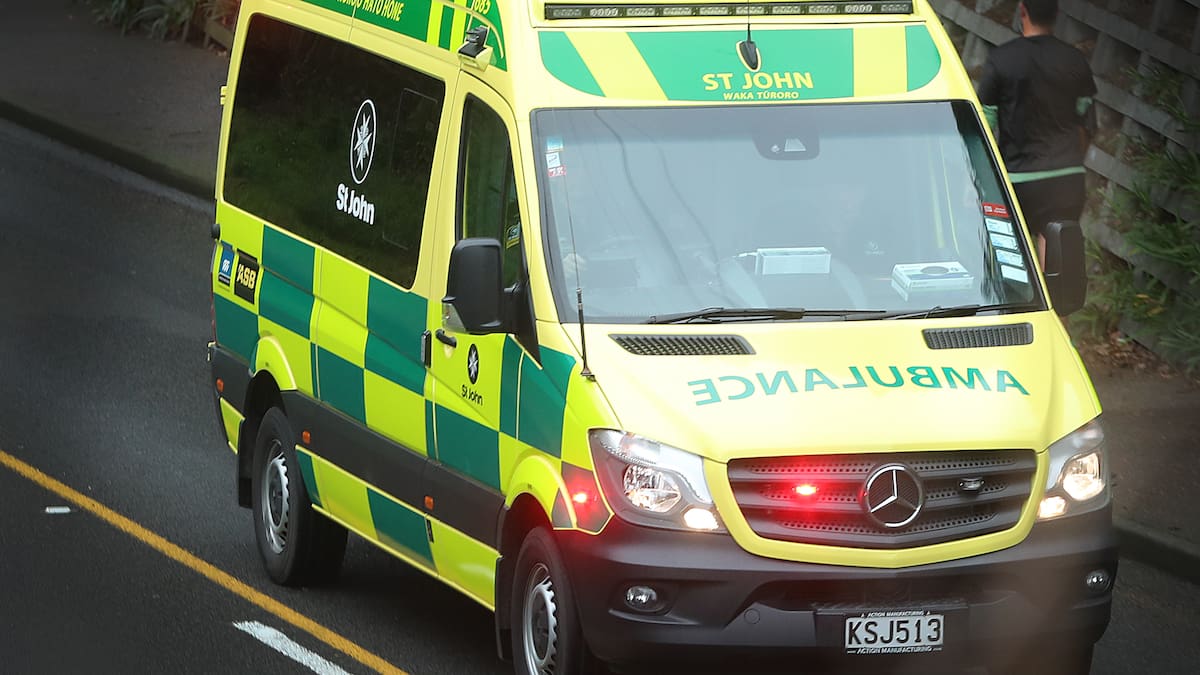
“Family members could be helping us, not threatening us.”
The officer has worked as a paramedic for more than 20 years, mainly in Auckland and Christchurch, and said she had experienced fewer than five threatening incidents across her entire career – until recently.
In the past 18 months in Northland, she and her partner had faced “five quite dicey situations” involving violence, threats or volatile behaviour usually fuelled by methamphetamine and alcohol.
Lockie, who oversees about 300 staff across the region, echoed the concerns.
“If my people are exposed to threats, violence, aggression, inappropriate behaviour, they are directed to leave. And if a patient dies on the floor because you’ve threatened one of my people, that’s on you, not my people.”
One recent incident the paramedic described happened while she and her partner were stopped at an intersection when a man approached their ambulance “in a threatening manner”, brandishing an object and trying to get inside.
“We were just like, ‘No, thank you. See you later,’” she said. “So I did an awesome six-point turn and took off.”
Other situations were harder to escape.
At a large gathering, the patient refused care but his associates threatened the crew when they went to leave.
“Everyone involved was high on meth, and backing out of the scene was pretty freaking difficult,” she said.
Another incident began as a routine medical job but turned out to be a violent domestic assault. Although the victim fled to safety, her alleged assailant suddenly claimed a medical problem.
“He was unpredictable, aggressive, threatening,” the paramedic said. “Every fibre of our being wanted to get out of there … but he had a medical complaint and we didn’t want to leave him.”
Eventually, his behaviour escalated to the point where the crew had to withdraw and return with police support.
The most serious case involved a critically unwell patient whose family threatened a critical‑care paramedic.
“They reportedly said: ‘I’m going to kill you or I’m going to ram you if you don’t move those vehicles.’
“That 100% risked the patient’s life,” the paramedic said.
The patient survived, but the officer described the situation as “bizarre” and frightening.
Another time, a gravely ill patient was also extremely violent. Bystanders were furious about the ambulance delay and “up in our faces”, the paramedic said.
Two police officers were needed to restrain the patient, adding further delay.
The paramedic said ambulance staff now relied heavily on police for their safety, although police presence often riled bystanders further.
Lockie said aggression towards staff was a nationwide problem, although particularly acute in rural regions like Northland.
Hato Hone St John Northland District Operations Manager Ben Lockie. Photo / Supplied
“We live in a rural and remote environment. It’s not a situation where an ambulance is just around the corner.
“There’s this expectation that we just appear – and that’s simply not the case.”
Lockie said violence was generally but not always linked to intoxication. Another major driver in Northland was grief.
“Some people process that with anger and rage, and will often take that out on ambulance staff,” he said.
Lockie said the toll on staff was severe, contributing to burnout, compassion fatigue and PTSD. Abuse and violence were also affecting retention and recruitment.
“Our people have started to normalise these behaviours as just part of the job.
“Verbal abuse, spitting, having things thrown at you – that’s become fairly normalised” – leading to under-reporting of incidents.
The paramedic said she had “never felt as unsafe as I do up here”, and that a newer colleague she worked with had already left.
“She loved the job, but she’s gone to do something safer,” the officer said.
Lockie said the service supports the Government’s June 2025 announcement that it would introduce new offences for assaulting first responders with intent and increase maximum prison sentences for violence against emergency workers.
“The public needs to understand we are here to help,” Lockie said.
“But my people will walk away if they are abused – and I will back them 100%.”
Sarah Curtis is a news reporter for the Northern Advocate, focusing on a wide range of issues. She has nearly 20 years’ experience in journalism, most of which she spent court reporting in Gisborne and on the East Coast.