

As New Year’s resolutions kick in, science has good news: the power of exercise doesn’t depend on how long you work out but on the biological signals it sends through your body. Even a short “flash” session can activate DNA repair mechanisms that make your system an immediate enemy of cancer.
What if protecting your health didn’t require hours at the gym? Many people start the year determined to move more, yet few know where to begin or how much time it really takes. According to a new study published in the International Journal of Cancer, your body responds to physical activity within minutes — triggering changes far deeper than most imagine.
Ten minutes that transform your body’s chemistry
In this study, researchers at Newcastle University examined 30 volunteers — men and women aged 50 to 78 — who were overweight but otherwise healthy.
After a short warm-up, participants cycled for about ten minutes at an intensity high enough to make them breathe hard. Blood samples taken before and immediately after exercise revealed something remarkable.
Out of 249 circulating proteins measured, 13 showed a sharp increase after the workout. Many of these proteins play roles in reducing inflammation, improving blood vessel function, and regulating energy metabolism.
“Exercise doesn’t just benefit healthy tissues,” explains Dr. Sam Orange, a senior lecturer in clinical exercise physiology. “It also sends powerful signals throughout the bloodstream.” Those signals seem to create an environment less favorable to cancer cell growth — and the effect appears almost instantly.
Among the most interesting molecules, interleukin-6 (IL-6) stood out for its part in DNA repair, a process essential to preventing cancer-causing mutations.
A direct hit against cancer cells
To test this effect further, researchers applied blood serum collected after exercise to colon cancer cells grown in the lab. The results were dramatic: the activity of more than 1,300 genes changed.
Genes involved in DNA repair and energy production became more active, while those linked to rapid, aggressive tumor growth slowed down. One crucial gene, known as PNKP, which helps repair damaged DNA, was especially stimulated. “Even a single session can make a difference,” says Dr. Orange, who also works at the Newcastle upon Tyne Hospitals NHS Foundation Trust.
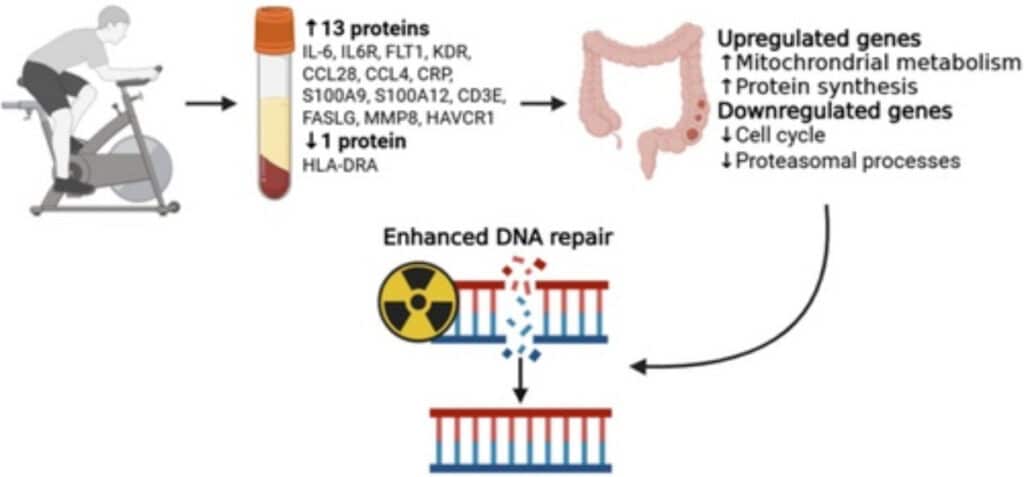
Physical exercise releases bioactive molecules into the bloodstream that can directly slow the growth of cancer cells. In the case of colon cancer, this mechanism could help limit disease progression. © Samuel T. Orange et al., 2025
A powerful tool for prevention and therapy
Colorectal cancer remains one of the most common types in both France and the U.K., with over 45,000 new cases every year. Studies estimate that regular exercise lowers the risk by about 20% — and this new research offers a clear biological explanation why.
The researchers emphasize that physical activity doesn’t have to mean intense gym sessions. Brisk walking, cycling to commute, gardening, climbing stairs, housework, or simply having an active job can all stimulate these beneficial processes.
Next, the team plans to investigate whether repeated short sessions produce lasting effects — and how they might enhance treatments like chemotherapy and radiotherapy. “These findings pave the way for new strategies that could imitate or amplify the effects of exercise,” concludes Dr. Orange.
So next time you’re tempted to skip a workout, remember — even ten minutes can set powerful changes in motion inside your body.

Christelle Cherrier
Web editor
Passionate about words and driven by curiosity, I traded my career as a market research analyst for the sharpened pen of a web writer. For five years, I’ve specialized in health and wellness, delivering clear and insightful content. I’m endlessly fascinated by everything human—from the workings of the body to the mysteries of the mind. My goal? Making complex topics accessible, informative, and engaging—no prescription required!