
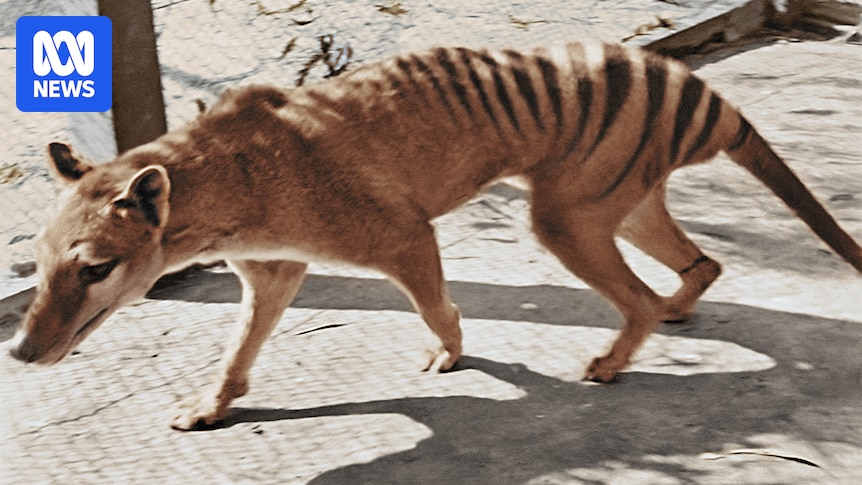
New evidence has emerged that Tasmanian tigers once roamed South Australia’s Eyre Peninsula.
Thylacines (Thylacinus cynocephalus) were marsupial carnivores, commonly known as “tigers” to Europeans because of the stripes on their backs. They became extinct on mainland Australia 2,000 years ago.
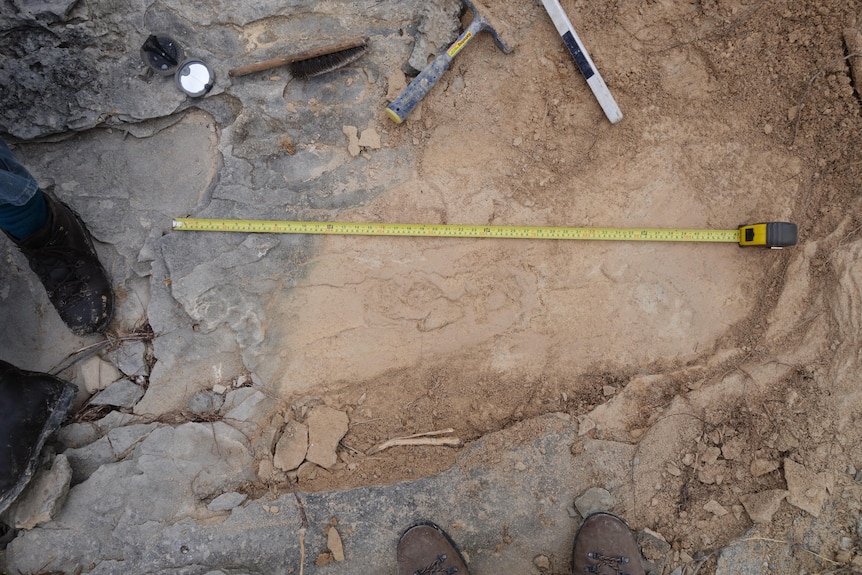
Thylacine prints were found in the Coffin Bay area. (Supplied: Aaron Camens)
By the time Europeans arrived in Australia, the thylacine population was limited to about 5,000 in Tasmania.
By September 7, 1936, the last of the species had died.
Pancake stacks
The preserved footprints on Eyre Peninsula tell a tale of a different Australian landscape.
A team from Flinders University, led by palaeontology lecturer Aaron Camens, investigated the series of ancient footprints along the coastline near Coffin Bay and Lincoln National Park at the beginning of this month.

Flinders University palaeontology lecturer Aaron Camens. (Supplied: Aaron Camens)
The team looked at the Bridgewater Formation across South Australia, which features calcareous coastal dune ridges from the Pleistocene era that hold layers of history and fossils.
“Wherever you see them on the coast, they can look kind of like a pancake stack, lots of individually layered sediments, and these sediments actually have fossil footprints occurring in them right across the south coast of Australia, and we were looking for those in Eyre Peninsula,” Dr Camens said.
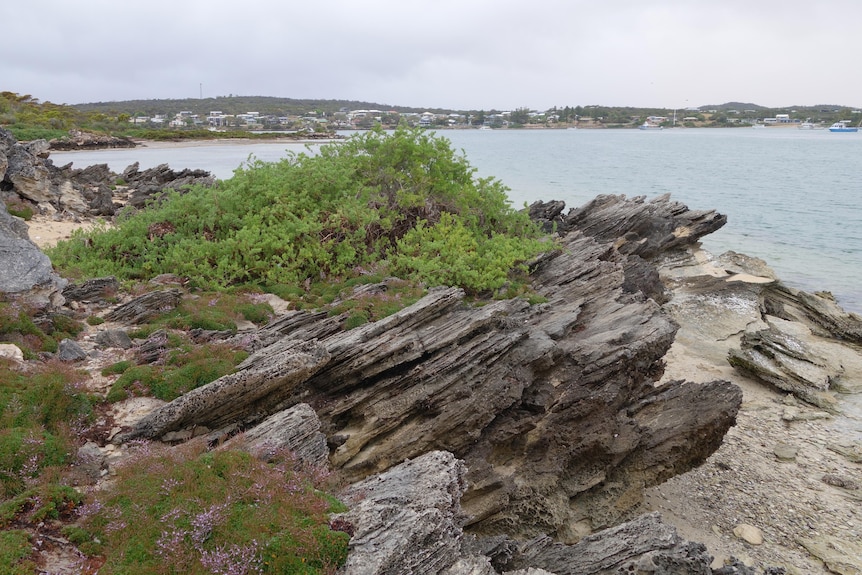
This outcrop near Coffin Bay is protected from the open sea, making it ideal for fossil preservation. (Supplied: Aaron Camens)
The researcher said the fossils were formed when a combination of sea spray settled on footprints in the sand, and then dried out, forming a salt crust which was then quickly buried by the wind blowing sand.
“There’s a huge range of animals represented [in the Bridgewater Formation],” Dr Camens said.
“We do have elements of the megafauna; there are extinct kangaroos.
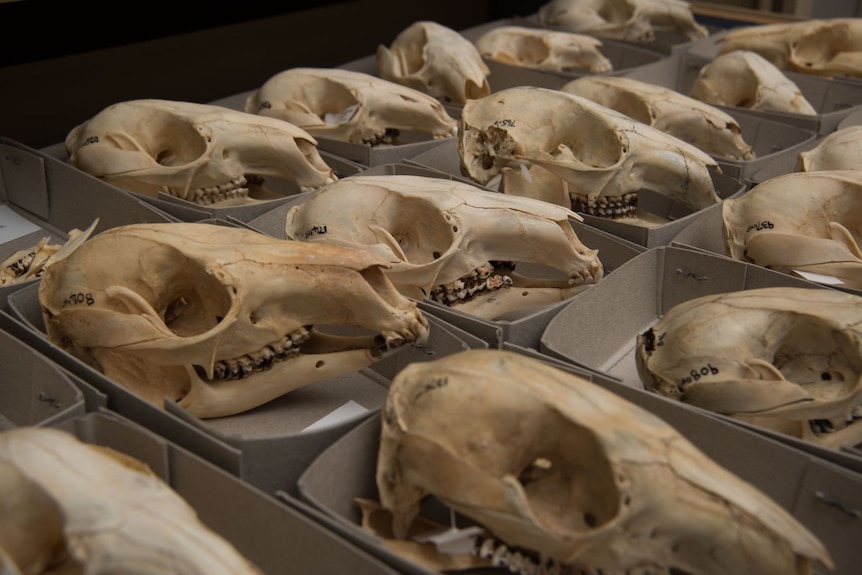
Kangaroo megafauna skulls. (Supplied: Merinda Campbell/Museum and Art Gallery of the NT)
“We rarely find animals like thylacoleo (marsupial lion), sometimes some big relatives of the giant herbivore Diprotodon, but we also find some of the smaller animals, so things like Tasmanian devils and thylacines.
“We even get smaller animals all the way down to things like birds, like oystercatchers.”
Fossils destroyed
“We do actually see them being regularly eroded, so especially if they’re right on the coast and there’s a big swell hitting it all the time,” Dr Camens said.
“We might see that the footprints might be exposed for only a few years and then they’re destroyed, but then new ones are exposed as well.
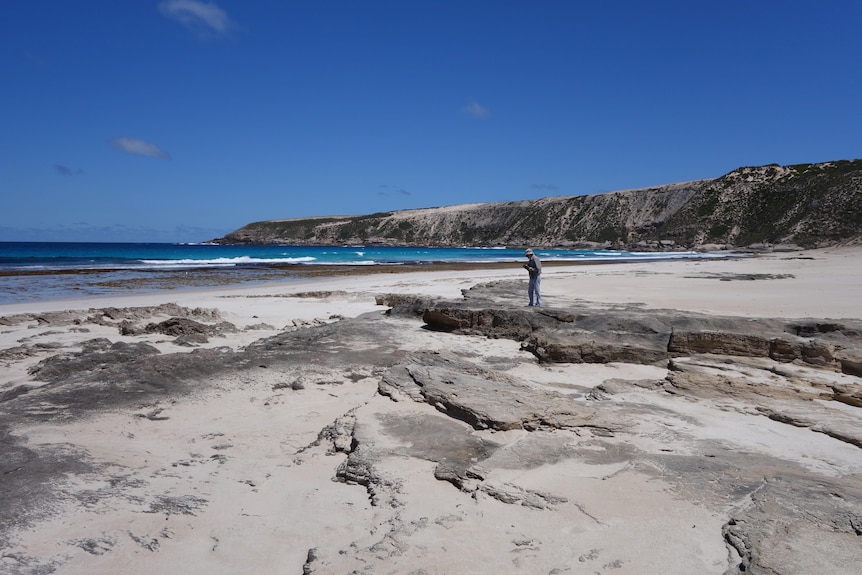
Researcher John Sherwood, pictured at Jussieu Bay in Lincoln National Park, along the Bridgewater Formation where fossils can be discovered. (Supplied: Aaron Camens)
“We’ve got some footprints near Coffin Bay that are in an area that isn’t seeing lots of erosion, so they can basically be seen; there’s not much changing.
“There are other areas, like on the south coast of Lincoln National Park, where there’s a big swell hitting them and the environment’s changing all the time.
“Quite often they’re in hard-to-get-to places.
“The best areas that we find these in are actually areas that are being smashed by the waves, so they could be cliffs 20 metres high, so they can be a bit unstable, so they’re not necessarily in the safest place to look at.”
Retired national parks ranger Ross Allen said he had been aware of fossil sites on Eyre Peninsula for about 20 to 30 years and had shared that knowledge with the university researchers.
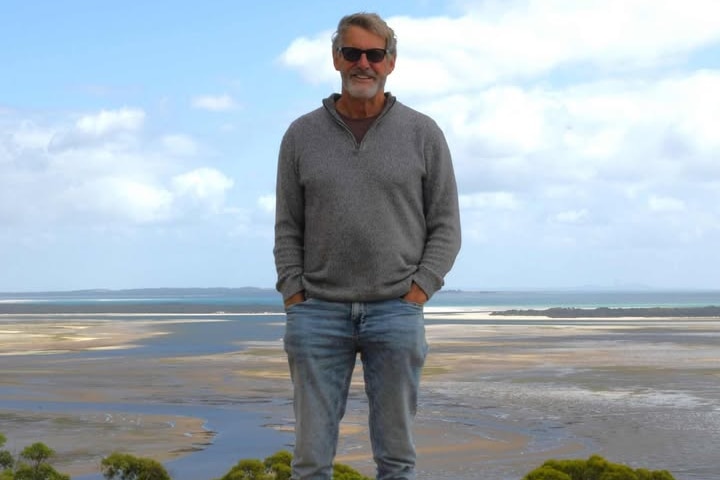
Port Lincoln’s Ross Allen joined the palaeontologists and researchers who documented footprints of a Tasmanian tiger on Eyre Peninsula. (Supplied: Ross Allen)
“If you get to the right location at the right time, you can sometimes [find] hard layers of sandstone that have impressions from over 100,000 years ago,” Mr Allen said.
“So much can be learnt from those sorts of fossil remains in South Australia, particularly on Eyre Peninsula, from way back in time when all sorts of animals roamed around that no longer exist.”
He said the prints were tricky to find unless you knew what you were looking for.
“They’ve been eroded over time, and so they’re not distinct.
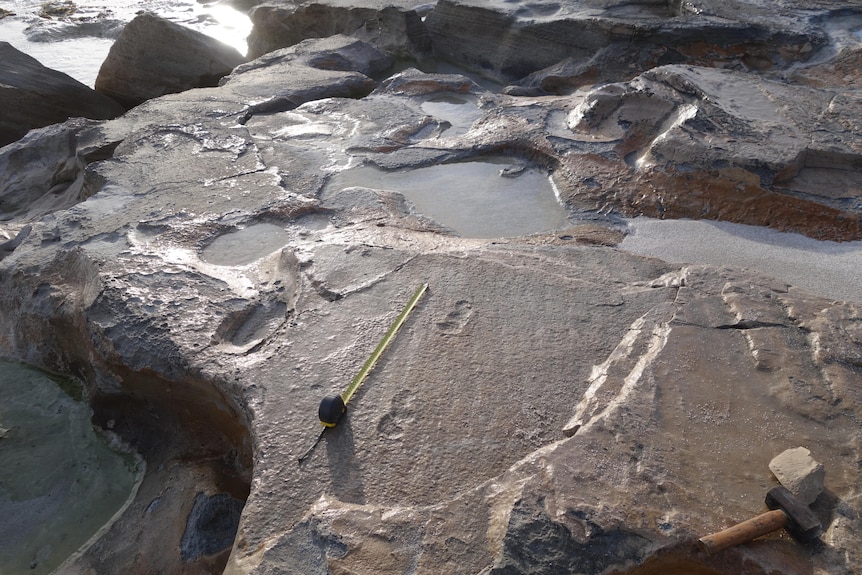
Researchers think these might be footprints from a Thylacoleo (marsupial lion), found in the South Australian west coast. (Supplied: Aaron Camens)
“For thylacine prints, they’re just a circular impression that is obviously, once you know what you’re looking at, made by a dog species, and there were no dingoes back over 100,000 years ago, so the only animal that existed back then that could have made it is a thylacine.”
Dr Camens said sometimes the key to identifying a species was to find a repeating pattern.
“You might not see something that you can clearly say, ‘Oh, yeah, that looks like a thylacine print, or that looks like a kangaroo print,'” Dr Camens said.
“But if you see a repeating pattern, with the same shapes and the same spacing between them, then that means you’re probably looking at a trackway.
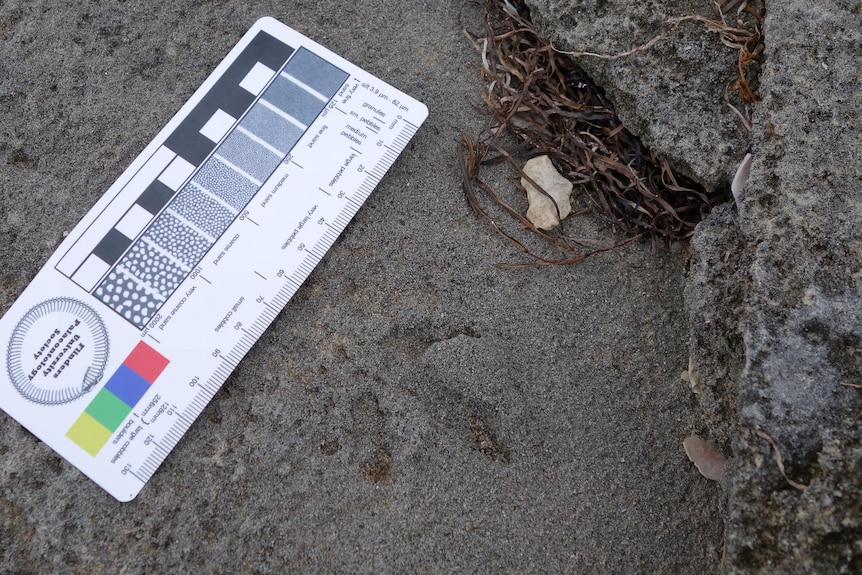
The researchers found fossils of oystercatchers, a small coastal bird. (Supplied: Aaron Camens)
“Most of the footprints we’re looking at are around about 110,000 to 130,000 years old.”
Mr Allen said the fossil discoveries were an opportunity for people to appreciate the natural features of the coast and to look after them.
“Our wildlife is under threat constantly from, you know, impacts, human impacts, particularly on habitat and clearing vegetation, so people need to be aware that they can play a big part in looking after the future welfare of important wildlife,” Mr Allen said.
The Australian Museum reports fossilised remains of thylacines have been found in Papua New Guinea as well as throughout the Australian mainland and Tasmania.