
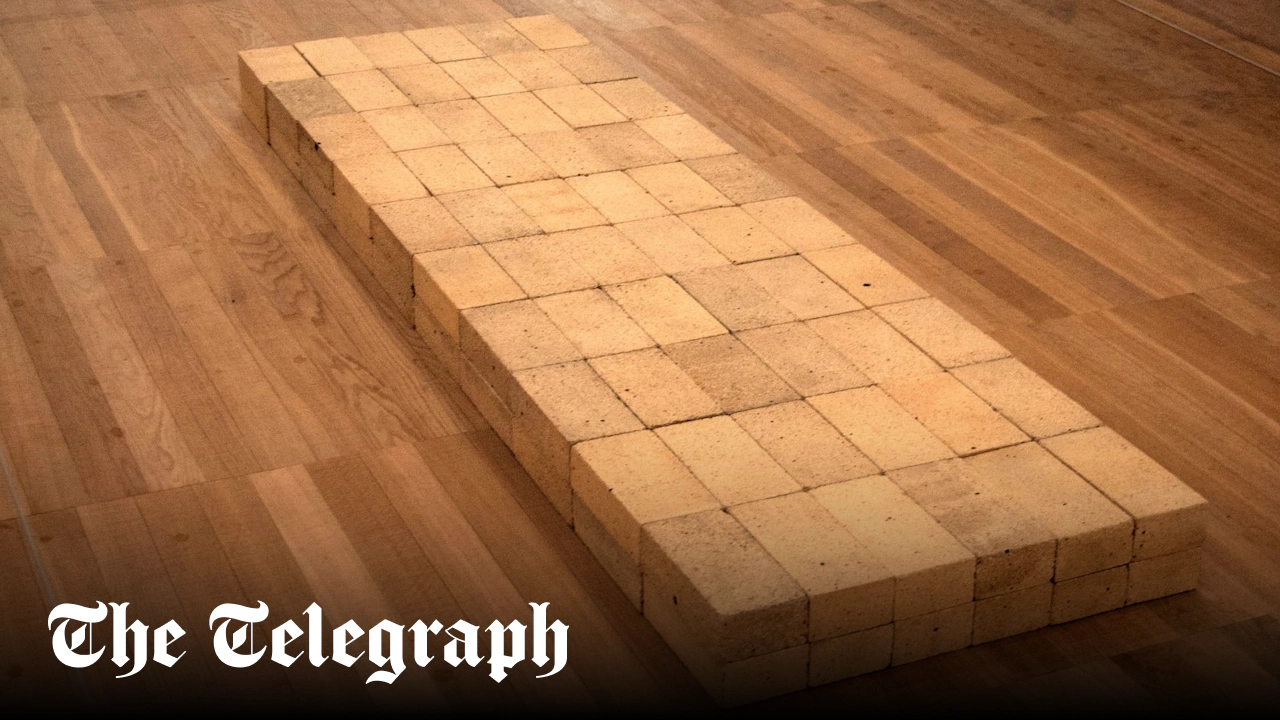
Within weeks of the sculpture going on display, Peter Stowell-Phillips, a chef and amateur artist from Clapham, south London, expressed his displeasure at what he saw as both a poor piece of art and a waste of taxpayer’s money by donning a three-piece pinstripe suit to throw blue food dye over them, to – he claimed – bystanders’ applause. “I most definitely do not regret doing it,” he told the BBC for its 2016 documentary Bricks. The Tate did not press charges but banned Stowell-Phillips for life. “People weren’t used to vegan types and pro-Palestinians throwing things at paintings then, so it was very shocking,” Comfort recalls.
The bricks were removed for cleaning and Reid resolved to keep them off display for a period, saying: “I was hoping people would begin to understand a little what it was about, but it will take longer than a few days.” Staff were outwardly loyal, yet some muttered that the acquisition had been ill thought-through. After all, as its name suggested, Equivalent VIII was only one in Andre’s Equivalent series of eight sculptures of brick stacked two deep in rectangular piles, shaped differently but each containing 120 bricks – hence “equivalent”.
“I think my curator and colleagues misunderstood what they were buying. They thought the bricks had aesthetic value when in fact it was a very American, very boring, abstract mathematical thing showing the physical manifestation of 120, which is considered a special number because its factors are one, two, three, four, five, six… But that idea was completely lost because they only bought one set,” says Cumming.
Reid was shaken by the outcry. Sandy Nairne, later director of the National Portrait Gallery, then working as a Tate researcher, recalls that for a long while after the bricks scandal, “horns were drawn in and there were many fewer contemporary acquisitions of a more ambitious nature for a long time”.
The bricks sparked endless mockery – but also creativity. Gregor Muir, the Tate’s current director of collection, then a schoolboy, recalls watching BBC’s current affairs programme Nationwide as a child and seeing “a huge outpouring of public ideas about what the Tate could buy from them”. He says: “I distinctly remember someone sending in a Polaroid of a coffee cup in a saucer balancing on the corner of a filing cabinet, saying it was available for sale. It was a sort of community art project that galvanised a response and got the public very much involved, and it left a mark on me.”
Decades later, in a London taxi heading to meet Andre for dinner, Muir asked the cabbie if he had heard of him. “I was expecting a typical cabbie’s response, but he said: ‘That work was quite mathematical.’ He seemed to know more about it than me.”
As events unfolded, the hirsute Andre, the son of a marine draughtsman from Massachusetts – who said the bricks’ inspiration came after a canoeing trip made him want to create sculpture that was flat like water – remained in New York. He declined an interview with BBC News, reasoning that “the temptation to make a fool of myself would have been enormous”. Later, he compiled a selection of press cuttings on the affair, placing each in its own ruled oblong box. “I think he, like everyone, was rather amazed by the sheer scale of the outrage,” recalls Morphet.