
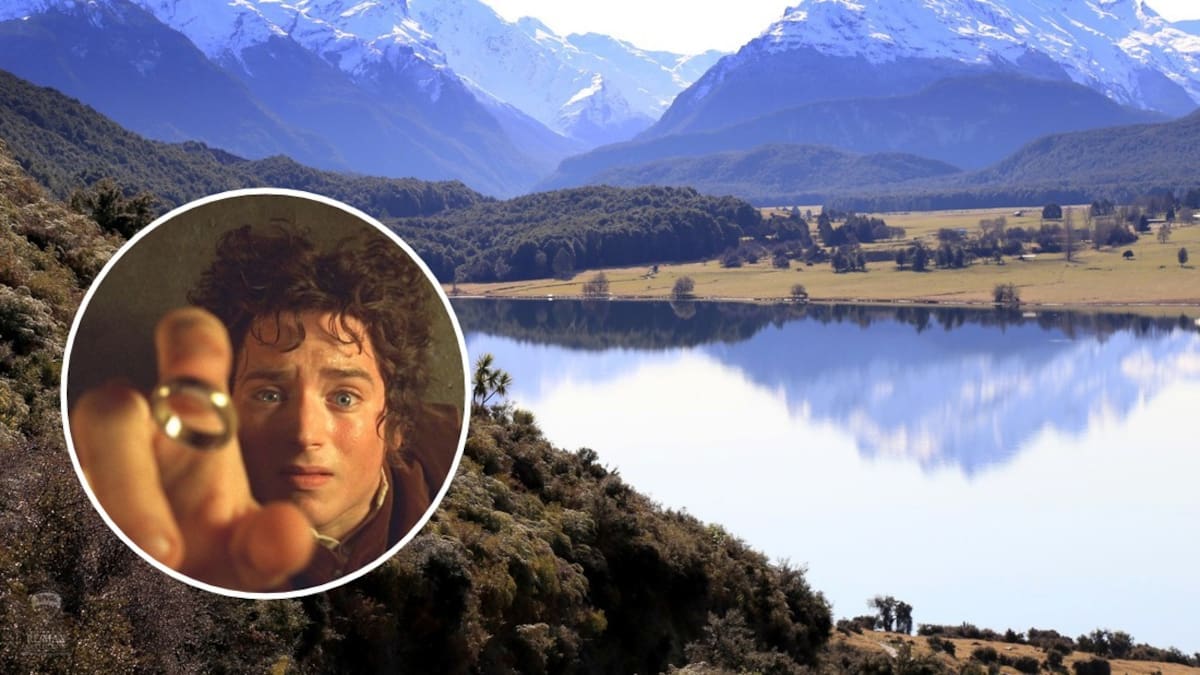
“We have decided to support filming and tourism.”
Arcadia Station, on the shores of Diamond Lake near Glenorchy, was used as a location for Sir Peter Jackson’s The Hobbit: The Desolation of Smaug. Photo: Nick Gregory / RE/MAX Queenstown
The shift brings an abrupt end to the station’s long-running pastoral operation, with hundreds of Simmental cattle and more than 1800 Perendale sheep dispersed. The stock lines were built up over decades and, in some cases, generations.
The entire herd was sold at dispersal, stock agent Kevin Smith told the Herald, with all cattle and sheep cleared.
For former owner Jim Veint, whose family bought the property in 1951, the sale represents the end of an era.
“I’ve seen my cattle, sheep and horses developed over a lifetime.
“Those bloodlines don’t just come back once they’re gone.”
Edney said removing livestock was about practicality as much as strategy.
Film crews required certainty – controlled landscapes, predictable conditions, and minimal disruption – something that was difficult to guarantee on a working farm.
“The reality is that, when a film crew comes in, they need consistency.
“They need control over the environment, and that’s difficult to achieve with active farming.”
Ian McKellen, who played Gandalf, once described the station as “heaven on Earth”. Image / File
He said the decision also reflected where the property’s long-term value lay.
“It’s about using the land in a way that makes the most sense economically. Film and tourism are where the value is for this property.”
Set across 257 hectares on the edge of the Dart River and bordered by Diamond Lake and Mt Aspiring National Park, Arcadia has long straddled two identities: a working high-country station and a globally recognised film location.
In recent years, Edney said, the balance had tipped decisively towards the latter.
The property includes a stately homestead built in 1905, with 11 bedrooms, a four-bedroom shepherd’s cottage, a four-stand woolshed, two large hay sheds, and sheep and cattle yards.
It also has significant development consents attached, including 11 consented residential sections and four consented lifestyle sections, with approximately 21 hectares zoned for rural visitor accommodation and tourism development.
The station features about 1.4km of frontage to Diamond Lake and roughly 1km along the Dart River.
Owner Tim Edney confirmed all livestock were sold at auction on March 31, a move he said was necessary to meet the demands of operating a high-use filming location. Photo / Peter de Graaf
Gandalf actor Sir Ian McKellen once described the farm as his favourite place on earth.
Publicity around the 2020 sale, when Edney bought it from Veint, indicated the property was being marketed in the $15 million-$20m range.
Edney said filming activity remained ongoing at the station, but declined to comment on specific productions.
When asked about potential links to recently announced Lord of the Rings film productions, Edney said he was under a confidentiality agreement.
Veint began working on Arcadia as a teenager and went on to develop a large-scale breeding operation across cattle, sheep and horses.
He said the farm’s livestock represented decades of selective breeding and careful management.
The property includes a stately 1905-built homestead with 11 bedrooms, a four-bedroom shepherd’s cottage, a four-stand woolshed, two large hay sheds, and sheep and cattle yards. Photo / File
The removal of the livestock represented a major shift in the property’s identity.
“It was always a working station. That’s what it was built on.”
He said farming helped to maintain the landscape that later attracted film productions and visitors.
“The animals were part of the scenery. They helped shape the place as people know it.”
Arcadia Station and the surrounding Paradise area have long been used as film locations, hosting a range of domestic and international productions.
Edney said its appeal was largely its alpine backdrop, open grasslands and relative accessibility compared to more remote conservation land – and that the station’s film credentials were central to its future.
“It’s already an established filming location. We’re building on that.”
Veint was concerned about the long-term implications of removing livestock, particularly in relation to land management and the preservation of the station’s character.
“There are practical aspects to having stock on the land.
“They help with weed control and maintaining pasture.”
The station is one of New Zealand’s best-known movie locations. Photo / File
He also said he would have preferred to see farming continue alongside filming.
“It doesn’t have to be one or the other. The two can work together if managed properly.”
Edney, however, said the shift reflected a clear strategic direction.
“You can’t run a working farm and a high-volume filming operation at the same time without compromise … This approach avoids that conflict.”
Tourism and screen production in the Queenstown Lakes region have been increasingly important economic drivers, with the region’s commitment to the industry ramping up in recent years.
Last year, actor Brad Pitt was spotted filming a project in Glenorchy, while British actor Tom Hiddleston was also known to be working in the area.
Brad Pitt was spotted filming in Queenstown last year. Photo / George Heard
Meanwhile, a sprawling Hollywood-style film studio, the Ayrburn Screen Hub, is planned for a 26-hectare site near Speargrass Flat between Arrowtown and Lake Hayes. The project is being considered under the Government’s fast-track approval process.
A Glenorchy local and film technician, who did not want to be named, was saddened by the Arcadia move.
“Paradise translates to a place of supreme bliss, beauty and happiness; an idyllic environment free from worry, which currently couldn’t be further from the truth.
“I remember driving through the land 20 years ago, thinking these must be some of the luckiest animals on the planet.”
Edney said Arcadia would continue to evolve as it adapted to demand from film crews and visitors.
“The intention is to keep the landscape open and suitable for filming.
“That means managing it differently than a traditional farm.”
Veint, meanwhile, said the change marked the end of an era.
“It’s been a big part of my life and my family’s life.
“Seeing it move away from farming is hard to accept, but that’s the way it’s gone.”
Ben Tomsett is a multimedia journalist based in Dunedin. He joined the Herald in 2023.