
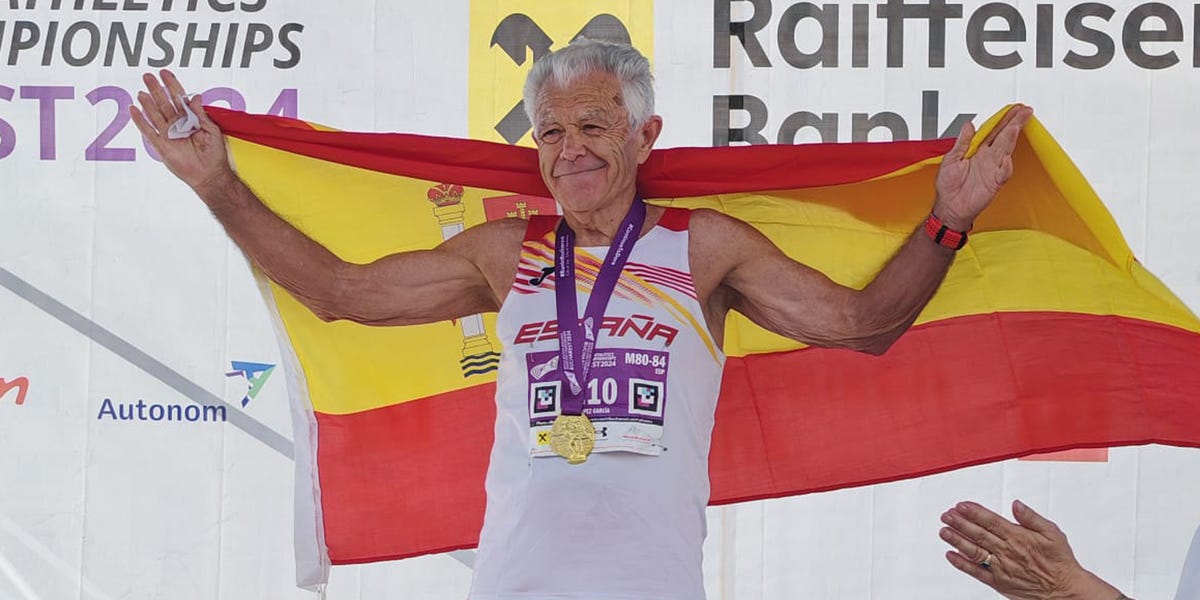
You’ve probably got an excuse or two tucked in your back pocket for when you really, really, want to skip that run. Sadly, “feeling old” can no longer be one of them.
In May 2025, Juan López García completed a 50-kilometer race in 4 hours, 47 minutes, and 39 seconds at the Spanish Master Championship in Malaga, turning a decade-long world record in the 80+ age category to dust, besting it by nearly 49 minutes. And naturally, that made a few scientists sit up and take notice.
A team of Italian and Spanish scientists invited García into their lab for a battery of tests to figure out exactly what’s going on in his body, and to see if the rest of us mere mortals may be able to replicate his success. What they found, published in January 2026 in the journal Frontiers in Physiology, is the kind of data that will make you reconsider your relationship with the snooze button.
The thing that makes the biggest difference in García’s running ability is his VO2 max—the running topic du jour, which is a measure of how efficiently the body delivers and uses oxygen during hard effort. It’s also one of the best predictors of both endurance performance and long-term health. García’s clocked in at 52.8 milliliters per kilogram per minute, or more than double the average of an untrained man his age (which usually falls between 18 and 25). By comparison, his number ranked in the top 30 percent of healthy men aged 20 to 30, and it’s the highest known VO2 max ever recorded in a person over 80.
Related Story
Better yet, his lactate threshold (the point where your body starts accumulating fatigue-causing acids faster than it can clear them) occurred at 91 percent of his maximum effort, meaning he can sustain that brutal pace that makes the rest of us stop for a break for a very long time. Moreover, the team found, he’s also an exceptional fat-burner, still efficiently oxidizing fat at 77 percent of his maximum effort.
Interestingly, García’s heart was good, but not so good that it made a meaningful difference. The researchers found that his cardiac output was lower than younger elite masters athletes, partially offset by a high hemoglobin concentration (the stuff that helps ferry more oxygen to muscles). So really, where García genuinely defies expectation is at the cellular level, and the way his muscles absorb and use oxygen at rates that exceed people even in the Gen Z set. And that, the researchers added, led to his mitochondria appearing to be remarkably well-preserved.
“His muscle oxidative capacity actually exceeded values typically seen in young endurance-trained athletes,” Simone Porcelli, MD, PhD, associate professor in human physiology at the University of Pavia, and lead author of the study, shared with Runner’s World via email. “It suggests that consistent running, maintained over years, can preserve—and even enhance—the health and metabolic function of muscle tissue in ways that go well beyond what aging would otherwise predict. The mitochondria appear to respond to training stimulus at any age.”
Now here’s the fun part for everyone reading this: García isn’t some lifelong athlete who has a leg up on you from his high school track days. As García shared with the researchers, he ran casually in his twenties, then stopped for decades before lacing up for his first run at 66, and his first competition at 70.
This, Porcelli said, “tells us that the capacity for meaningful physiological adaptation to endurance training does not simply switch off with age. The window for improvement appears to remain open far later in life than most people assume.”
For his actual training, García follows a structured, but not punishing, routine. He ran between 65 and 120 kilometers per week, depending on the time of year, peaking at six to seven sessions weekly ahead of major races, covering more than 3,500 kilometers annually, the study explained. The bulk of his work was done at a comfortable, conversational pace, with a bit of interval training added in as he prepped for runs, progressing from short 200-meter repeats up to efforts of 8 kilometers.
Related Stories
“Consistency and patience matter more than heroic single efforts,” Porcelli said. “The message for recreational runners is clear—build a large aerobic base at moderate intensity, respect structured periodization, and let the adaptation come to you.”
Porcelli also mentioned that this athlete isn’t the only remarkable older runner his team is studying. The research is part of a broader longitudinal project called “Trajector-age,” tracking the physiological trajectories of exceptional older athletes.
Of course, Porcelli and the team flagged that this is just a single case report and that García’s genetics likely play a role. But the broader message is this: It’s never too late, and you’re never too old to try.
“As for whether we have personally applied any of his lessons, I will confess that seeing his data has made me look rather differently at my own training,” Porcelli said. “Seriously, though, the principle of building a large aerobic base at moderate intensity, which underpins his approach, is something the exercise science community has long recommended and which we would both encourage in our own practice.”

Stacey Leasca is an award-winning journalist with two decades of newsroom experience. Her photos, videos, and words have appeared in National Geographic, Travel + Leisure, Time, Los Angeles Times, Food & Wine, Glamour, Men’s Health, Afar, and many more. Stacey also served as an adjunct professor of journalism at the University of Southern California teaching feature writing and visual journalism. She is also a Ph.D. Candidate with a specialty in building resiliency to misinformation.