
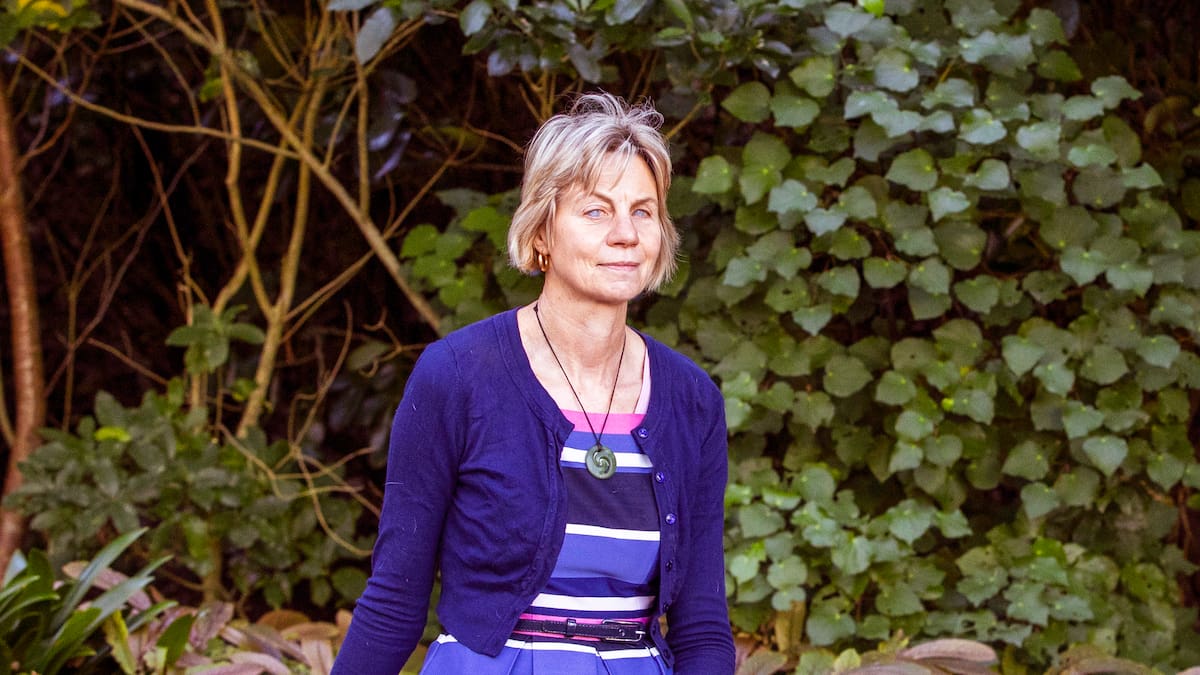
Even so, Maria never imagined she would go on to become a world-class athlete, representing New Zealand in the para-triathlon and marathon.
“It was really by chance I got into marathoning,” laughs Maria, who was born with congenital glaucoma and, as a child, would do anything to avoid sport.
Maria never imagined she would go on to become a world-class athlete. Photo / Hagen Hopkins
“A colleague at the time, Christine Adamson, said, ‘You’ve got the right build, you could be a good runner.’ I thought she’d forget, but she kept asking me about it, so I decided, ‘I’ll have to show her that I’m not a good runner.’”
Maria discovered she was a natural and also that she loved it, and soon she was running half-marathons.
“It’s very freeing to be out moving on the streets and trails,” smiles Maria, who runs tethered to a guide for safety.
Next, Maria was introduced to two-time world mountain running champion Melissa Moon, who quickly became her guide, friend and mentor.
“Melissa said, ‘I think you have what it takes to do a full marathon,’ and it seemed like an amazing goal to be able to run 42km.”
Maria finishing the swim in Taranaki with Melissa. Photo / Lisa Burd
The pair trained together intensively and, in 2015, they qualified to run the full marathon at the Para-athletic World Championships in London.
It was an incredible feeling to be competing on the world stage, but the high was short-lived. Maria returned to New Zealand with persistent pain, and was eventually diagnosed with stress fractures in her femur and foot.
“It took a really long time to recover and build myself back up, but I knew I would do it,” she says.
That determination inspired her to take on a new challenge – the para-sprint triathlon, which consists of a 750m swim, a 20km bike ride and a 5km run.
“It was fun to try a whole different learning curve,” smiles Maria, who is tethered to a guide during the swim and run, and rides a tandem bike.
Melissa and Maria biking. Photo / NZ Woman’s Weekly
“The swim is my hardest challenge. You never know if the sea is going to be colder or rougher than expected, but I just have to get through it without panicking, keep calm and push on.”
Maria and Melissa have competed together in New Zealand, Canada, Japan and Australia. In 2023, she placed second at the World Para-triathlon Series in Devonport, Tasmania.
But in recent years, self-funding international competitions, often with only 30 days’ notice, started to take a toll. So now Maria focuses on events closer to home.
She runs up to 16km twice a week with a friend, Kim Norton, and swims in the Wellington Harbour with another friend, Karen Jenkinson, up to four times a week.
Maria with her trusted guide dog Ava. Photo / Hagen Hopkins
“I’m so lucky to have all these women around me helping me do these crazy things,” tells Maria.
She also works full-time for the Wellington Regional Council, walking to and from work daily with her trusted guide dog Ava.
“She’s always with me and is a constant companion – Ava enables me to be more independent and confident,” enthuses Maria, who rarely turns down the chance to try something new.
“As I’ve got older, I’ve learned to just give things a go. I haven’t planned a lot of what I’ve done, but when opportunity knocks, I open the door and say yes.
“People have sometimes said, ‘I feel sorry for you’ because I can’t see, but I don’t think I’m disadvantaged at all.”
In fact, Maria’s life is so full, she wouldn’t change a thing.
“If I were offered to have my vision restored, I don’t even know if I would accept because I have just adapted to the way I am.”
International Guide Dog Day is on April 29. To find out more or donate, visit blindlowvision.org.nz