
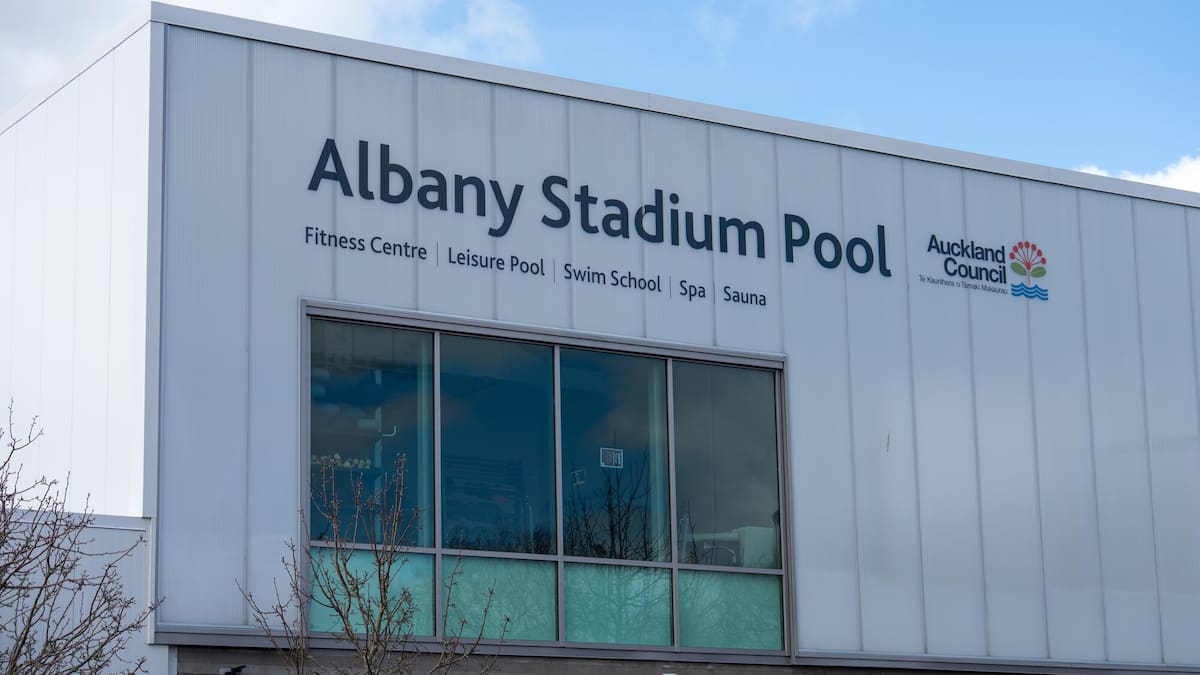
The woman who complained to pool staff about the incident did not wish to discuss the specific details of the alleged offending while it was still proceeding through the courts.
The mixed-gender changing room has individual cubicles that swimmers use to get changed. Photo / Annaleise Shortland
When the Weekend Herald visited the Albany Stadium Pool this week, there were still areas above and below cubicles, where it remains possible to peek under or film other swimmers by holding a phone or device through the gap. It was also possible to stand on a bench in one of the cubicles and look down into another.
There were no floor-length partitions in place in any of the cubicles viewed. The Weekend Herald understands temporary partitions had been trialled in a few of the cubicles. A sign saying the use of cameras was prohibited greeted swimmers upon entering the changing room.
The woman involved in the incident said pool staff were empathetic and helpful at the time, but she believed there needed to be separate changing rooms for men and women to prevent something similar occurring.
“Everyone who I shared this story with were, firstly, annoyed with the fitting room situation, it’s so unnecessary,” the woman said.
“I support having a gender-neutral changing room but there should be options for single-sex changing rooms. There needs to be more safety, I mean there are children getting changed in there.”
Maintaining a safe space for all genders and non-binary people was important, she told the Weekend Herald, but this could be in addition to separate spaces for men and women at the facilities.
“There needs to be more safety, I mean there are children getting changed in there.” Photo / Annaleise Shortland
At the time of the incident, she felt vulnerable and disgusted, and she said it has continued to impact her by making her feel hyper-aware when getting changed and using pool facilities. She has since started swimming elsewhere and reduced the number of days she was visiting the pool.
Auckland Council’s Upper Harbour Local Board member Uzra Casuri Balouch has been advocating for changes at the Albany facility and said secret filming was sickening and a gross invasion of privacy.
She believed it wasn’t a widespread issue at the Albany facility and that other members of the community should feel safe to continue swimming there.
What was disappointing about the behaviour, in her opinion, was that the pool had always had a “happy, family-friendly” vibe with many people enjoying the communal facilities.
The individual cubicles allowing families to change together were beneficial for people with disabilities or young children who needed assistance, she said. The pool also had a purpose-built accessibility changing room with specialised equipment for wheelchair users.
“It’s very popular, busy and a well-loved pool. We get people from across Auckland visiting,” she said.
“We have had no issues of this nature, but even one incident of this kind is too many and I will ensure that the privacy of our community is not compromised by the actions of one person.”
People travel across Auckland to use the pool and facilities in Albany. Photo / Annaleise Shortland
Casuri Balouch sought confirmation from the council that the partitions would be changed as soon as possible to prevent filming from above and below and requested further signage be installed by pool staff.
She said pool staff were working on designing and installing customised partitions but they had to adhere to fire safety requirements.
Separate gendered changing rooms were something she would investigate further if the Albany community wished, but she said that could require further council investment and a shutdown period for renovations.
However, the woman at the centre of the incident believes there are ways the pool changing room could be redesigned without serious renovation to provide some separation for male and female swimmers.
Another council-owned pool facility, the Olympic Pools & Fitness Centre in Newmarket, was also targeted for secret filming.
Earlier this year, Remuera accountant Chong Yew Khoo admitted to unlawfully filming almost 400 males over six years at the pool. He captured footage of the men naked or partially naked while changing, with Khoo secretly filming their genitals.
The offending in this case took place within an all-male changing room and Casuri Balouch said this showed the traditional changing room model could also be exploited for malicious purposes.
As technology advances, it is becoming increasingly difficult for authorities to stop covert filming.
The Weekend Herald earlier reported on a sharp rise in covert filming cases and new technology such as Meta Glasses, with police struggling to identify the often hundreds of victims in these cases.
New Zealand’s Privacy Commissioner Michael Webster said this week there needed to be clear expectations set around the use of smart glasses.
He told Newstalk ZB that New Zealand needed to look at its legal framework to strike a balance between its benefits and the harmful consequences.
Across the Tasman, the Australian Attorney-General has said the Government has no plans to ban smart glasses imports. The Australian Government has drafted privacy reforms, which include a “right to erasure” from large social media platforms and search engines.
Leading New Zealand criminal lawyer Sam Wimsett, KC, told the Weekend Herald that deciding if filming someone is unlawful depends on whether that person had a reasonable expectation of privacy.
“That means someone filming you with their new Meta glasses on Queen St isn’t committing a crime. It’s similar to influencers vlogging or news reporters filming in public and catching people walking behind them.”
Wimsett said things change when the filming occurs in an intimate setting. A setting is “intimate” where a person is somewhere they’d reasonably expect privacy, and they’re naked, engaged in sexual activity, showering, using the toilet, undressing, being filmed up their skirt, or similar.
In its LGOIMA response, Auckland Council said it had a range of measures in place across its pools and leisure network to help protect individuals’ privacy, which included staff presence and monitoring within facilities.
The council also had the power to issue trespass notices to visitors to facilities, typically for two years, which could apply to a single facility or multiple facilities within the network.
A man was charged last month for filming a woman at a North Shore pool, but he denies the charge and is due to stand trial next year.
When asked about what people should be looking for if they have concerns about secret filming, the police provided a short list:
An object oddly aimed at private areas.Small holes in walls or ceilings with electronic equipment nearby.A device that appears modified or tampered with.
Sign up to The Daily H, a free newsletter curated by our editors and delivered straight to your inbox every weekday.