
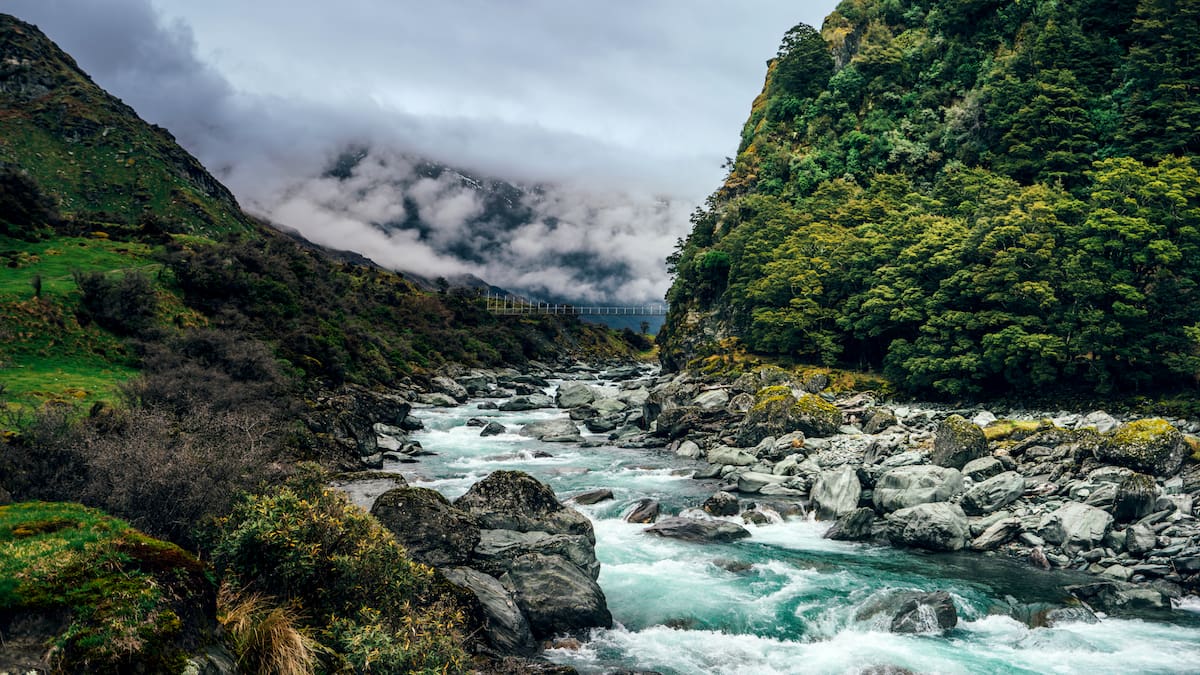
In the winter of 2004, two friends and I went walking in Lees Valley, an area of rugged and gloomy foothills northwest of Christchurch. We were students, occasional trampers only, a pastime we’d begun a year or two earlier.
We walked under a dull sky, all the while
trying to make each other laugh – our usual way when in the wilderness. The specifics of this conversation have mostly escaped my memory, but I do recall us talking about what age we thought we’d live to. Someone joked he’d be made immortal by having his consciousness downloaded. It would fit on just a single floppy disc, we said. Maybe half a cassette tape.
In this way, we carried on up and up, until we emerged from the trees to arrive at a saddle thick with snow. Our feet sank into it. The surface was icy. But still we tried to head up, struggling on while getting colder. My hands ached. We got nowhere. Finally, we stopped to devour a bag of potato chips and to make the decision to turn back and head for a hut we’d seen on the map.
We walked for hours more. It got dark and we were still walking, still far from that hut when we decided to give up on that plan, too. Instead, we rolled our sleeping bags out over a muddy patch of earth beneath the trees. We pulled plastic pack liners over them, climbed in and huddled together, readying ourselves for the night.
Our tramping gear was a collection of cast offs, all of it second-hand and scrounged. My sleeping bag was from Kmart, designed for sleepovers and summer nights, with only a thin layer of polyester fill between me and the cold. All around us the trees dripped and creaked. I slept for maybe two hours, the rest of the night clenching my teeth and shivering until the sun came up and we were able to walk out, back to our car.
We drove to a nearby pub and silently drank a jug of lukewarm Coca-Cola, craving sweetness. We were shaken, tenderised. Something we’d always felt but not voiced had been made acute ‒ the knowledge that the bush was impassive, completely unconcerned about us and our safety.
What would have happened if we hadn’t turned back, if we hadn’t stopped when we did? These were questions best forgotten, and that evening we did the thing least like tramping we could think of: we went to the movies. We sat in the comfort of an air-conditioned cinema with the biggest tubs of popcorn they sold. But halfway through the film, something terrible happened. One of the characters wandered into a dark forest. Beside me, my friend muttered, “This is a bit close to the bone.”
John Summers: Writing about his worst fear was a form of therapy. Photo / Ebony Lamb
Relentless search
In a Wellington office in 2011, I read a brief description, no more than a paragraph, about a New Zealand Search and Rescue award given to Wayne Keen. Keen had been part of two searches for people who’d gone into the bush and never returned.
Teams of volunteers scoured the bush finding nothing, and eventually the searches were suspended. Yet Keen went back. He continued to look, alone. He found clues that led police to recover the remains of one man from up in the mountains. On the second occasion, Keen himself found the body of the missing man. It was a Christmas Day when he found this person, and on reading this, I forgot about the office. Its clean and quiet spaces were replaced by the mud of the bush. I thought of what I’d glimpsed on that disastrous trip into Lees Valley: the possibility of walking in and not walking out, of being submerged in the bush, and facing that same dark and cold alone.
I went back to my work, but Keen’s story stayed with me. For almost a decade, I carried those few words in my mind, wondering what had been left out of that mean little paragraph, until finally, one day, I drove to Keen’s home in a small settlement near Waimate, South Canterbury. I sat with him and heard his story. I learnt more but still not enough. Our conversation was the beginning of something ‒ it would become a book about being lost in the bush.
All these years of thinking and eventually writing about the bush were also years in which I moved houses, changed jobs and travelled. I became a father. In other words, I worked and lived. I marked the milestones of middle age, was careful to stay on the track. I went tramping only occasionally, usually just for a weekend and never alone, just as in those student days. And while I was better equipped than back then, I still didn’t own more Goretex than the next person.
The bush remained a place I went into in order to walk back out again, and I still never felt entirely at ease. A faint echo remained with me of an older narrative about the bush, one told by early Pākehā settlers, who saw it as a place to fear.
Officially, we’ve moved on. The bush is now closer to a playground, a site of recreation and a tourist attraction. But in the stories of people lost, it’s something else again: something like a laboratory where we suddenly have everything we depend on taken away, replaced only by trees and dank earth. It’s the site of an experiment on whether we can hold ourselves together in the worst circumstances.
That was what I thought, anyway, as I set out to learn about this, my worst fear ‒ an experience I believed to be separate from my own life. Until, eventually, I began to see how much they were intertwined, how much I needed to know what that fear felt like ‒ as confirmation of the need to stay on the path, even as my own trudging track felt at times like a tightrope.
Brushes with death
Most books are really two books: one the ostensible subject, the other the author’s thoughts and preoccupations, and this was no different. “Men will literally [insert risky activity] instead of go to therapy” goes a recent meme. In my case it was “write a book about getting lost in the bush”.
I talked to those who’d been lost and made it out. I heard stories about unavoidable and unrelenting cold, about hunger and humiliation. After staggering through the West Coast bush for five days without food in 2021, Aritra Basu began to see houses and ships among the trees. He felt the presence of another following him, all this the product of his own mind. I heard about moments in which death was close, coming within an hour or two of whisking someone away. All this proved just how awful it was to be lost.
But there was something else that came through again and again ‒ something I hadn’t anticipated ‒ the presence of kindness and connection. People were lost and alone out there in a place that didn’t care whether or not they lived or died, and yet they were more vivid than ever in the thoughts of the people who missed them and who were looking for them, even if those searchers were strangers.
Tom White emerged from the Tararua range in the early 2000s to discover a hall full of people he’d never met, all entirely focused on his wellbeing and whereabouts. They had a whiteboard covered with notes about him. “I mean masses of writing,” he told me. The gloom and the loneliness of the bush were in these stories, but also, and always this: people searching, worrying, hoping. Our better nature.
Green Sea: Lost in the New Zealand Bush, by John Summers (Te Herenga Waka University Press, $40) is out now.
SaveShare this article
Reminder, this is a Premium article and requires a subscription to read.
Copy LinkEmailFacebookTwitter/XLinkedInReddit