
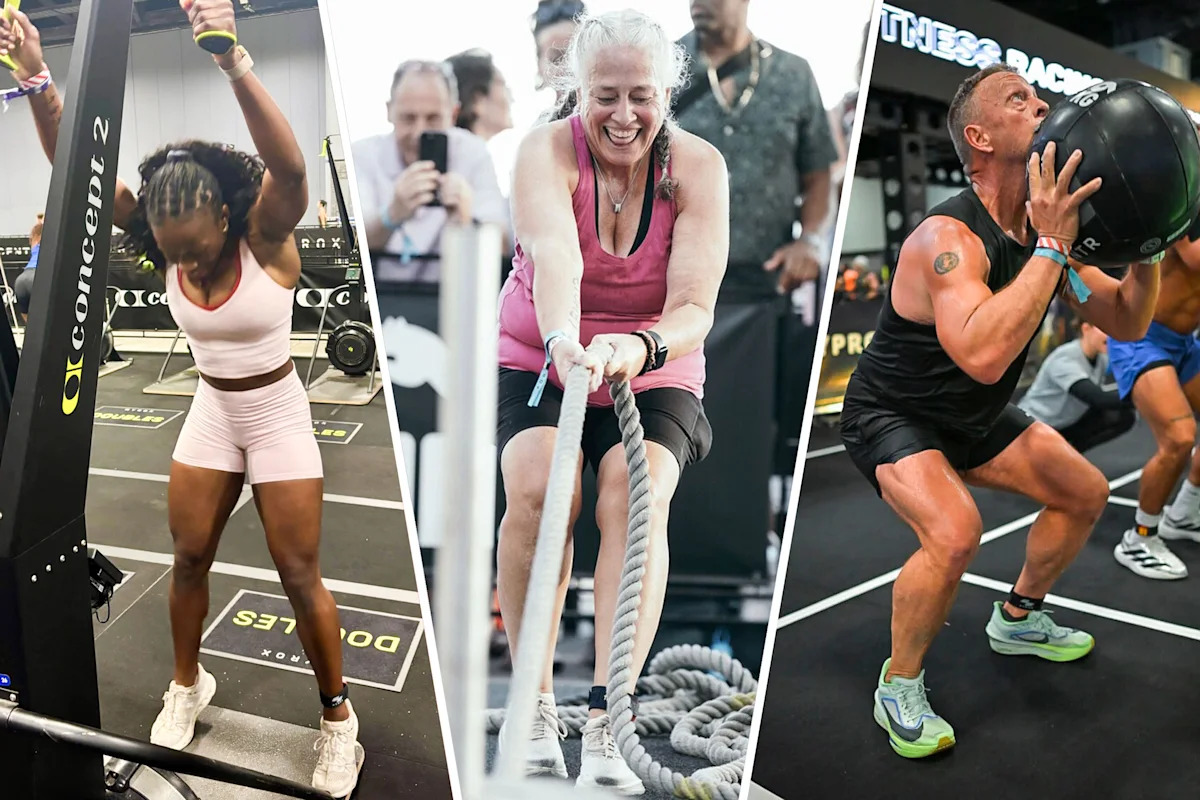
At this point, you’ve probably heard of Hyrox.
Maybe someone at your gym is training for one. Maybe a friend has developed a sudden passion for pushing a sled across the floor. Maybe the algorithm has decided that watching red-faced strangers do burpee broad jumps is relevant to your interests. And that was all before “Poopgate,” when a recent race went viral for a reason organizers probably didn’t anticipate.
The numbers suggest it’s not just your feed. The fitness competition, which combines eight 1-kilometer runs with eight workout stations, attracted 1.5 million participants across 34 countries this year, according to The Athletic, and is projected to generate $270 million in revenue. The concept has been so successful that Hyrox’s founders are now investing in another standardized fitness competition to turn even more gym-goers into competitive athletes.
To the uninitiated, spending your free time hoisting and heaving medicine balls and sprinting across turf might seem bananas. What exactly are all these people chasing? For many Hyrox participants, it turns out, the answer isn’t simply fitness. In conversations with competitors ranging from their late 20s to mid-60s, a similar idea kept coming up: “I was just tired of not having something to work toward,” Kardia Dunah, a 28-year-old therapist and former college track athlete, tells Yahoo.
For more than a decade, sports had given her life built-in goals. There were practices, races and qualifying times. Even after her own collegiate career ended, she coached track while earning her master’s degree. When the structure disappeared, Dunah continued to exercise but struggled to stay consistent.
Hyrox finally gave her another milestone to reach for.
As a therapist, she sees a similar transition among young adults moving from the built-in markers of school and sports into an adult life where progress can be harder to measure. Dunah knows the feeling herself. “You’re constantly accomplishing something,” she says of her years in sports. “That adds to your sense of identity.”
That may help explain why training for some sort of physical competition can feel so different from simply working out. “Maintenance is invisible,” Michael Wetter, a board-certified clinical psychologist in Los Angeles whose work focuses on mental health and performance, tells Yahoo. “When you exercise to stay healthy, success looks like nothing happening, and the brain struggles to stay engaged with a goal that offers no clear signal of progress.”
A finish line, on the other hand, offers something tangible.
Research on goal-setting has found that specific, challenging goals can produce more effort and persistence than vague intentions, Wetter notes. Training for an event also creates a narrative that people are naturally inclined to follow: There’s a beginning, middle and an end.
Hyrox obviously didn’t invent working out. But it’s given regular gym-goers a finish line — and something to show for crossing it. Despite the recent furor, people are still lining up to give it a shot.
Scratching the itch for a new challenge, at any age
Hyrox was created in Germany in 2017 around a simple observation. Millions of people went to gyms, but unlike runners, cyclists or triathletes, most had no standardized event where they could test that training.
Its format is identical from race to race, meaning a participant in New York can compare their time with one in London — or, perhaps more importantly, with their own previous performance.
While Hyrox didn’t respond to Yahoo’s requests for participant demographics, available data suggests its appeal extends well beyond 20-something fitness influencers. Infront, the sports marketing company that until recently held a major stake in Hyrox, has said the competition has “strong representation” among athletes 30 and older.
The competition itself is designed to accommodate a wide range of ages and abilities. Participants can take on the full race individually in the standard Open division, opt for the heavier weights in Pro, split the work with a partner in Doubles or divide the race among a four-person Relay team. Singles competitors are also ranked by age, with categories stretching from 16 to 89 years old. (There’s even a separate Hyrox branch for competitors aged 8 to 15.)
That adaptability and accessibility matter because the desire to accomplish something difficult doesn’t necessarily disappear with age. What the accomplishment represents, Wetter says, may simply change.
In our 20s and early 30s, challenges can help form identity and prove capability. In midlife, he says, they may provide a sense of self outside roles like employee, spouse or parent. Later, the motivation may shift toward vitality and proving that age hasn’t closed the door on getting stronger.
That desire for a new challenge showed up among older competitors like Michelle Smart. She didn’t start exercising regularly until 40 and now, at 66 years old, has completed three Hyrox Doubles competitions. “When I train for Hyrox, I’m not simply working out. I’m training with a purpose and a goal in mind,” she tells Yahoo. “Hyrox has taught me to believe in my physical capabilities and continues to give me the confidence to keep discovering what I’m capable of at this stage of my life.”
For Nicole Michelson, 58, signing up for Hyrox was similarly about seeing how far she could push herself. She hadn’t considered herself much of an athlete as an adult. After losing 100 pounds, she began thinking more seriously about strength and cardiovascular fitness, particularly as she got older. She started running and eventually found Hyrox, where so many others have: On Instagram.
She watched women she followed on social media descend on a Hyrox race in New York and could feel the energy. More importantly, it looked accessible. Eventually, she signed herself up.
“I really just cared about finishing,” she tells Yahoo. “I wanted to prove to myself that I could do this.”
Michelson set a goal of completing the race in three hours. She did it in 2 hours and 48 minutes. “I think it’s just amazing that I did it,” she says.
She described a kind of post-race euphoria — part adrenaline, part atmosphere and part satisfaction that she had done what she set out to do. And that feeling “stays with you for days,” she says.
The adult gold star?
For roughly the first two decades of life, someone else keeps score. There are grades and graduations, sports seasons and trophies, auditions and acceptances. Then adulthood arrives, and many of the things we’re supposed to succeed at become much harder to measure. There’s no medal for maintaining friendships, keeping yourself healthy or making it through another year of work and family obligations.
Signing up for a race can shake things up. “Completing something hard gives us evidence about ourselves that no amount of reassurance can replace,” says Wetter. “Our confidence grows most reliably through mastery experiences, moments when we faced real difficulty and came through it.”
And that confidence can travel beyond the event itself.
“A person who finishes a grueling event often walks into a tough conversation at work or a family challenge with a quiet sense that they can handle discomfort,” he says. “Difficulty is not an obstacle to the reward. In many ways, it is the reward.”
That’s how Chris Green sees it. At 57, Green describes himself as someone who has always been driven. He became a CEO at 44. But after a 30-year career in hospitality, he felt stagnant. He began a fitness journey in July 2025, first by walking and changing his diet. Then Hyrox started appearing in his social media feeds.
“I know enough about myself to understand that having a goal keeps me working,” he tells Yahoo. So, he signed up.
His first target was Hyrox Houston in March 2026. He began training the previous November. He arrived 50 pounds lighter and convinced he was ready for the race. He wasn’t. He failed to finish, dropping out at the lunges.
“I was incredibly disappointed and at the same time motivated,” he says.
So much so that he found a Hyrox-specific training program and “went to work” ahead of his next event in New York City, where he finished in 1 hour and 49 minutes. Then he hired a running coach. In Washington, D.C., he cut 10 minutes off his time and finished 21st in his age group.
He says his “confidence is through the roof” after those successful finishes, though “it’s really the pursuit that excites me.” That alone feels valuable at this point in his life.
“When you get to be my age, you take inventory and say, ‘What else?'” he says. “Maybe it’s like the old days of midlife crisis, but in a better way.”
Enduring through controversy
The drive to push yourself in such a grueling endeavor, however, has also raised questions about how far is too far. In September, Australian athlete Joanna Wietrzyk made headlines when she lost control of her bowels during a Hyrox Elite 15 race in Beijing, featuring the sport’s top female competitors — and kept going. She went on to cross the finish line first, but the incident sparked backlash over the potential health risks to other competitors and why officials hadn’t stopped her.
Hyrox already had rules penalizing competitors for everything from spitting on the floor to pouring water over their heads, as GQ pointed out, but no clear rule addressing what happened in Beijing. Cofounder Moritz Fürste later acknowledged that organizers had made a mistake by failing to intervene and announced changes allowing race directors to withdraw athletes if bodily fluids pose a health or contamination risk. Wietrzyk also apologized for not taking herself out of the race, retroactively withdrawing and forfeiting her points.
It’s a complicated moment for a sport built around discovering what you’re capable of.
But for most participants, pushing those limits isn’t about how far they’re willing to go at any cost. It’s about finding out what they can do — and then signing up to see if they can do it again, only faster.
Dunah says one of the things she loves about Hyrox is that it offers the structure and stakes of a competition, without necessarily making anyone feel like they’re losing. As a track athlete, she always knew where she stood in a race. “You know who’s in first and who’s in last [place],” she says. At Hyrox, competitors start in waves, meaning there’s no clear sense of speeding ahead or falling behind while you’re on the course. “You just ran your race.”
Michelson felt the same way. “You don’t feel like you’re getting left behind ever, no matter how slow you are,” she says. “Most people have no clue that you’re getting lapped by people. You’re just caught up in the energy of it.”
There’s another reason why Hyrox is particularly good at creating converts: you do it with others.
Michelson found the sport by discovering other competitors online. Green found it in his feed, too. Now, his wife, son and daughter-in-law are all planning to compete.
Dunah sees the community as part of the draw. She often encourages therapy clients to find ways to be physically active with others, especially when self-motivation feels difficult. “Our society has moved into a more independent and isolated society,” she says. “There’s so much value in the collective and in community, and I think that plays a huge part in why Hyrox is so successful.”
While Hyrox participants may read as ultra-competitive to outsiders, for many of them, the most meaningful opponent is their previous selves.
Dunah went into her first race hoping to finish in 1 hour and 30 minutes. She finished in 1:43. Her reaction? “OK, now I gotta go back and try again because I didn’t hit my time,” she recalls. “That’s probably how they get you.”
Michelson calls it “me against me.” Green’s progression tells a similar story: He returned to shave 10 minutes off his previous time.
The ability to measure progress — against other people, but also against a previous version of yourself — is part of what makes fitness competition so psychologically satisfying, Wetter says. And unlike winning or losing a traditional game, improvement creates another accomplishment to chase or the desire to test your limits once again.
“During the race you literally suffer,” says Green, noting that there’s a point in each race where he’s questioned why he voluntarily signed up for this. “Then you finish, and it’s some strange phenomenon,” he says. “Let’s do another one, we can train harder and suffer again.”