
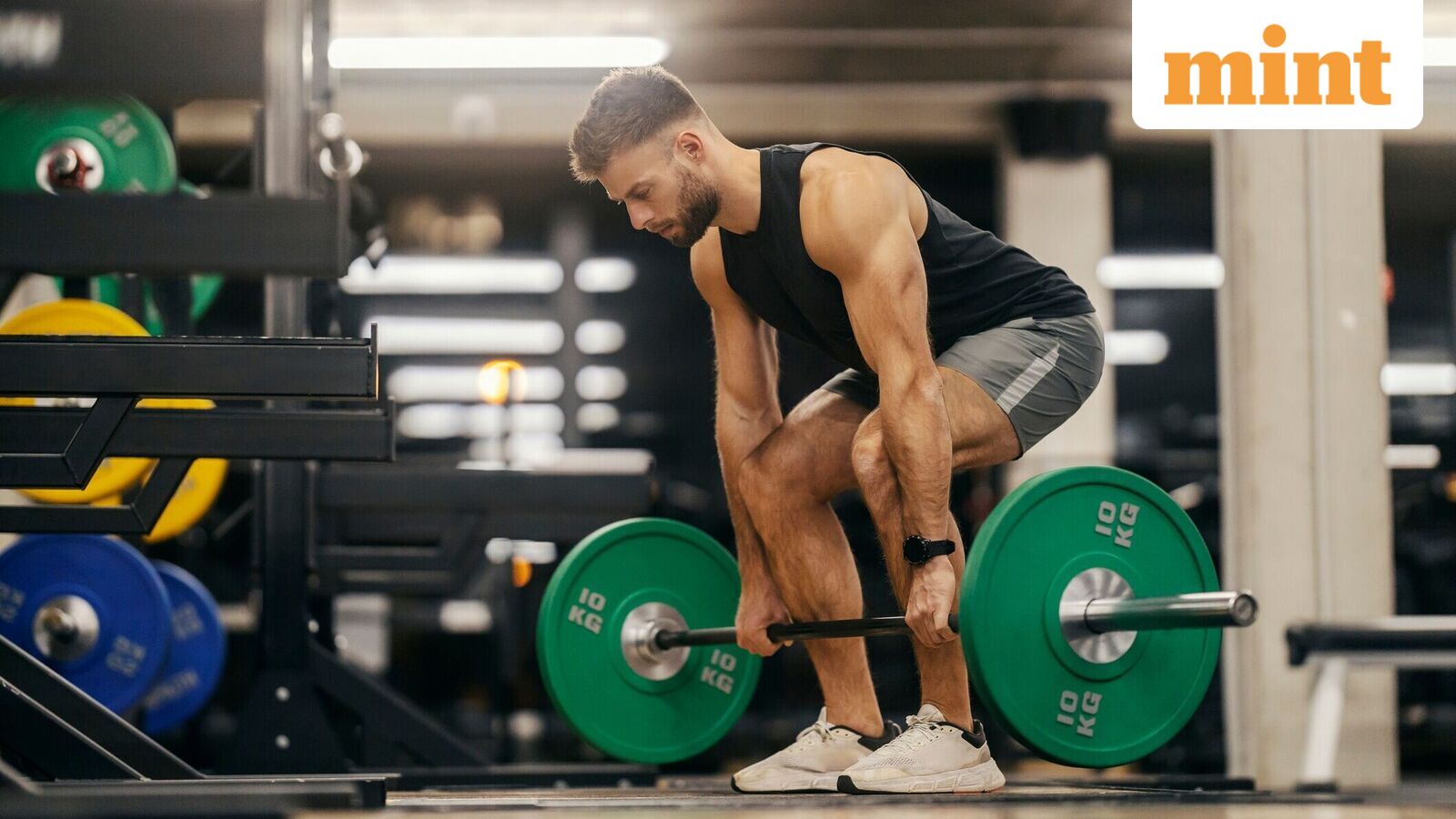
Anyone who has fitness as part of their social media algorithm will remember the sheer number of deadlift videos people were posting once upon a time. One-rep maxes and first-time lifters finally nailing the form would be highlights of these. But over a period of time, the deadlift debate seems to have become more evident: does the tough-to-learn but five-star compound exercise have enough risk-to-reward ratio to continue doing it regularly?
It seems like the deadlift has shifted out of focus as exercises become more specific to the smallest of muscles, and the back becoming more prone to injury due to lifestyle. The other problem with the deadlift that it is a difficult exercise to get to grips with initially. One needs to learn the right technique to do the hip-hinge and pulling the weight up while keeping a straight engaged back and core. Given that the deadlift is one of the foundational compound exercises, every gym regular would have gone through the process of learning a deadlift.
Also Read | Why you need to do the tricep dumbbell kickback for stronger arms
Whichever route you take learning it, it’s worth keeping in mind how deadlift training might differ from bench press or squat training. The two latter exercises, which are also compound movements, can be tweaked easily by adding some accessory lifts and finding the right weight to play around with. Since the deadlift is even more taxing on the body than the barbell squat, it needs to be approached differently.
“The deadlift generally responds best to a fairly high frequency of hinge-pattern work, but a relatively low frequency of actual deadlifting. I find that around 50% of people do best deadlifting once per week, around 25% of people do best deadlifting twice per week, around 15% of people do best deadlifting less than once per week (i.e. twice per 3 weeks), and only around 10% of people do best deadlifting 3 or more times per week,” writes Greg Nuckols in a Stronger by Science blog titled, How to Deadlift: The Definitive Guide.
Also Read | 5 great quick workouts to stay fit during a busy December
Nuckols has a Master’s in Exercise Physiology and has held three all-time world records in powerlifting in the 220lb and 242lb classes. He writes that the main barrier to doing the deadlift is the fact that it is difficult to learn the hip hinge. However, this can be turned into an easier process by adding accessory lifts which are also moderately advanced; e.g. Romanian deadlifts, kettlebell swings or hyperextensions.
So the road is already complicated and daunting: perform exercises that mimic the hip hinge but do the deadlift just once a week depending on how good the back and body feels. Whereas a bench press technique can be accelerated quickly by adding weighted push-ups, which is quite literally a bench press done upside down. Shalak Nelson has been coaching people in the gym for the best part of a decade and stopped deadlifting three years ago. “I don’t miss working out with a sore lower back which is unavoidable when you deadlift heavy,” says the Vadodara-based 32-year-old.
Nelson spends around 50 hours a day in the gym which includes his workouts and spending time with his clients. He has observed an evident dip in the number of people performing deadlifts. “When I started lifting, fitness content creators were heavy lifters. But with the industry growing so much, more people started studying it as a science and figured out deadlifts are not entirely necessary to do. People would rather train with something more interesting like time under tension methods or learn to do hyperextensions, which for many are safer and better.”
Also Read | Understanding shoulder AC joint injuries, and how to treat it
He adds that the deadlift surely makes up for the top three toughest exercises to teach. “Anything with the hip hinge or the lower back is a difficult technique.” The deadlift includes both. I wrote an article on deadlift alternatives for Lounge in 2022, where you can find more exercises to do in place of them.
There is an interesting episode from 2019 on the Joe Rogan’s podcast on the deadlift. The 2013 and 2018 finalist of World’s Strongest Man, Robert Oberst, was speaking about his injuries when he mentioned how “deadlifts for the sake of learning or getting better at deadlifts are fine but otherwise don’t do it.” He goes on to say that the risk-reward ratio from deadlifts “is a joke”. He gives an excellent example of how athletes in the NFL are not doing it. “A lot of people won’t like this but if you go anywhere where people are getting paid to be fit, they are not deadlifting.”
With newer content curated towards the whole ‘train like an athlete’ formula, the deadlift is slowly exiting daily routines. People are choosing safer options but that doesn’t take away from how effective an exercise it is to build a strong lower back and posterior chain. Perhaps the deadlift shouldn’t be written off entirely, but just be treated with caution. Lighter and safer versions (like the trapbar deadlift) are still very good for the body. Do those, and you can enjoy the benefits of the deadlift without the injury risks.
Pulasta Dhar is a football commentator and writer.