
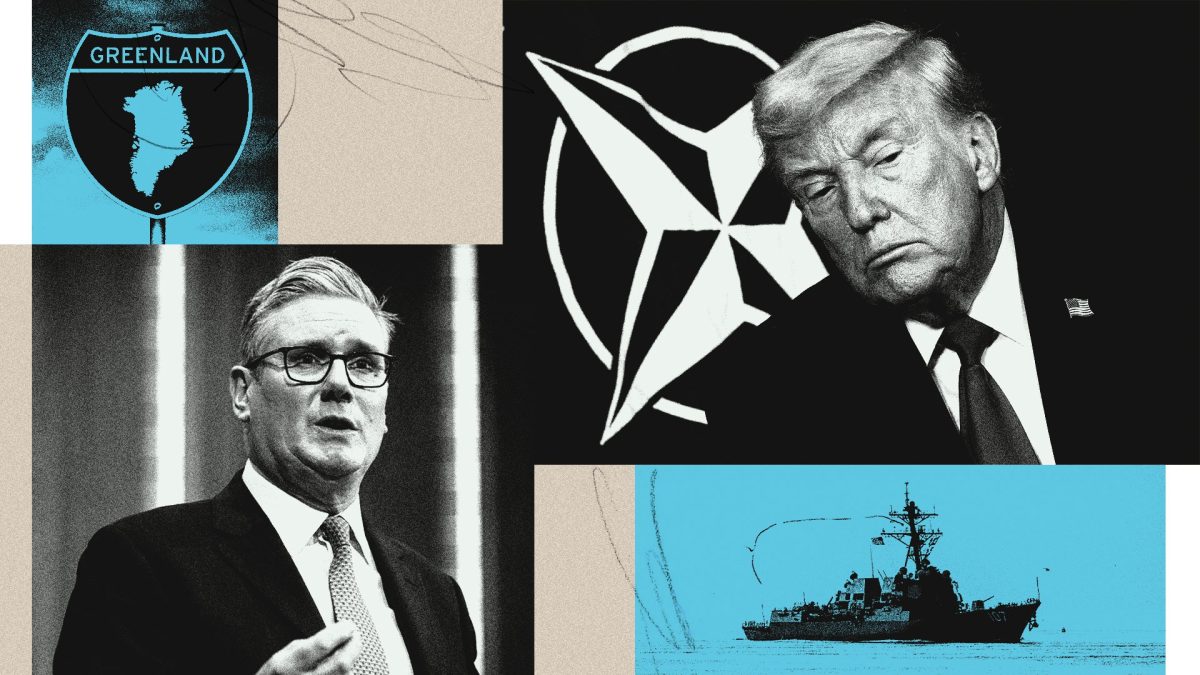
British ‘cup-of-tea diplomacy’ helped resolve the Greenland issue, Denmark said – but it won’t help the PM at home
Sir Keir Starmer started the week with his foreign policy – one of the few successes he can point to in his 18 months in power – seemingly in tatters.
His decision to hug Donald Trump close, despite the qualms of his own Labour allies, looked like a great idea – until it wasn’t.
But by the end of another long week in politics during which it looked like the Nato alliance might collapse, the Prime Minister can pack for next week’s China trip believing he played a key role in averting disaster – at the same time as standing up to Trump more stridently than ever before.
The US President had thrown another huge rock into international waters by announcing he would impose a tariff of 10 per cent, rising to 25 per cent, on countries, including the UK, which were publicly opposing his threats to seize Greenland.
‘An act of great stupidity’
This would have knocked up to 0.8 per cent off Britain’s GDP, according to Oxford Economics – a hefty blow to a Government which claims its priority is growth. With the EU threatening retaliation amounting to a full-blown trade war, the UK looked set to be further damaged in this crossfire.
So instead of spending the week talking about his policies to bring down the cost of living, starting with a speech in Yorkshire and continuing with the launch of the warm homes plan, Starmer found himself once again wading into the choppy waters of the transatlantic partnership.
He had to summon a Downing Street press conference on Monday morning, cancelling his speech, to try and calm things down.
But it did not work: in the early hours of Tuesday, Trump took direct aim at the UK Government over the decision to hand the Chagos Islands to Mauritius, a move previously backed by the White House.
Trump said on his Truth Social website: “The UK giving away extremely important land is an act of GREAT STUPIDITY, and is another in a very long line of National Security reasons why Greenland has to be acquired.”
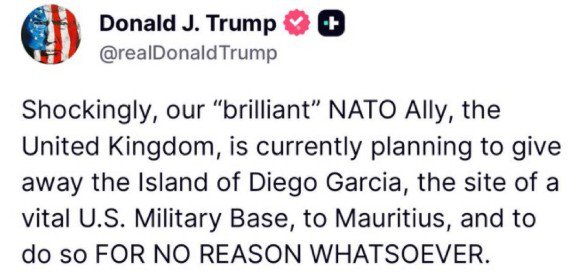 Part of Trump’s tweet on his Truth Social site
The setback, which blindsided No 10, provided quiet satisfaction for those in Labour who had always been uncomfortable with the Starmer-Trump alliance.
“The Trump whispering thing has been shown to be not even a qualified success,” one senior MP remarked.
Contrasts were drawn with EU leaders, who were quickly drawing up a package of retaliatory tariffs to hit back at the US, along with strong words.
Canada’s Mark Carney – the former head of the Bank of England and a friend of Rachel Reeves – delivered an acclaimed speech at the World Economic Forum in the Swiss ski town of Davos calling on America’s allies to wake up to the need to become more self-reliant and build new friendships.
“The old order is not coming back. We should not mourn it,” he said. “Nostalgia is not a strategy.”
In Davos on Wednesday Trump had threatened: “All the US is asking for is a place called Greenland. You can say yes, and we will be very appreciative. Or you can say no and we will remember.”
But hours later the script was flipped again. He announced out of the blue that he had hatched a deal in Davos with Nato members to shore up the security of Greenland, and that he was withdrawing the tariff threats.
One Cabinet minister said the about-face showed that Starmer had been right all along to avoid antagonising the President, for example by denouncing him in a way similar to the scene in Love Actually where the British prime minister, played by Hugh Grant, makes an anti-American speech in front of president, played by Billy Bob Thornton.
“There is a pretty widespread view across the Cabinet that the Love Actually approach would have the opposite effect to the one you want,” the minister told The i Paper. “The characterisation ‘Keir was supine’ is not right because he was so strong on Greenland.”
Another MP said: “It doesn’t hurt us to have a different position to the EU. It allows Keir to paint himself as an honest broker.”
Backbenchers were sharing a meme which jokingly quoted Starmer as saying, “Look, I get it, he’s mental but what the f**k do you want me to do about it?”
That is not to say that the Prime Minister has not shifted his position on Trump.
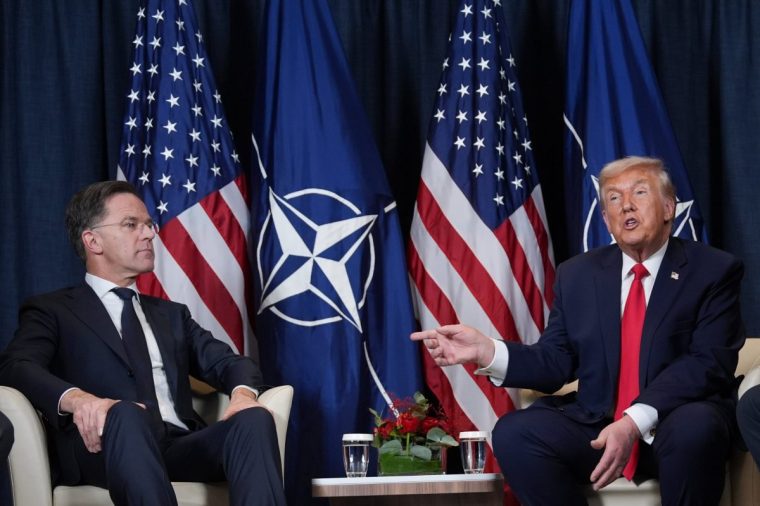 Donald Trump with Nato secretary-general, Mark Rutte, in Davos this week. The two reportedly cooked up a deal for Greenland, leading to a U-turn on the US President’s proposed tariffs (Photo: Evan Vucci/AP)
This week he became more critical of the President than he has been in the past, saying in the House of Commons that he “will not yield” on Greenland and challenging Trump directly over his mixed messaging on Chagos.
“He deployed those words for the express purpose of putting pressure on me and Britain in relation to my values and principles on the future of Greenland,” Starmer said.
He also hit back when Trump played down the contribution of non-US troops to Nato operations in Afghanistan. On Friday, Starmer issued his toughest ever rebuke of the President, saying: “I consider President Trump’s remarks to be insulting and frankly appalling and I am not surprised they have caused such hurt to the loved ones of those who were killed or injured and, in fact, across the country.”
Cup-of-tea diplomacy
But within the national security establishment, it is believed that trying to cut Britain loose from America is a pipe dream, and that the threats coming from Canada and the EU are not backed up either by hard power or by a willingness to sacrifice existing priorities in favour of mutual defence.
Starmer himself boasted that his “pragmatic” approach towards Trump was “very British” – and Denmark’s Prime Minister, Mette Frederiksen, agreed, telling him at a Downing Street meeting that the “British way of doing things” where “you have a cup of tea and then you think a bit about everything” had successfully de-escalated the tensions.
As she left No 10, she wrote in the visitors’ book a homage to the Beatles: “We’ll get by with a little help from our friends.”
Starmer will seek to hammer home his successes on a trip to China next week, although he will face tough questions about whether getting too close to Beijing could be a threat to Britain’s security.
The question now is a familiar one – whether or not the Prime Minister can help use a strong position on the world stage to build up his credibility at home, with Labour still languishing in the polls.
An ally of Starmer insisted he can use global credibility to win back domestic popularity, saying: “Even if you don’t like him a lot of people will think he is a reassuring presence.”
The source added: “Lord knows where we will be by the next election, but it is not unforeseeable that he could point to a good track record there and say, ‘Kemi was cheering Trump on and Farage was cheering Putin on.’ Imagine if they’d been in charge!”
Andy Burnham wildcard
One place Starmer might not be at the next election is No 10.
Labour MPs remain unhappy with a string of policy blunders and U-turns – two more of which materialised this week, as Starmer delayed the passage of a “Hillsborough law” designed to make public officials more accountable after major disasters and announced he would be open to a ban on under-16s using social media, a position he had previously opposed.
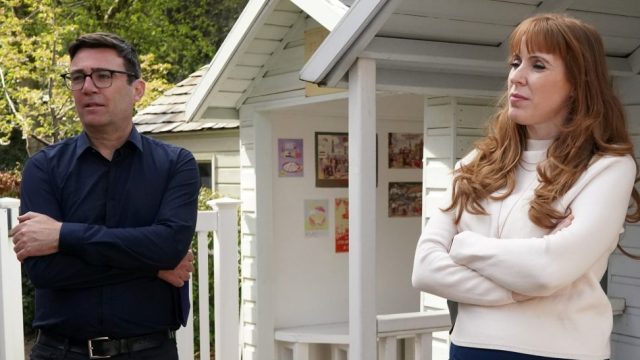
The potential return of Andy Burnham to Westminster could be a major wildcard. The Mayor of Greater Manchester has not, at the time of writing, ruled out a bid for the Labour candidacy in the by-election for the vacant seat of Gorton and Denton, prompting warnings from Starmer allies that they may seek to block Burnham from getting the nod to stop him becoming eligible to replace the current Labour leader.
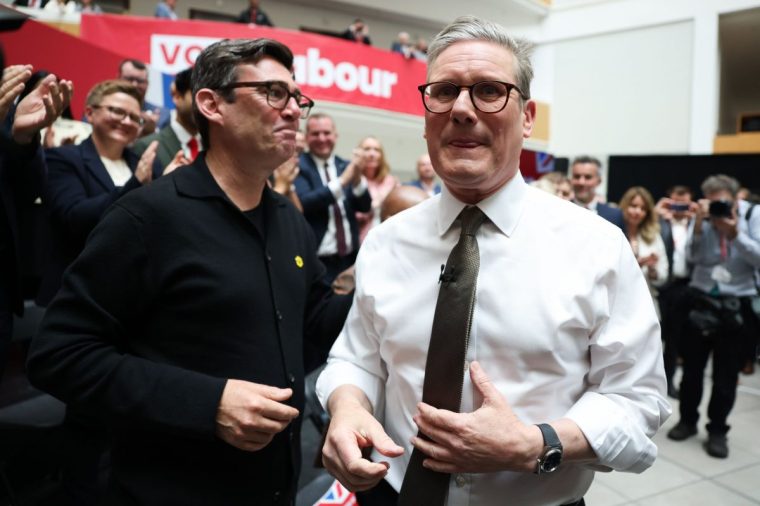 Sir Keir Starmer with Andy Burnham in June 2024. The Mayor of Greater Manchester may seek to run for Labour leader (Photo: Hollie Adams/Bloomberg via Getty)
But even if Burnham doesn’t stand, that the prospect of his return is causing such disquiet speaks volumes about the Prime Minister’s precarious position.
One supporter of the Prime Minister’s foreign policy expressed a fear that the domestic turmoil could end up weakening his stance on the world stage, saying: “There will be a temptation against the backdrop of Andy Burnham to get tougher on Trump, and out-do Wes Streeting on Europe.”
Chris Hopkins, of pollsters Savanta, warned it would be tough for the Prime Minister to make political gains from foreign affairs.
Your next read
He told The i Paper: “There is a danger that if Starmer isn’t seen to be standing up to an unpopular President, that could be negative for them, but that said there isn’t much positive benefit from getting it right. So there isn’t much upside, there can only be a negative impact or a net neutral one.”
The conventional wisdom in Westminster is that the local elections in early May remain the key moment that will decide Starmer’s fate.
But the risk for Labour, according to Hopkins, is that it could already be too late. “Reform are likely to do very well, and that helps to legitimise them in the minds of voters as a genuine party of government,” he said. There may be nothing that wins in Davos, Washington or Beijing can do to pull Starmer out of the quagmire he is in at home.
UK fears over possible Chagos deal collapse
British officials are discussing whether the deal to hand over the Chagos Islands to Mauritius can survive if the US pulls its support for the plan, The i Paper has learned.
The UK Government has been adamant in public that the deal will go ahead nonetheless, given that the treaty governing it has already been signed.
But it is understood that behind the scenes, officials are gaming out what would happen if the US did formally withdraw its previous support for the arrangement.
A diplomatic source said: “When it comes to dealing with the Americans you have to pick and choose who you deal with and at which level. Luckily some of the administration are easier to deal with than other.”
Officials like Secretary of State, Marco Rubio are “sensible”, the source said, but less experienced figures in the administration are “let’s say, challenging”.