
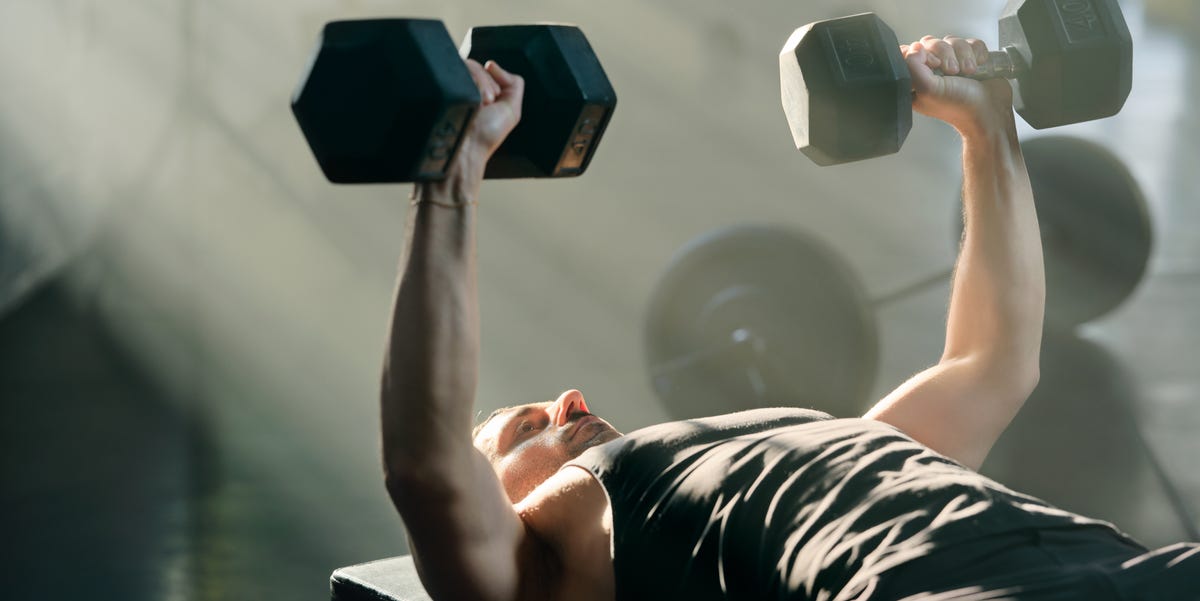
Isolating the triceps is key for enhancing arm size and definition – but not all exercises are created equal. If you have limited shoulder mobility or a history of injury, you may find that some of the most effective exercises for tricep hypertrophy – skull crushers, dips and overhead extensions, for example – cause discomfort. A solid alternative for targeting the triceps without over-stressing the elbows: the Tate press.
Popularised by powerlifter Dave Tate, the Tate press is performed while lying supine on a bench. ‘You start with dumbbells held straight out in front of you, as if you’re at the top of a bench press, and from there, you open your elbows out to the sides and let your hands start to come inward toward your chest,’ explains PT Monty Simmons. ‘You lower the dumbbells down in a slightly sideways position by bending the elbows, palms facing inward, and then use the back of your arms, your triceps, to press the dumbbells back up.’
Muscles Worked by the Tate Press
The Tate press primarily targets the triceps brachii – in particular, the long and medial heads. ‘This is due to the shoulder position, which places the long head under stretch as it crosses the shoulder joint,’ explains Simmons. This, he says, is great for firming up and strengthening the back of the arms.
Additionally, the exercise engages the anterior deltoid, on the front of the shoulder, which helps to stabilise the position. ‘The forearms work to control the dumbbells, and the core engages lightly to keep you stable on the bench,’ says Simmons.
How to Do the Tate PressLie flat on a bench with a dumbbell in each handStart with your arms extended above your chest, palms facing inward, dumbbells almost touchingBend your elbows and lower the dumbbells toward your chest, keeping the upper arms relatively stillLet the dumbbells come close to the chest while maintaining controlPress the dumbbells back up by straightening the elbows, squeezing the triceps at the topBenefits of the Tate Press
Simmons rates the Tate press for its ability to isolate the triceps while avoiding agitating the shoulders. ‘It’s a really nice option because it avoids that overhead, pinchy shoulder feeling that some people get with exercises like French presses or skull crushers,’ he says. ‘It strongly targets the triceps while allowing you to control the movement very well, which is one of the big benefits of using dumbbells.’
Because the Tate press tends to be gentler on the shoulders than some other triceps exercises, it allows you to train both the concentric and eccentric phases under control. ‘It’s good for building arm size and strength, firming up the back of the arms, and supporting triceps tendon health when loaded appropriately,’ Simmons says.
‘It also requires the shoulders to stabilise throughout the movement, so you’re not just training the elbow, you’re also reinforcing shoulder control and stability at the same time.’
Common Mistakes to Avoid
If you’re prone to sensitivity around the back of the elbow, particularly around the triceps tendon, Simmons cautions that the Tate press could cause irritation. In this case, it’s best to opt for an alternative exercise instead.
‘Don’t go too heavy too soon, as the weights travel down toward the chest and need to be well controlled,’ Simmons advises. ‘Start lighter than you think and build up gradually so you can learn the movement safely.’
He emphasises the importance of maintaining slow and controlled reps, particularly on the lowering phase, as this is where a lot of the benefit comes from. ‘If you don’t have access to dumbbells, diamond push-ups can be a good alternative,’ Simmons says.
‘Overall, it works best as an accessory exercise within a triceps-focused session, especially if overhead triceps work causes discomfort.’
Related Stories