
As a tweakments expert, most of the ‘testing’ I do involves needles, lasers and the odd polynucleotide (that’s a skin-boosting chemical).
But when an invitation arrived to have my brain thoroughly assessed at Viavi, a discreet wellness and longevity clinic for the elite 0.1 per cent, I did what any curious 60-something with an over-busy life and a dodgy memory for the whereabouts of keys and glasses would do: I said yes.
The fact the testing would check my dementia risk was a huge lure. Elevated levels of p-tau protein – a key biomarker for Alzheimer’s – can show up in blood up to 15 years before symptoms arrive.
I’m 62 and keen to know if this is heading my way – and Viavi is the only clinic in the UK that can currently test for p-tau.
What’s more, a study last month linked the menopause with a reduction in grey matter associated with memory and emotion – news that made 50-plus women roll their eyes at the gift that keeps giving. I’ve never suffered with the debilitating brain fog that hits so many women during the menopausal transition. When I started feeling a bit fuzzy round the edges both in mind and body 16 years ago, I had my hormone levels checked.
Sure enough I was in perimenopause – something nobody talked about at the time – and have had my hormone levels managed ever since, which made the transition through menopause a breeze (sorry).
But the study – which put 11,000 menopausal women through MRI brain scans – shows that even taking HRT didn’t stop this loss of grey matter. Eek.
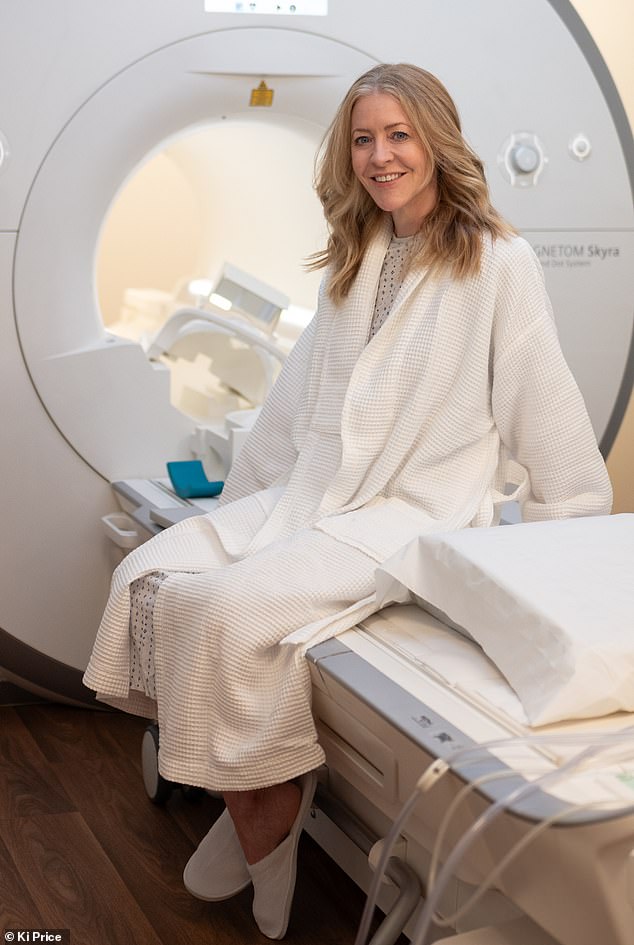
Viavi, a discreet wellness and longevity clinic, invited Alice Hart-Davis for a brain scan which would check her dementia risk
I was also intrigued to learn that I’d be tested for something that Viavi’s founder and CEO, Dr Sabine Donnai, calls ‘CEO brain’.
What on earth is that? Well, explained Dr Donnai, a former GP who’s now a leading authority in proactive health management, it’s essentially a hard-wired tendency towards a go-getting, positive mood, better executive function and more entrepreneurial, risk-taking behaviour.
Apparently, some people have a mutation in their COMT gene (bear with me), which breaks down neurotransmitters such as dopamine, known as the ‘happy hormone’. That means people with this genetic mutation have more than their fair share of the stuff and are generally living life on a dopamine high, which, suggested Dr Donnai, may well lead to a combination of qualities and attributes that makes for a good CEO. Hence ‘CEO brain’.
Among the general population, only 23 per cent of us have this COMT variation, but among Viavi’s elite clientele of lawyers, investment bankers, hedge-funders, celebs and entrepreneurs, a massive 81 per cent do. It sounds wonderful – as long as you don’t lose the ‘off’ switch, because the CEO brain is also highly vulnerable to burnout.
Did I fit that bill? I doubted it. I’m the founder of a small company (The Tweakments Guide), but I’m easily distracted when I’m meant to be concentrating.
There was only one way to find out: with a mass of highly specific tests, including a brain MRI, a fitness evaluation, and blood and DNA tests.
‘When we focus on your brain,’ Dr Donnai told me, ‘we look at three areas. First, what is your brain like now? Are there structural issues like a tumour? Second, what could harm it? Are there nutrient deficiencies, or inflammation or genetic issues?
‘Third, what is supporting it – your sleep, your fitness, your microbiome. Then we ask: how is your brain doing, and what should the strategy be to prevent any problems?’
So off I went for the MRI. Then, back at the clinic, I huffed as hard as I could into a device that measured respiratory volume, did some DNA swabs to check genetic mutations, and had 23 vials of my blood taken (23 vials? That’s nearly an armful!). This would be sent off to labs in the UK and the US to check my levels of vitamins, hormone levels, inflammation markers and toxin levels – and of the p-tau protein (that sample had to go to the US for testing).
Next came the fitness test, where I pedalled on an exercise bike, grumbling as the resistance became harder and harder, while ECG electrodes on my chest monitored my heart and an alarming face mask measured the oxygen I breathed in and the carbon dioxide I puffed out.
After that, the tests were easy. Body composition, bone density, grip strength, ‘brain mapping’ with tiny electrodes glued to my head . . . though by the time I got to the cognitive tests at the end of the day, trying to remember a sequence of words, then numbers, then shapes, then identify them again under time pressure, I was feeling old and slow.
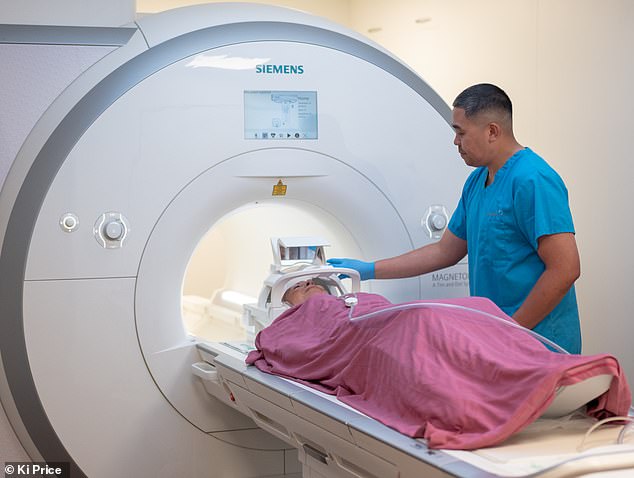
Alice underwent a mass of highly specific tests, including a brain MRI

Alice pedalled on an exercise bike while ECG electrodes monitored her heart and a mask measured the oxygen she breathed in and the carbon dioxide she puffed out
I left clutching home-testing kits. A continuous glucose monitor would track my glucose levels and relay these to an app on my phone, while a device to measure my heart-rate variability – clipped to my ribs and below my collarbone with stick-on electrodes – would show how stressed I became and how well I recovered from said stress. I also had a spit-in-a-tube saliva test to check my levels of cortisol, which is a key stress hormone.
A few weeks later, apps bulging with data, I was back at Viavi to get my results.
First, the easy bits. I had already worked out via the apps that my glucose levels were consistently stable (except for the one time I ate a Pret baguette for lunch, which sent them soaring).
My stress levels were consistent too – but consistently high. Indeed, the app kept telling me to get more rest, but since I go to bed early and sober 95 per cent of the time, and do a fair bit of yoga, I was stumped as to how to do this.
At my debriefing, however, there was so much good news, at least at the start, that I began to relax.
My MRI was clear. My brain is working surprisingly well and rates three years younger than my actual age (yay, I thought, until Dr Donnai told me I should really aim to get it ten years younger). And my grey matter? Just fine, since you ask.
A ‘lovely volume of grey matter,’ confirmed Dr Donnai, ‘above the typical range’. Thank goodness.
All that pedalling showed my VO2 max – the maximum amount of oxygen that a body can use during intense exercise, aka your fitness levels – was up in the exceptional category (double yay!). My cholesterol levels were a tad high and I was a bit low on antioxidant vitamins B and C, but otherwise all the blood results were fine.
Oh, and I don’t have any signs of p-tau, the Alzheimer’s biomarker.
Dr Donnai seemed delighted. I was thrilled – and amazed, given how old and creaky I feel when I lever myself out of bed in the morning.
And then we got to the heart rate variability and recovery data from those electrodes I’d had stuck to my chest 24/7 for three weeks – and Dr Donnai looked suddenly serious.
‘Your days are a bit like a horror story,’ she said. I laughed nervously, but clearly this wasn’t a joke.
‘We’re seeing a nervous system completely stuck in high alert,’ she said. ‘You do recover a bit at night, but not enough to compensate. Our bodies should build up a “savings account” of rest. You’re dipping into your savings account every day.’
My levels of cortisol – the main stress hormone – were out of whack, too. Ideally, Dr Donnai explained, you wake with a healthy cortisol peak that falls steadily to almost nothing by bedtime. That tells your body it’s safe. My cortisol started off high and simply climbed all day until bedtime. It looks like there’s no ‘off’ switch at all in my life.
Is this CEO brain? I asked meekly. Suddenly it didn’t seem such a great idea.
‘Oh, definitely,’ said Dr Donnai. ‘You think you’re coping, but physiologically your system is in constant fight-or-flight.
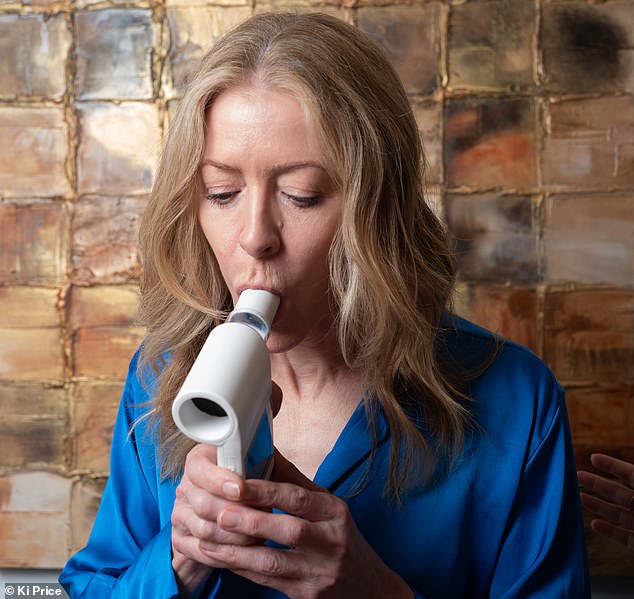
Alice huffed as hard as she could into a device that measured respiratory volume and had some DNA swabs taken to check for genetic mutations

Alice also had 23 vials of blood taken. Tests revealed her cholesterol levels were a tad high and she was a bit low on the antioxidant vitamins B and C
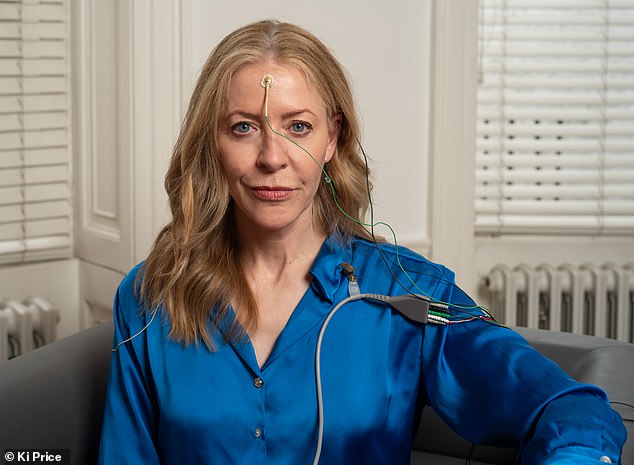
The Viavi tests revealed that Alice has CEO brain – a hard-wired tendency towards a go-getting, positive mood, better executive function and more entrepreneurial, risk-taking behaviour. It also makes her highly vulnerable to burnout
‘If people do that for long enough, they pay, first with sleep quality, then mood and focus. Hormones will be affected, and eventually their body gives up.
‘Pushing through isn’t clever,’ she added. ‘That’s where burnout happens. Because you keep pushing where someone else would say, “Hold on, this isn’t good, something really needs to change.”
‘Sadly for many people like this, often something bad has to happen to make them see that they need to change.
‘But our role is to stop that from happening, to make you realise what’s going on and give you the tools to change it now.’
She added, very ominously, that whenever people arrive at the clinic with cancer, she looks back two or three years in their medical history for a period of acute stress that could have been the tipping point.
Suddenly, I was in tears. I love my work; I love the variety, the over-full days, the being ‘always on’. This has been my ‘normal’ for many years, and I’m always up for new challenges, though I have to admit I feel constantly on the brink of collapse. How on earth do I learn to be different? Is it even possible to change how my body reacts to life at my age?
‘Of course you can,’ said Dr Donnai. ‘We see this all the time.’
In contrast to all the high-tech testing, my recovery plan is largely good old common sense advice, starting with a proper evening wind-down regime, with all screens off an hour before bed, a hot bath and a book. When I wake in the night, no playing with my phone or even meditating (the brain needs its downtime for repair and it can’t do that if you keep feeding it information), but counting down from 100 instead.
During the day, I need to remember to breathe more deeply and slowly as often as possible, to calm down my hypervigilant nervous system.
Brains need lots of oxygen so keeping up the exercise is a must. Dr Donnai reckoned that my fitness level was the one thing standing between me and imminent collapse.
Nutrients are vital for the brain, too. I should aim to eat 100 different foods a week (herbs and seeds count), switch to organic produce to reduce the pesticide load, eat more slowly, and also chew more thoroughly to extract the nutrients from whatever I’m scoffing. And seeing as I’m under-nourished, Dr Donnai suggested I need a lot of green juices – celery and kale – for more antioxidant vitamins, made with a masticating juicer, not a centrifugal one. Cripes, what’s the difference? A masticating one grinds ingredients more slowly to yield more nutrients; the other has a high-speed blade that heats the juice and destroys lots of the antioxidants that you’re after.
Can’t I just take supplements? Food first, she advised. Also, more fibre and fermented foods to help my gut microbiome, plus activated charcoal capsules to mop up toxins (if your gut is unhappy, your brain will hear about it).
So yes, I have CEO brain and it makes life exciting. But now, of course, I’d rather not have it at all.
I had a horrible feeling that, if I didn’t get a grip, it would be the end of me. Another huge incentive was that if I could find that elusive off-switch, my brain should get sharper when it’s ‘on’. Dr Donnai seemed supremely confident that I could do this.
I wish I could say I left the clinic and instantly became the poster child for R&R, but life barged in.
My ancient, adored father became ill and died. Work galloped on and in the fug of grief and funeral planning, a major lifestyle overhaul involving green juices, no caffeine after 11am (a genetic mutation means my body struggles to get rid of it), regular detoxing saunas and phone-free nights went out of the window. Later, I thought.
Later is now. I can’t say I’ve made much progress, but I’m trying. My phone sleeps, mostly, in another room. I aim to be off all screens by 9.30pm and fill the time before bed with stretching and reading. The one thing that does make my nights less riddled with stress, at least according to my wearable fitness watch, is having a hot bath before bed.
I aim, but constantly forget, to practise deep-breathing during the day, to tell my body it’s safe, that there is no tiger about to pounce. My fruit and veg are now organic. And top of my birthday list this year? A masticating juicer.
Health assessments from £9,000, viavi.com