
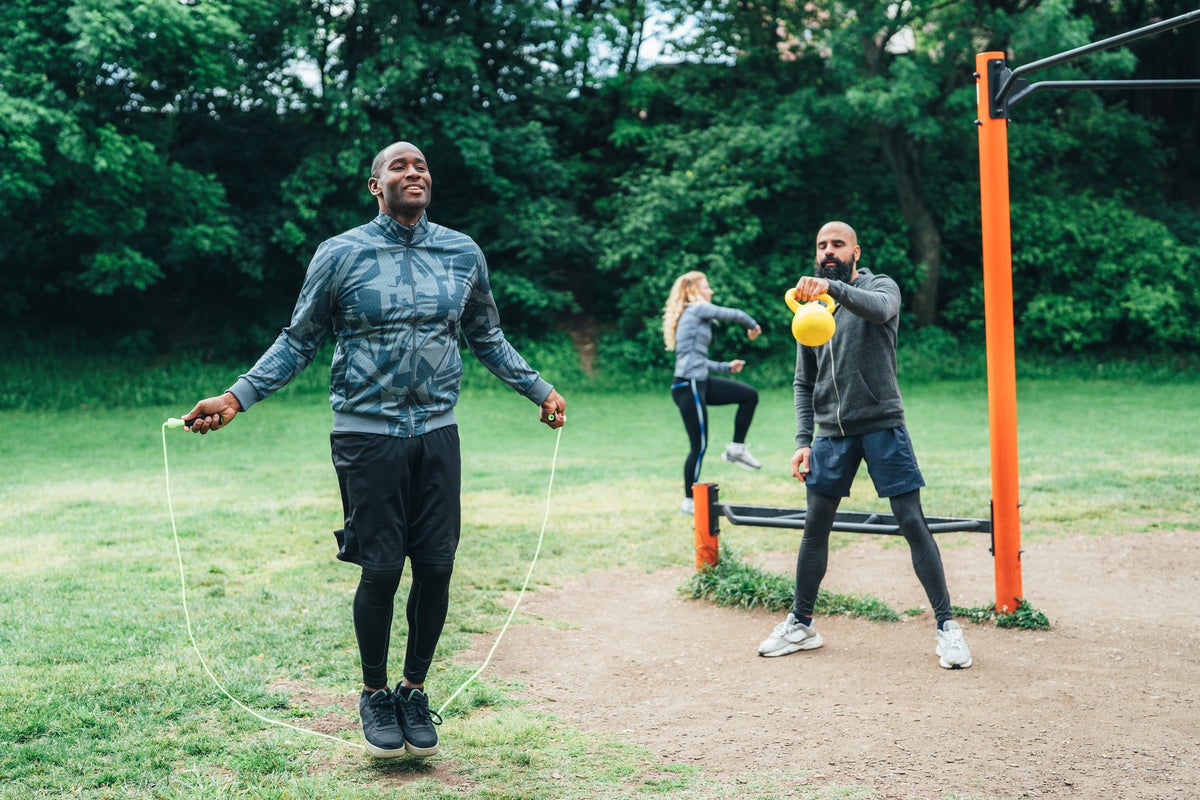
There is no shortage of fitness advice on the internet. Much of it looks rather similar: walk 10,000 steps a day, commit to regular strength training sessions and hit your daily protein quota. These are all solid guidelines to go by.
But there is another frequently overlooked fitness habit that can completely transform your exercise efforts for the better: go outside, spend time with others.
“I’ve been lifting weights since 1965 and coaching since 1979,” seasoned strength coach Dan John tells me. “When you train outdoors, people start to gravitate towards you. If you go to a park every Saturday at 9am and invite friends, then your friends invite friends, pretty soon you’re going to build an intentional community.”
The benefits of these communal workouts extend far beyond calorie burn. Not only will your fellow exercisers hold you accountable to your fitness commitments, but training in a group also offers an enjoyable social hit in a world where personal interactions are more optional than ever.
Leading social isolation researcher Professor Andrea Wigfield likens loneliness to feeling hungry or thirsty: “Social interaction is an essential thing, and as a human being you need people around you.” From my experience, those who train in groups are far more likely to have their fill.
There are plenty of physical perks to al fresco fitness too, even when braving Britain’s temperamental elements. John explains each one below, and also shares a kettlebell workout to help you get started.
The outdoor kettlebell workout with countless benefits for mind and body
For your first outdoor workout, John suggests grabbing a kettlebell and hitting a session he calls “Coyote” – named after Coyote Point, the California spot where he created the session and shared it with friends.
Complete the sequence below for 5-20 rounds:
This workout recruits the entire body and covers the fundamental human movements, John says. These are squatting, hingeing at the hips, pushing, pulling and carrying.
Beginners should start with five rounds, then as you become fitter you can build up to the full 20 rounds. The aim is to move smoothly during the workout, performing each exercise with good technique and resting only as needed.
To make the session more accessible, you can swap the press-ups for kneeling press-ups. If you want to make the workout harder, John first suggests upping the number of press-ups in each round, then increasing the weight of the kettlebell if you’re after an extra challenge.
Read more: Expert trainer names his three essential exercises for a stronger more mobile body
.jpg) Press-ups are an excellent way to build strength outside – just make sure the space you choose is clean! (Harry Bullmore/The Independent)
Press-ups are an excellent way to build strength outside – just make sure the space you choose is clean! (Harry Bullmore/The Independent)
The many benefits of training outside
The workout starts early
Most strength training workouts start after you step foot inside a gym – not so when exercising outside. The workout starts the moment you begin hauling your kit from your house or car to your chosen training spot.
“I’ve told people for years that the secret to training in a park is you pull up in your car, then you have to bring four kettlebells out onto the field and bring them back again at the end – there is your loaded carry work,” John says.
“When we were training at Coyote Point, there were Canada geese that would relieve themselves everywhere, so you had to search around to find the spot with the least goose poop. That often added up to 400m.
“Then you had to put the kettlebell down and go back to the car to get your exercise mat, towel and water. All of a sudden you’ve done a 400m loaded carry and walked half-a-mile before your first lift.” You’ve also done a decent warm-up.
Read more: Stop overthinking exercise – these six straightforward habits will improve your health
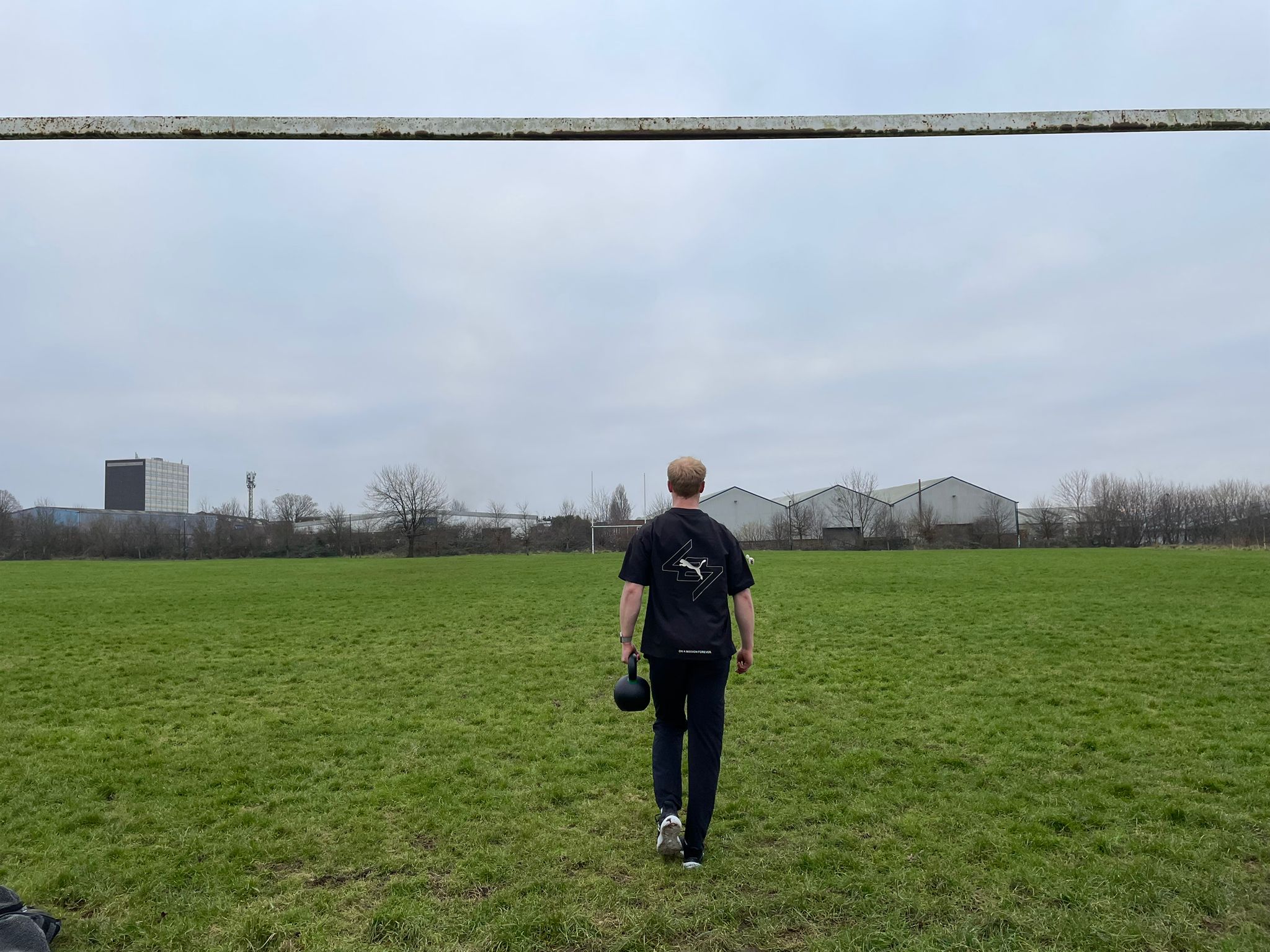 Exercising outside offers both physical and mental benefits, says coach Dan John – even if the weather doesn’t always play ball (Harry Bullmore/The Independent)
Adaptation is essential
Adaptation is the driving force behind all exercise. You exercise because you want your mind or body to adapt in some way – whether that’s gaining muscle, losing fat, improving heart and lung function, boosting your mood or otherwise.
Adaptation in the human body requires new challenges. And, as John points out, training outside provides plenty of those.
“Training outside makes you more like a jazz performer,” he says. “Maybe the ground is soggy so you can’t do a lot of ground work like Turkish get-ups; maybe it’s unseasonably hot; maybe your usual spot has been taken by a family picnic. You have to adapt,” he says.
“I think unexpected adaptations make for great training programmes. Every good idea I’ve ever had as a coach has come from not having access to perfect conditions and making adaptations.”
John invented the goblet squat, now a staple in many strength and conditioning programmes, to cater to the needs of his class and the equipment he had available.
He created the suitcase carry, where you carry a weight in one hand à la a suitcase, because he noticed the benefits of one-sided carries while hauling his daughters’ bags around on holiday.
“There are built-in adaptations when you train outside,” John tells me. “The great thing is, as you are making your way to the park, you don’t know what they are going to be yet – no battle plan survives after the first bullet, and as a coach no plan survives the first comment out of somebody’s mouth.”
When you train outdoors, plans change, green exercisers are forced to try something new and experienced gym-goers might relearn a thing or two through scaling back from the bench press to the press-up. And at the end of it all, everyone benefits from the challenges at hand.
“Also, I don’t know what the calorie burn of keeping gnats off your face is, but it’s not zero, so that’s another benefit,” John adds with a laugh.
Read more: I tried training with one of the fittest women in the world – and it didn’t end well
 ‘If you go to a park every Saturday at 9am and invite friends, then your friends invite friends, pretty soon you’re going to build an intentional community’ (Getty/iStock)
Community
I spoke to Dan on a Monday morning. Our call has an endpoint that is set in stone, because at 9.25am a large group of people will arrive at his Utah house ready to train.
“Five days a week, I open my garage up and people come to train with me,” he says. “It’s free, and we’ve had people come from all over the world.
“So you might say, ‘Dan, you’re so disciplined training at 9.30am every day. But the truth is, I’m not – I train every day because people show up and show their enthusiasm. I’m using their free will to train. I already have the equipment and knowledge, and I have the workouts ready to go, so when they show up I train with them.”
John calls this process “building an intentional community” – a group of people that holds you accountable, outsources motivation as needed and enjoys each other’s company.
His bonus tip for creating a tight-knit group is to go for a bite to eat afterwards every now and then.
“When I lived in California, we always went to a little cafe right off the freeway called Pete’s,” John says. “Obviously you try to go to a place with reasonably healthy food, then you just sit and eat. By the time everyone has food in their bellies, talk turns to next week and how you can make things better. It becomes more normal for people to give a damn about the workouts.”
Read more: I tried Harry Styles’ workout – I’m not surprised by his impressive Berlin Marathon time
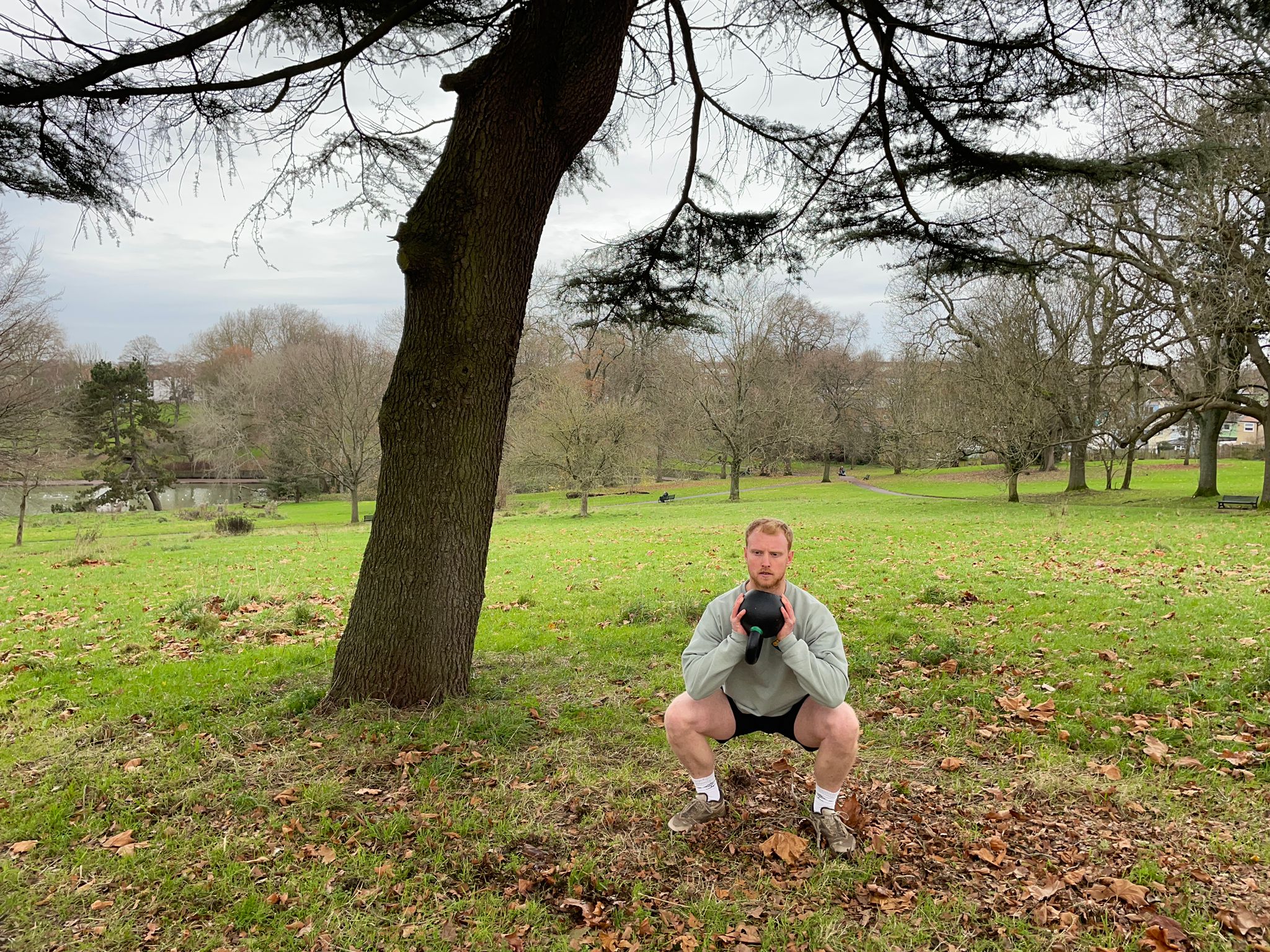 The writer Harry Bullmore performing a goblet squat, a fitness move invented by John himself (Harry Bullmore/The Independent)
Improved mood from more time in nature
You don’t need me to cite research telling you that spending time outside, surrounded by trees and other greenery, is likely to benefit your mental and physical health.
There are plenty of studies to choose from. The University of Loughborough, for example, reported that spending as little as 15 minutes in nature can boost your wellbeing. It is associated with everything from improved mood and concentration to lower blood pressure and resting heart rate.
Yet the average Brit spends just seven per cent of their time outside during the work week . If you can do your workouts outside, this number shoots skyward. Subjectively, it is also rather enjoyable.
“When you’re on your back doing an exercise, one of the funny things is you start to notice things,” John says. “Because I train with people outside, everybody has a squirrel story now. We also have hummingbird feeders in the garden, and when people train out there they start to notice them.
“Now, it’s not that the hummingbirds weren’t there and all of a sudden they showed up. They were always there, but now you’re out there too, and you start to notice things. In a generation of people who always have their head down on their phones, I think that’s quite healthy.”
Read more: Longevity expert says this diet is more effective than Ozempic at changing the human body