
 16 min read
YOU SEE IT in Tom Brady and Roger Federer, who competed into their 40s. In Cristiano Ronaldo and LeBron James, still dominating in their fifth decades. You even see it at your local gym, where grizzled veterans hang with meatheads half their age. Which raises the question: What do they know—and how can the rest of us stay strong and athletic decades from now?
First, the sobering science: We all get weaker, slower, and stiffer. Starting around age 30, we lose muscle mass at a rate of 3 to 8 percent per decade, and muscle strength at about twice that rate. Most precipitous is our loss of power—the explosive combination of speed and strength.
Cardiovascular fitness declines steeply as well, resulting in reduced stamina. Compounding all these issues is the inevitable accumulation of wear and tear on joints, cartilage, and connective tissue, which limits full-body mobility. With each passing decade, the rate of loss of all these qualities increases. Building fitness starts to feel like running up a down escalator.
But research shows we can slow these changes dramatically—extending not just lifespan (how many years you live) but healthspan (living those years free from disability) if we train intelligently. It means recategorizing mobility from “optional” to “essential.” Subbing out exercises on your strength menu that have started doing you more harm than good. Adding some dedicated explosive work. Getting serious about cardio. And above all, learning to listen to your body more sensitively as you age, so injuries never sideline you. That’s the art of durability.
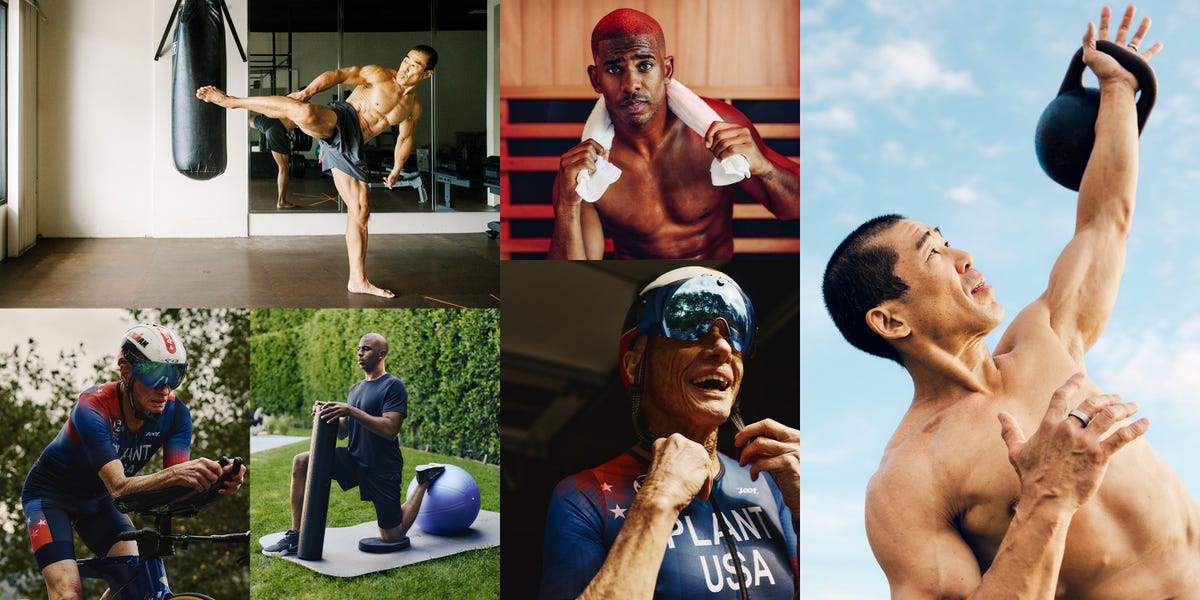
Athletes like 40-year-old hoops icon Chris Paul, 57-year-old trainer Bill Maeda, and 82-year-old triathlete Robert Plant have all made subtle but critical shifts over time. All have maintained elite performance, even after major injuries.
The adjustment, says Mike Boyle, owner of Mike Boyle Strength and Conditioning, is straightforward: “As you age, the ingredients change—but the recipe stays the same.” Hill sprints become air bike intervals. Bench presses become standing cable presses. One thing stays constant: a focus on the three pillars of durable fitness—strength, power, and endurance—and the discipline to check your ego at the gym door. Here’s your road map.
 Clayton Cotterell
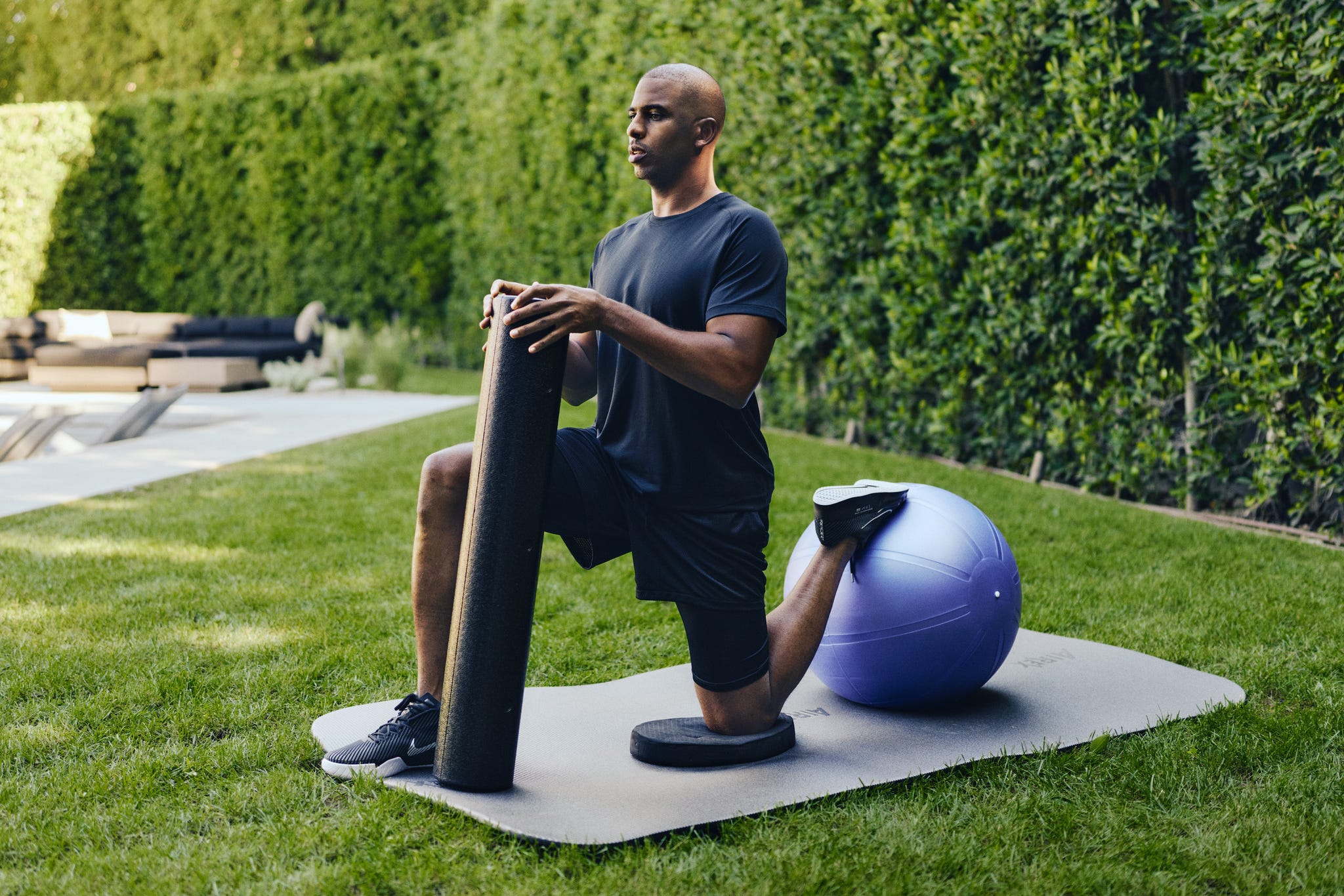
Chris Paul doing a hip mobilizer at his home in Encino, California.
Extend Your Peak
How basketball icon CHRIS PAUL evolved his training to endure 21 years in the NBA.
IN A LEAGUE OF GIANTS, Chris Paul built a Hall of Fame–worthy résumé at just six feet tall. Rookie of the Year. Twelve-time All-Star. Eleven All-NBA teams. Second all-time in assists and steals. In his second-to-last season, he played all 82 games. How’d he pull it off?
It wasn’t luck. Over two decades, Paul endured hand surgeries, foot issues, thumb problems, shoulder setbacks, and a pair of hamstrings that stubbornly refused to stay strung—the kind of tweaks that erode both cartilage and confidence. Paul thrived in the league by doing exactly what all of us need to do as the decades pass: He evolved.
“There was a time before a game I was praying to God I didn’t get hurt,” says Paul, 40. “I got to a point when I was almost scared to go for the ball.” That hesitation is familiar to anyone who’s wrenched a knee or strained a back: You don’t just lose strength—you lose trust. “The best way to play is to be free of thought,” Paul says. “That’s everything.” Regaining that freedom required a late-career tactical shift.
Like many athletic guys, Paul spent his youth attacking the weights with intensity above all. But in 2018, after yet another hamstring injury, he began working with trainer Donnie Raimon, a former Navy SEAL who approached his body like a systems engineer. At the time, Raimon was building a rep among NBA players as a go-to guy for injury prevention. Instead of adding more weight, they started by examining alignment, mobility, and joint mechanics.
“Your feet are literally your foundation,” says Paul. “You could have a dope house with artwork and pianos, but if the foundation isn’t good, the house is going to crumble.” So his workouts begin there, with Raimon mobilizing Paul’s toes, arches, and ankles. Then his hips, his spine—and his quads and hip flexors, using a brutal mobilizer known as the couch stretch. “I won’t play basketball without doing this stretch,” Paul says. “The first thing that gets tight for me—it’s the quads.”
Clayton Cotterell
Another big lesson: Staying healthy is equally about what you do when you aren’t in the gym. “The first thing Donnie gave me was this back pillow,” says Paul. “If you see me going anywhere now, I’ve got this little gray pillow that reminds me to sit upright. So if I’m sitting in a restaurant, driving in the car, I’ve got the pillow.”
It’s not glamorous. But it restores something more valuable than brute strength: pain-free movement. “In Houston, I had a trainer that had been with me for a while and things just weren’t working out,” he says. Paul was plenty strong, but he couldn’t move easily—and his daily life suffered. “I wasn’t comfortable running around playing with my kids in the backyard.”
It’s a common misstep for gymgoers—losing sight of the fact that exercise should make you feel and perform better. If it has the opposite effect, it’s time for a change. “When your joints aren’t aligned,” Raimon explains, “it’s like driving a car with the wheels out of alignment. Something’s going to wear out early.” For aging lifters, that’s the lesson: mechanics first, strength second.
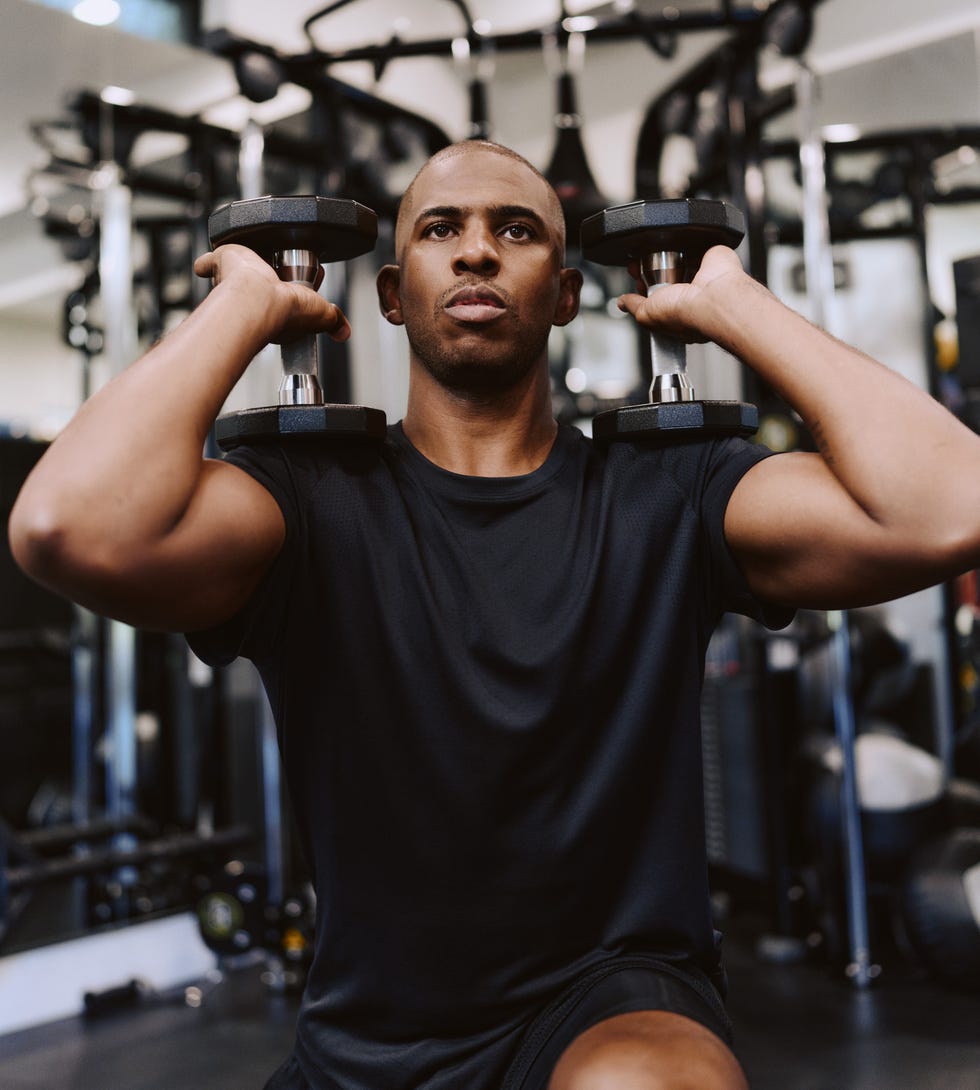
Today, Paul’s workoutsblend mobility, core work, and controlled strength training. Some sessions are toned down to focus on his long-term function and can look and feel more like pilates or yoga performed with barbells. But other times, it’s heavy. “We don’t have to worry about toning down leg day because he has a game tomorrow,” says Raimon. On leg days, Paul comfortably pulls 315 on the deadlift.
The core work emphasizes resisted rotations and anti-rotation drills—functional moves that force the trunk to stabilize while the arms and legs move forcefully. “A guy who used to work on my body always said, ‘Train to be an athlete, not to be a basketball player,’ ” Paul says.
That may be his most transferable insight. After 40, you can still look and perform exceptionally—but you’ve got to broaden your focus. In addition to mirror muscles and bench press numbers, you need to give equal time to the boring stuff: Mobility. Stretching. Form.
Do that, says Paul, and you’ll not only stay competitive on the boards and in the boardroom, but keep pace with the people who matter the most. These days, he says, “I want to go play golf with my brother and my dad. I wanna go shoot around with my son and my daughter. I wanna race somebody if they say they wanna race.”
Recently, on an off day, he says, he was playing a game with his wife, Jada, and their two teenage kids that required them to bend down and grab a paper bag off the floor with their teeth—no hands allowed.
“And I’m thinking to myself, The only reason I got a chance is because I lift,” he says. It’s funny, until you consider how many 40-year-old men would tweak their back trying the same thing. That ability to drop into a deep hinge. To control your body. To move without pain or hesitation. That’s durability. It’s about extending your peak and reshaping it so that strength shows up where you actually live.
Upgrade Your Foundation
To build and maintain max strength and speed in your 20s, 30s, 40s, and beyond, try these tactics.
Build Strength From The Ground Up
Give your dogs more love. Before you squat or run, make sure your toes, arches, and ankles are warmed up. Barefoot balance drills, trigger-point work with a tennis or lacrosse ball, and ankle mobility work can improve alignment all the way up the chain. If the foundation’s off, everything above it pays the painful price.
It’s Mechanics Over Muscle
Hire a trainer (or, failing that, film your lifts) to track your form, especially on big-ticket moves like the deadlift and squat. If your back rounds in a deadlift or your knees cave in a squat, fix that before adding load. Think: mechanics first, strength second. Lift heavy when it makes sense, but don’t let ego dictate the load. Leave three reps in reserve.
Treat Mobility Like a Main Lift
Tight hips and quads don’t just limit performance; they alter how you move through life. Make daily mobility nonnegotiable, especially for hip flexors, quads, spine, and ankles. Key moves for dudes seeking durability: 30–60 seconds each of downward-facing dog, backward lunges, couch stretch, cobra, and World’s Greatest Stretch.
HRV Is a Good Guide to Stress Levels
Heart rate variability (HRV), or the variation in your heart rate at rest, is one metric worth tracking on your Oura, Whoop, or Apple Watch. HRV reflects nervous system stress (it craters with poor sleep, excess exercise, and high stress) and so can reliably indicate when you’re ready for a tough workout and when you should hold back.
 Michelle Mishina Kunz
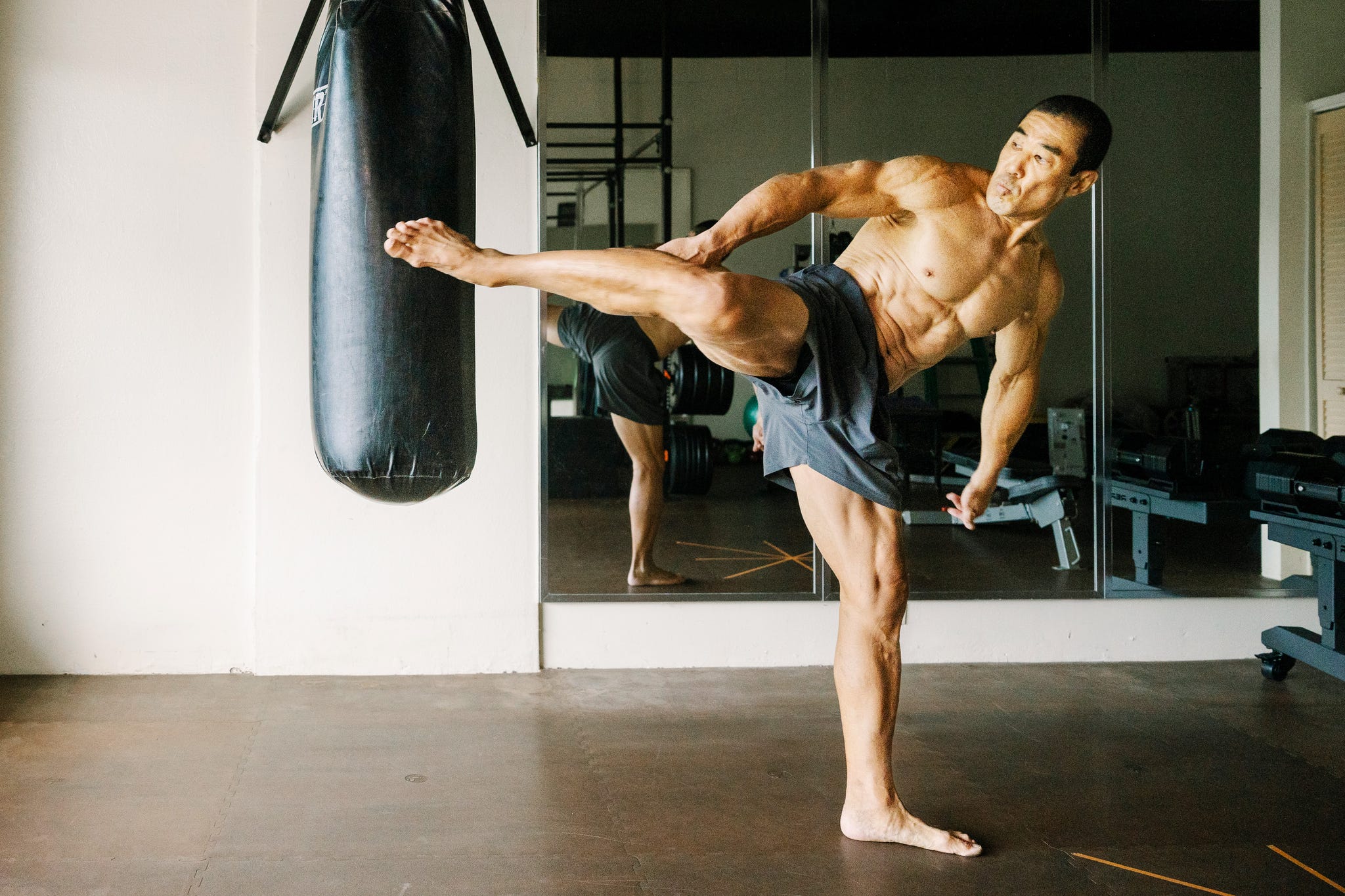
Bill Maeda working on his kicks at his private gym in Honolulu.
Forge Staying Power
How 57-year-old trainer BILL MAEDA stays ripped, strong, and ready for anything.
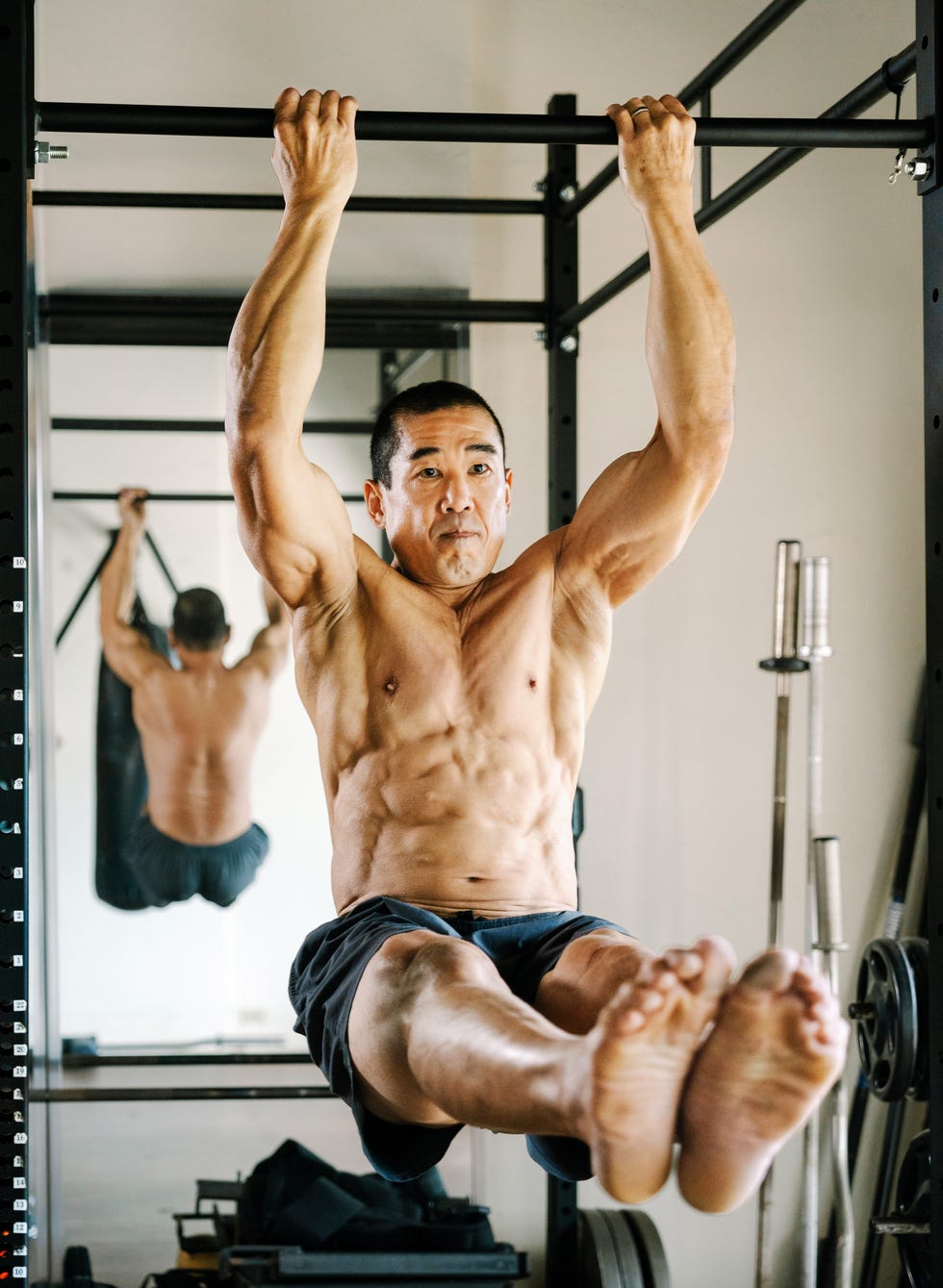
IN THE FLOTSAM of online fitness content, the posts of 57-year-old, Hawaii-based Bill Maeda stand out for sheer visual impact. It helps that Maeda looks like something out of a comic book: impressively muscled, but not overbuilt. More than just gym strong, Maeda looks genuinely athletic, as comfortable running and climbing as lifting heavy iron. You wouldn’t want to tangle with him—his heavy-bag workouts are formidable—but you might also think, If I really, really dialed it in, I could look like that too.
Then there are the moves. One day, the six-foot, 195-pound Maeda is doing a pushup on a pair of inverted kettlebells; the next, it’s a 225-pound deficit deadlift on a slant board; the next, it’s burpees in a 45-pound weight vest. You don’t earn 2.2 million followers on Instagram, however, just by being ripped and strong.
The secret sauce to Maeda’s success as a trainer/influencer—in addition to his chilled-out aloha vibe—is his form. It’s immaculate. Every circus-act move features a slow lift, a pause in the contracted position, and a controlled return to earth, his breathing as deliberate as a yogi’s. In Maeda’s meaty hands, heavy lifting is almost dance-like: effortful, but also graceful and precise, qualities he’s honed over a lifetime of lifting, martial arts, running, and rucking.
“I don’t call what I do working,” he says. “I call it practicing. If I do a max deadlift, I have to be able to place that bell down on the floor more precisely than I lifted it.”
Right there is Maeda’s number one rule on how to build muscle and strength as the years roll by: Check your ego. Control the weight. Listen to your body—and train the one you actually have today.
Though Maeda’s feed provides the wow factor that the ultracompetitive influencer space demands, he’s quick to acknowledge that great physiques are built with unflashy exercises, performed in unflashy ways, over long periods. Fanatical focus on the classic, old-school barbell and dumbbell moves: presses, rows, pullups, squats, deadlifts. “I spent 80 percent of my time…training from my sternum down,” he says. “Leg strength, hip strength, and back strength.” Some favorites: barbell squats, Zercher squats, and deficit Romanian deadlifts.
Michelle Mishina Kunz
Maeda’s lower-body emphasis is the inverse of what most bench-and-curl gym bros do, but it’s something every over-50 lifter should take to heart. Research suggests that maintaining strength and power in your lower body—more than your arms and torso—is essential to maintaining health, function, and even cognition as you age. One large study found that strong quads protected against heart disease mortality; another showed that leg strength predicted slower cognitive decline.
Maeda, whose first ambition was to be an Army Ranger, has never been interested in training for appearance alone. “I always wanted to train to fight,” he says. “When I’m deadlifting, I’m not lifting a bar; I’m lifting a person.” The taste for usable fitness kept his appetite for adventure and variety keen. Over the years, he’s rucked and hiked all over Hawaii and trained with martial arts legends Erik Paulson and Relson Gracie.
In his 40s, looking for a novel challenge, Maeda did a deep dive into kettlebells. Their thick handles and cumbersome shape demanded new levels of strength from his grip, while the athletic, explosive movements—swings, cleans, snatches, jerks—helped develop another skill that conventional weight training addresses only indirectly: power, or the ability to move not just forcefully but quickly.
Both qualities, it turns out, are closely linked with healthy aging. A major 2024 Italian study found that a weak grip was associated with higher incidence of type 2 diabetes, cardiovascular disease, muscle loss, frailty, and even some cancers. And power is crucial for fall prevention and everyday function in older adults—but it erodes quickly if you don’t train it directly. Don’t like kettlebells? No worries. Anytime you move a weight—including your own bodyweight—as fast as possible, that’s power training: Jumps, med-ball throws, Olympic lifts, and agility drills all fit the bill.
Maeda admits he hasn’t always been temperate. “When I was going through a rough period with my marriage and finances, I would bury myself in the kettlebells,” he says. “There’s this exercise called the long cycle—it’s a clean and jerk for 10 minutes straight. I would just go to war with myself.”
Despite the occasional lapse into excess, though, fitness has been a steadying force amidst business successes and failures, family drama, addiction, and even colon cancer, which he beat years ago. And that’s what he preaches to his clients: not punishment, but durability. “I’m a form guy,” Maeda says. “I don’t take a drill instructor approach.”
Some clients are even surprised at how manageable his workouts can be at first. “They might do five sets of one or two reps of a one-inch range-of-motion squat at first,” he says. “They’re surprised.” But intensity, he adds, is strong medicine—and quickly leads to burnout, especially if you’re over 50. “Ten minutes a day adds up if you keep showing up. It’s more important that you make it fun, and make it something you can do again tomorrow.”
Diversify Workouts
When you’re in your 50s or beyond, you’re in use-it-or-lose-it territory.
Commit to Flexiblity
Mobility losses accrue as you age. Ideally you’re doing dynamic stretches before your workouts (think high-knee marches and walking lunges) and static stretches after (think toe touches and door stretches). Even better: Hit a weekly yoga class on a day you’re not going to the gym. And before bed, foam-roll just two or three muscle groups—less than five minutes of work—as part of your wind-down routine.
Evolve Your Moves
Lifetime lifter or recent convert, a 50-year-old body has quirks and old injuries that make once-safe lifts too risky. Frequent culprits include the barbell squat, deadlift, and bench press. If you can do these moves with no problems, have at it—but if you always wake up with sore shoulders after bench-pressing and always strain your back when you squat, rethink your exercises. Boyle’s rule: If a move causes you post-workout joint pain twice, drop it.
Aim For The Sky
The capacity to move fast—which is dictated by your fast-twitch muscle fibers—is highly associated with long-term independence, but it’s also one of the first physical skills to wane with neglect. Spend five minutes—after you’ve warmed up but before you lift—on movements that require explosive speed: jumps, med-ball throws, agility drills. Keep the volume low (two or three sets of less than eight reps) and the effort sky-high.
Train Your Tendons
Holding a muscle group, and the surrounding tissue—tendons, cartilage, and ligaments—under tension for extended periods, even without max effort, causes these tissues to strengthen. A few times a week, hold a half-pushup, a half-pullup (feet on the floor if necessary), a deep squat, and a lunge (both sides) for 10 to 30 seconds each.
 Clayton Cotterell
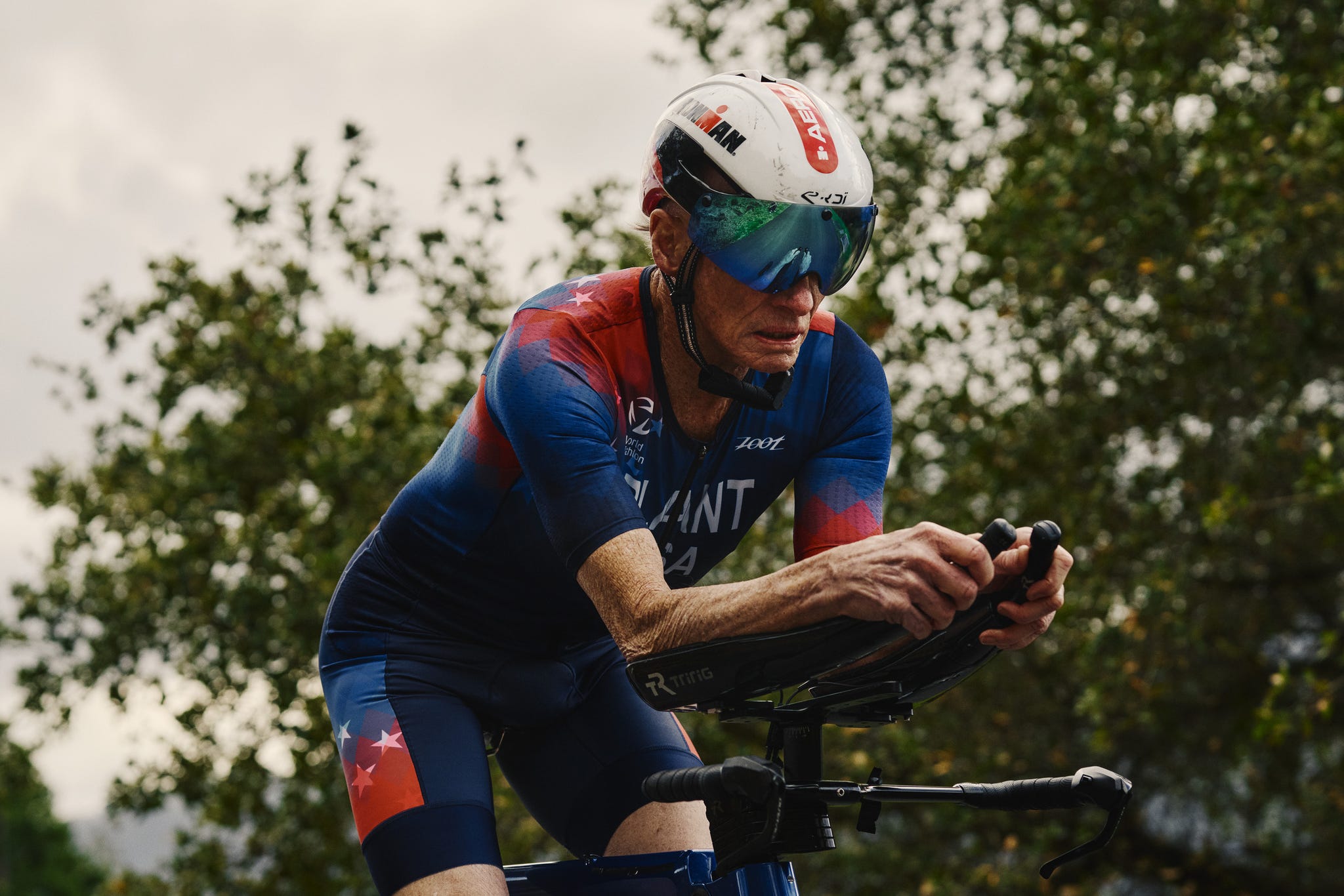
Robert Plant riding near his home in Woodside, California.
GO LOOOOOONG
How 82-year-old triathlete ROBERT PLANT has kept up the pace.
ASK MOST OLDER men about their glory days and they’ll respond with stories from a half-century ago. Not 82-year-old triathlon champion Robert Plant. He’ll regale you with his adventures from the past few years.
About getting blown sideways off his bike on mile 72 of a race in the plains of Texas. (“I broke my vertebrae. My ribs. I couldn’t walk for about three weeks.”) Or the time he finished third in an Ironman—140.6 combined miles of swimming, biking, and running—with a raging case of shingles. (“I was just hoping to finish.”) Or the time he almost froze swimming in the frigid waters of San Francisco Bay in the storied Escape from Alcatraz Triathlon race. (“When you get older, it’s harder to stay warm like the young guys.”)
What he probably won’t tell you is that, with 20 National Championships and 10 World Championship wins under his belt, he’s one of the most decorated age-group triathletes in history. That he set a course record at the Ironman World Championship that has stood for eight years. That in 2022, he was inducted into the sport’s hall of fame—one of just a handful of nonprofessionals ever given that honor.
“When people ask, I’ll talk about it,” says the affable, impossibly lean Plant. “But I don’t say, ‘Guess what I did last year?’ ”
He’s not done yet. Six to nine times annually, he says, he travels to places as far-flung as Abu Dhabi to test his mettle in the sport that’s fascinated him since 1989, when he served as a volunteer at the legendary Iron War between pros Dave Scott and Mark Allen.
“I’m mostly competitive with myself,” he says of what drives him to keep competing in his ninth decade. “If my buddy beats me, I’m happy for him. As long as I do the best I can, I’m happy.”
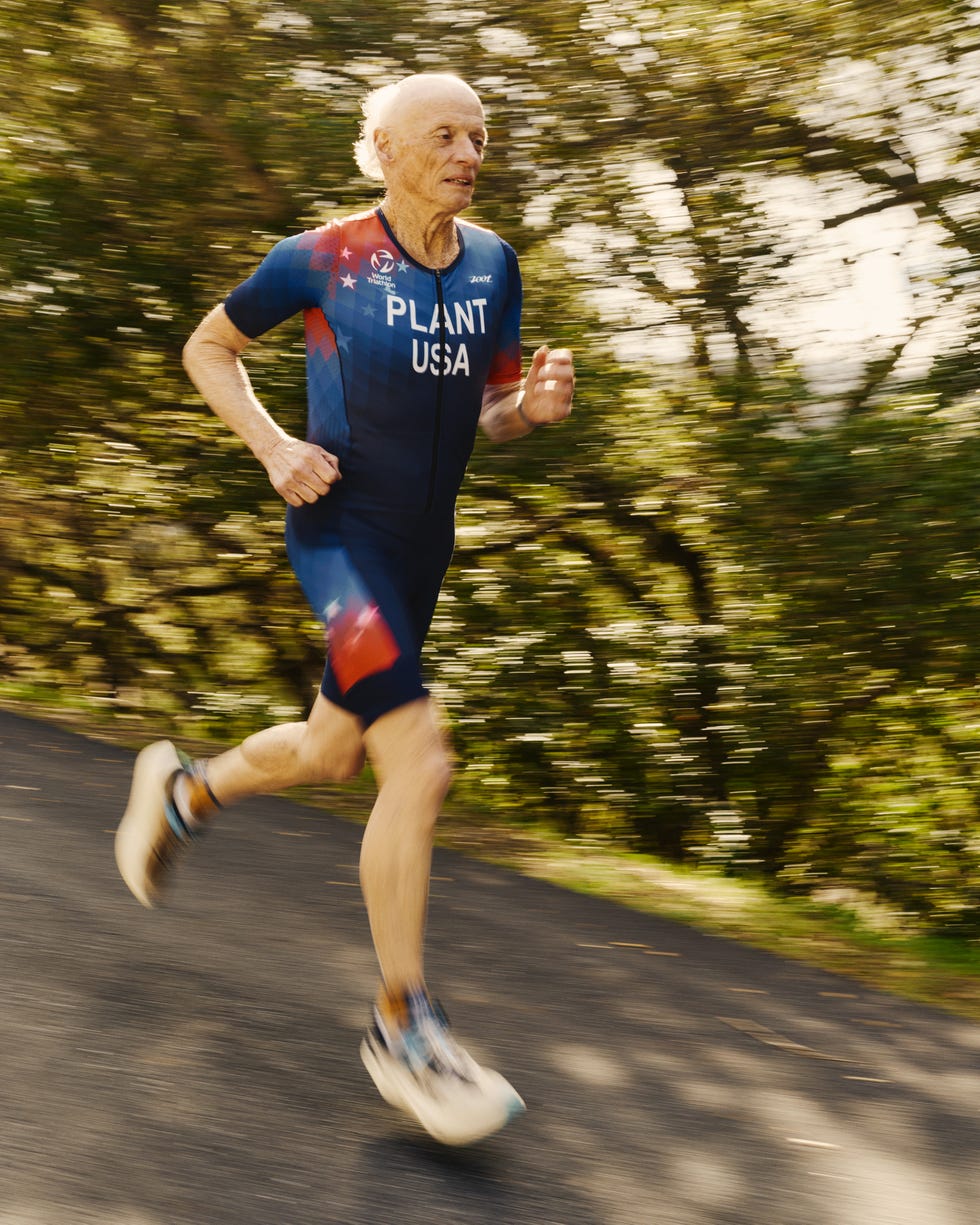
This temperate approach applies to his training as well, which, these days, consists mostly of moderate-distance, moderate-intensity swims, bikes, and runs. “I haven’t done really true speed work in a long time, just because there’s a good chance that you could injure yourself,” he says. After a break from strength training during the pandemic, he has started to ramp his efforts back up: “I’m only 130 pounds—normally, fighting weight is 135 with some muscle on,” he says. “So I’m getting back to that because it makes a big difference, in the legs, especially.”
Clayton Cotterell
It’s a wise choice, and not just for the sake of his running splits. Recent research on older athletes suggests that long-duration cardio exercise, while great for the heart and lungs, is insufficient to guard against age-related decline in strength and muscle. For that, you need strength training.
More than intensity or hardcore hero workouts, however, the key to his success is consistency. “I take one day off a week, whether I feel good or not,” Plant says. “If I don’t, by Wednesday, I’ll wish I had.” Working away at a sane pace, decade after decade, has given him a broad fitness base that allows him to compete at a high level—sometimes nearly on the spur of the moment. The most cycling he’d done before his last Ironman, he says, was “two 40-mile bike rides. And I think I ran 8 miles, maybe 10—once. And so [on race day], I get off the bike and I go, Oh, I’ve got to run 26 miles now.” A half-decade of muscle memory kicked in, however, and Plant ended up on the podium—again.
Competition gives the Woodside, California, resident focus and structure: Unless he’s continually trying to get better as a swimmer, cyclist, and runner, he knows his competitors will overtake him. At his age, that’s a canny approach. Prioritizing performance keeps him focused on how his body is responding to training, ensuring that he neither undertrains nor overtrains. “I listen to my body,” he says. “If I’m pushing too hard, I back off a little. Otherwise, you get injured—and then you have to start all over again.”
Another perk: Competing in triathlons continually broadens his horizons and guards against the loneliness that afflicts many men over 60. At an age when lots of his peers are slowing down, Plant is packing up his gear for a new locale every few weeks, challenging himself physically while also exposing himself to new places, cultures, and people. “I consider triathlon a big family,” says Plant, who is unmarried and never had children. “Race day comes and everybody has this sense of Okay, we’re going to war. Everyone knows and feels the same way.” Outdoor training and travel also boost mood, lengthen life, and improve memory.
So what does Plant’s enduring success teach us about aging? Are we doomed to decrepitude or can we actually fight it off?
Realistically, you’re unlikely to set personal records in your 80s. “I’m training hard as ever,” Plant jokes, “but there’s something wrong with my watch.”
The rate of that decline, however, is largely in your hands. A study found that lifelong cross-country skiers in their 80s and 90s had the cardiovascular fitness of college kids. “Guys half my age walk up stairs and are out of breath,” Plant says. “I tell them, ‘You can do this too.’ ”
Durability, it turns out, isn’t about heroic workouts or defying age. It’s about stacking small, repeatable wins—staying on top of cardio, lifting heavy things regularly, laughing with friends, competing a little, and coming back tomorrow ready to do it again.
Do that often enough and the calendar matters less than you think. “Just get to the next turnaround, the next hill,” says Plant. “I don’t even think about age. It’s not part of my game plan.”
Stay The Course
Four rules for performing your best as you blast through middle and old age.
Train To Keep Training
For lifters over 60, the enemy isn’t laziness; it’s getting hurt. Research on active adults shows that the best predictor of injury is a similar prior injury. So skip the hero workouts, listen to your body, and take rest days seriously.
Find Your Gentle Gear
Slow-and-steady training—where you can hold a conversation—is the real fountain of youth. It burns fat, improves durability, and enhances your ability to bounce back from training. Joints too creaky to run? Take a hike or brisk walk, or skip it and double up on low-impact cycling, swimming, or cardio machines.
Do Single-Leg Moves
Strong legs are a must for healthy aging. But at 60-plus, you may be more vulnerable to injury if you subject your spine to heavy weights. Cut the strain in half—without reducing the intensity—by training one leg at a time. Ditch the leg presses and barbell squats for split squats and step-ups. Work your way to walking lunges, rear-foot-elevated split squats, single-leg Romanian deadlifts, and (if you can handle them) single-leg squats. If an exercise hurts your joints, replace it with a move you can do pain-free.
Make Fitness More Social
Gym work is great, but sports and competition give you structure, friends, and new experiences. Whether it’s pickleball, a cycling club, or a hiking group, shared effort keeps body and mind stimulated and motivated.
This story appears in the Spring 2026 issue of Men’s Health.

Andrew Heffernan, CSCS is a health, fitness, and Feldenkrais coach, and an award-winning health and fitness writer. His writing has been featured in Men’s Health, Experience Life, Onnit.com, and Openfit, among other outlets. An omnivorous athlete, Andrew is black belt in karate, a devoted weight lifter, and a frequent high finisher in triathlon and Spartan races. He lives in Los Angeles with his wife and their two children.