

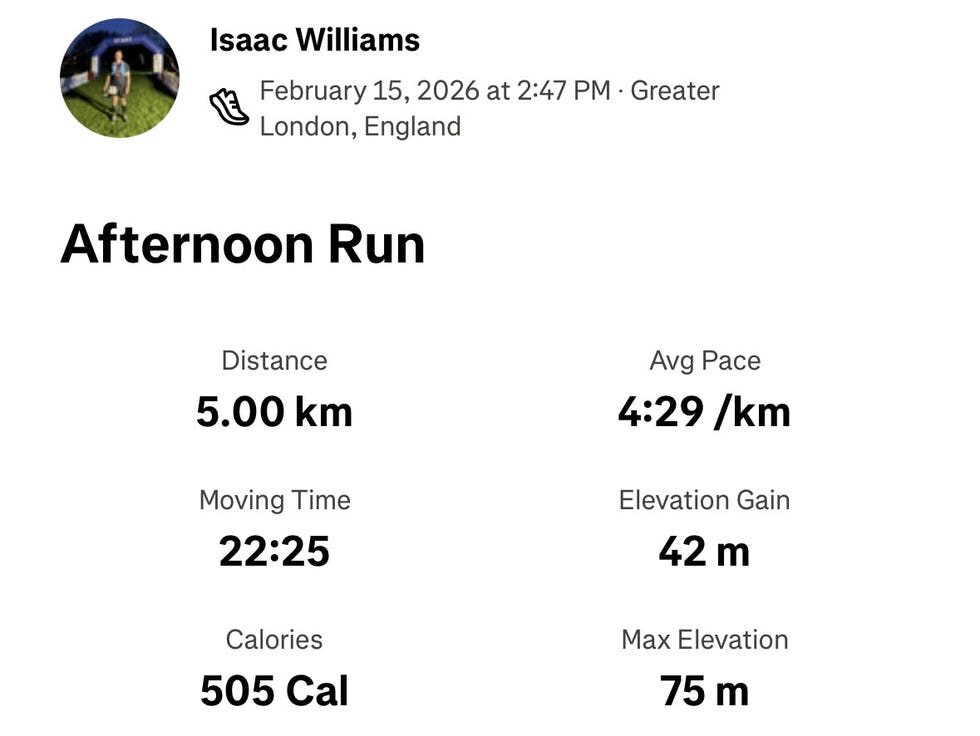
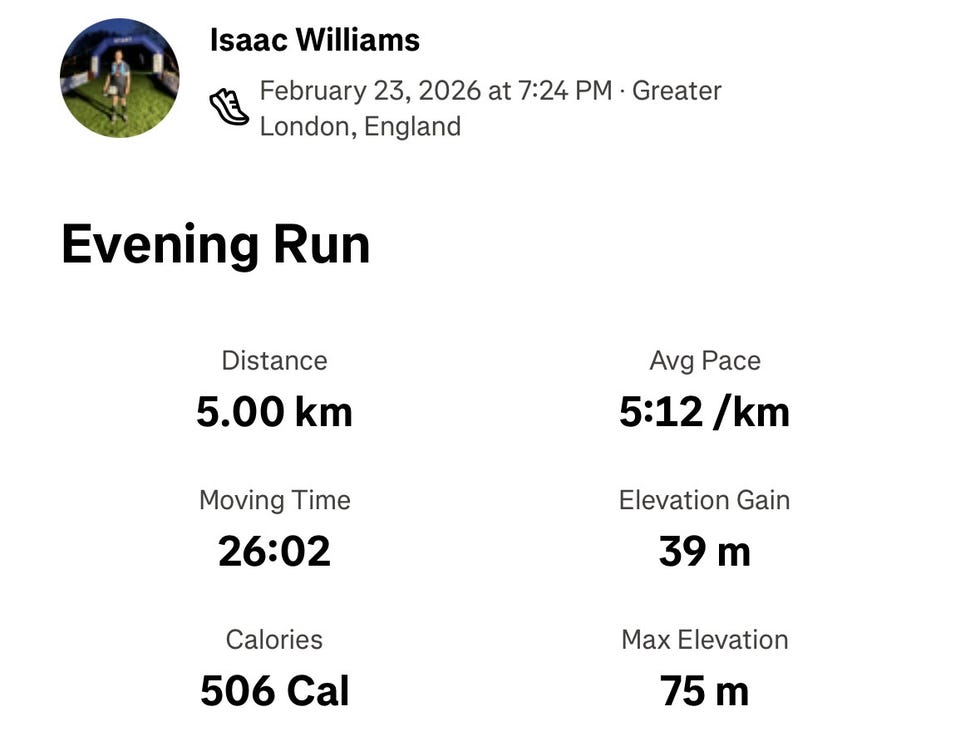
The challenge was simple: run 5K every day for 28 days. No rest days, no shortcuts, no doubling up to get ahead. Just 5K, every day, regardless of how I felt.
I wasn’t starting from scratch, but I wasn’t in peak running shape, either. My training had been half-hearted for a while – enough to get by, but not really enough to improve. I knew that 5K was doable on any given day. The question was what it would feel like doing it 28 times in a row, with a sleep-shy toddler, work and general life distractions thrown in. I also kept strength training twice a week throughout – mainly because I didn’t want my gym numbers to completely fall off a cliff.
The plan – if you can call it that – was to hold everything steady and see what gave first.
 Isaac Williams
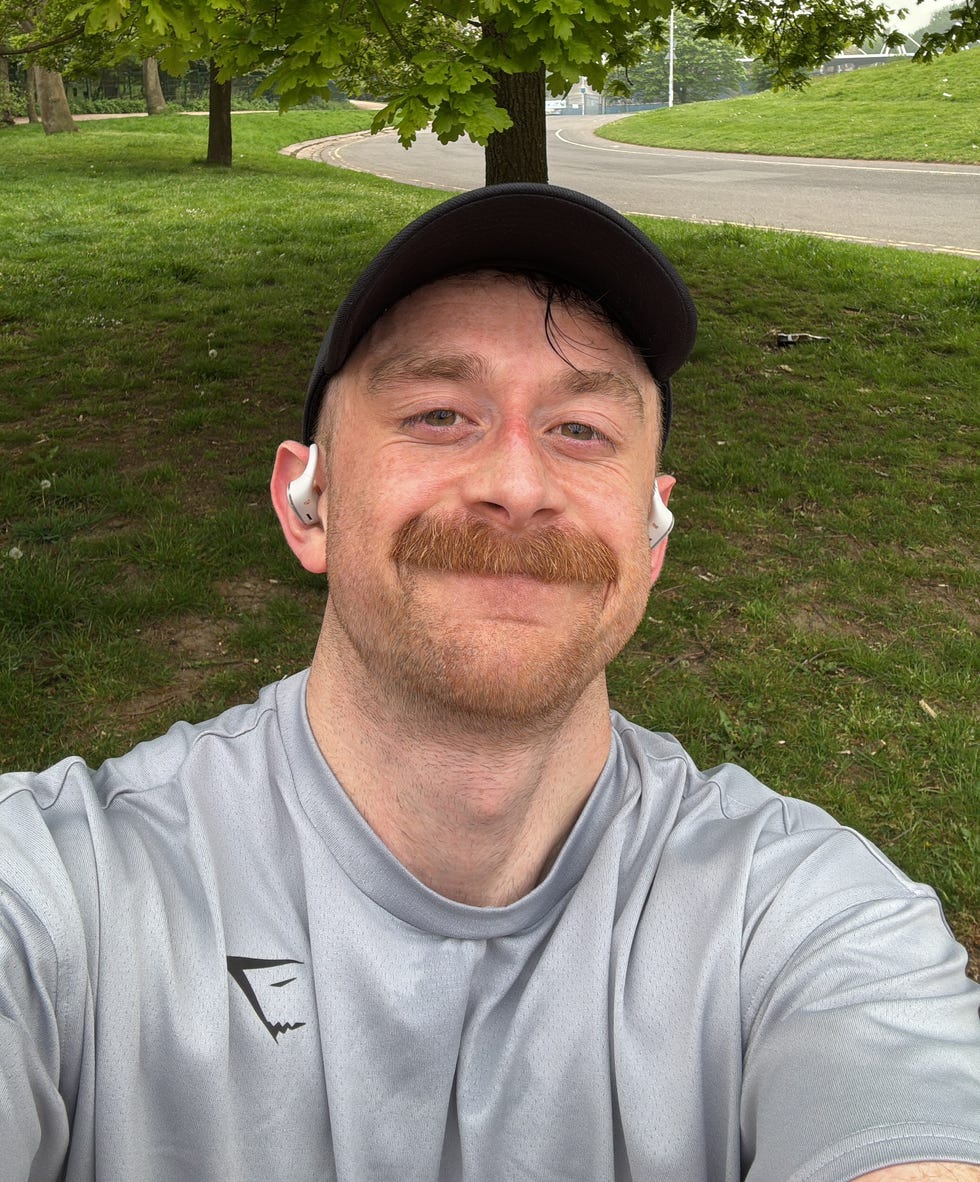
Isaac after one of many Crystal Palace Park laps
5K a day
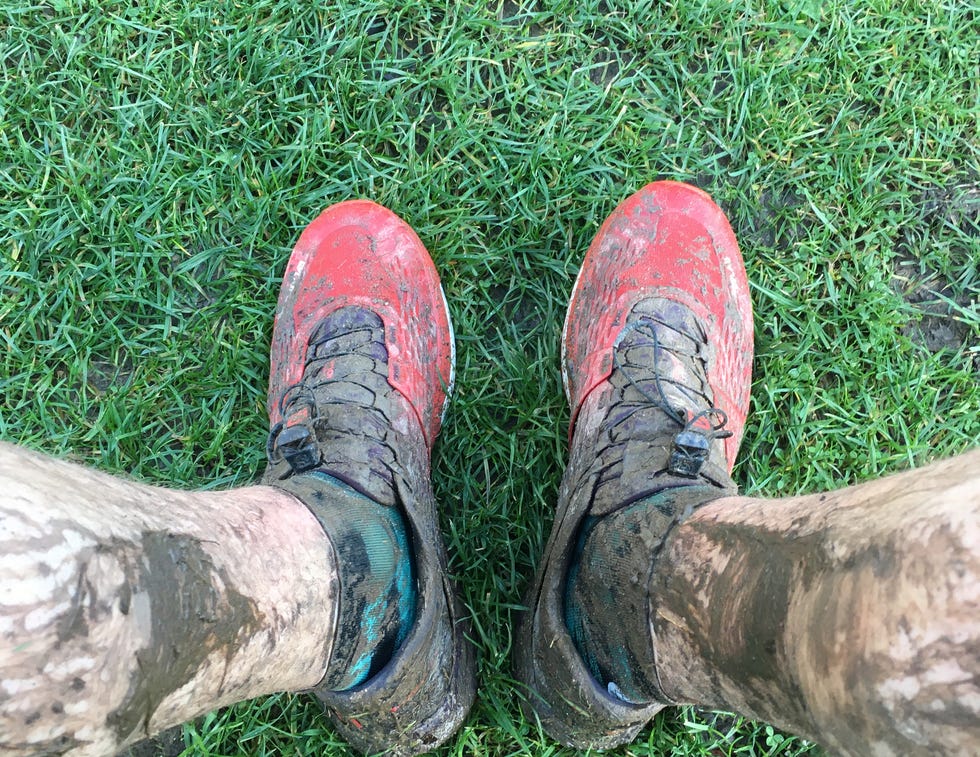
The first week felt like a chore more often than not. A couple of runs came straight after the post-work commute, when motivation was low and the run itself didn’t do much to improve things. One evening in the rain was particularly grim. Another came off the back of no sleep, was left until late and done purely because it had to be.
The gym treadmill made an appearance one lunch break, which was an immediate mistake. Five kilometres indoors felt far longer than it should have done, even when breaking it up with intervals just to stay engaged.
By the second week, fatigue started to build. Day nine stood out as the hardest – low energy, heavy legs and no real explanation beyond the fact that everything was adding up. It didn’t feel like I was getting fitter, just more tired.
Around the middle of the challenge, things became more manageable. The daily effort started to feel less like a battle and more like routine. By day 20, it was just part of the day.
Daily habits
Andrew Tracey, Men’s Health UK’s Fitness Director, explains the rationale behind daily fitness challenges.
‘If you’re looking to make a habit really stick, to the point where it’s almost automatic, then daily adherence can remove a lot of decision fatigue and deliberation. A study in the European Journal of Social Psychology found that, on average, it takes 66 days to achieve automaticity with a habit, but that daily adherence accelerated this time greatly.
‘That being said, ‘daily workout challenges’ tend to be found at the extremes: Facebook mums committing to 30 squats a day for a month (no shade, a great thing to do), or YouTube men documenting their weird new obsession (“You won’t believe what happened when I did this for 30 days…”). They also tend to veer from harmless – and usually fruitless – to ill-advised and self-destructive. But there’s a lot of evidence in favour of building daily habits – especially fitness ones – and the benefits that these can have on the rest of your life.’
Isaac Williams
Isaac Williams
Progressive overload
I wasn’t new to running, but if you are, heed this advice from Daine McKibben Rice, director of Validus Sports Injury Clinic.
‘Running 5K every day for 28 days is less about distance and more about load tolerance. For most people, 5K daily represents a pretty significant increase in cumulative load, particularly if they’re not already running regularly. The strongest evidence shows that rapid increases in training load are the primary driver of running-related injury, rather than distance alone.
‘For beginners, the risks are higher. Around one-third of recreational runners sustain injuries annually, with overuse injuries being the top of the list, such as tendinopathy, shin splints and patellofemoral pain. This can be due to repeated loading without sufficient conditioning or recovery, as musculoskeletal tissues take more time to adapt compared with cardiovascular fitness.
‘A gradual build-up is essential. For beginners, increasing running volume by 5% per week and progressing from two to three runs weekly towards consecutive running days is a safer approach than starting with daily 5K runs.’
 Isaac Williams
It wasn’t all sunshine and rainbows…
The verdict
By the final day, I wasn’t desperate for it to end, which felt like an achievement in itself. I finished with a 5K time trial and came within 30 seconds of the 20-minute mark – not an all-time PB, but the quickest of the year and better than expected given that there hadn’t been a single rest day in four weeks.
The more interesting result was how quickly my body adjusted to running every day. Individual runs didn’t suddenly feel easy, but they stopped feeling like a big deal. It became normal to head out, get 5K done and move on.
‘At the end of the challenge, I hit a two-rep squat PB’
The strength training was where things got confusing. I expected my numbers to dip, or at least stall, but the opposite happened. At the end of the challenge, I hit a two-rep squat PB, which either says something about the benefits of consistent training or suggests that I’d been underperforming before. Possibly both.
In terms of body composition, not much changed. I didn’t lose muscle, but I didn’t drop any body fat, either. That’s probably down to eating more to keep up with the extra running. Daily cardio on its own isn’t a guaranteed shortcut to getting leaner, especially if you’re fuelling properly. And to be fair, that wasn’t the point of the challenge anyway.
Running every day isn’t something that I’d recommend in the long term and it’s not the smartest way to improve performance. But as a short, controlled block of consistency, it does exactly what you’d expect: it builds a habit, raises your baseline and proves that you can handle more than you think.
This article first appeared in Men’s Health UK.