
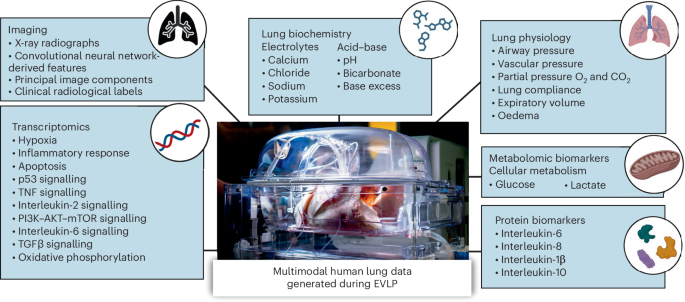
Using data from nearly 1,000 EVLP procedures, the authors assembled a longitudinal dataset spanning biochemical concentrations, physiological measurements, imaging and transcriptomic readouts (pictured). These data were used to train a hybrid modelling approach that combines physics-based descriptions of lung mechanics with machine-learning models, including gated recurrent units and gradient-boosted trees, to forecast the evolution of more than 75 functional and molecular parameters. The resulting digital twin operated as a dynamic, personalized model that can be initialized early during EVLP and updated as additional data are collected, yielding time-resolved predictions of organ state.
A central application explored in the study is the use of digital twins as a personalized control condition for therapeutic assessment. In this framework, the digital twin predicted the expected trajectory of a lung in the absence of intervention, creating a digital ‘no treatment’ control that can be compared to the physical counterpart treated with the blood clot thinner alteplase. This approach reduces reliance on matched control organs and partially mitigates inter-organ variability, a longstanding limitation in preclinical transplantation research. The authors showed that these digital twin-derived counterfactuals align closely with measured outcomes, supporting their use in evaluating treatment responses under EVLP conditions.