
The Employees’ Provident Fund Organisation (EPFO) has rolled out a simplified framework for Provident Fund (PF) advance withdrawals under the EPF Scheme, 2026, effective 29 June.
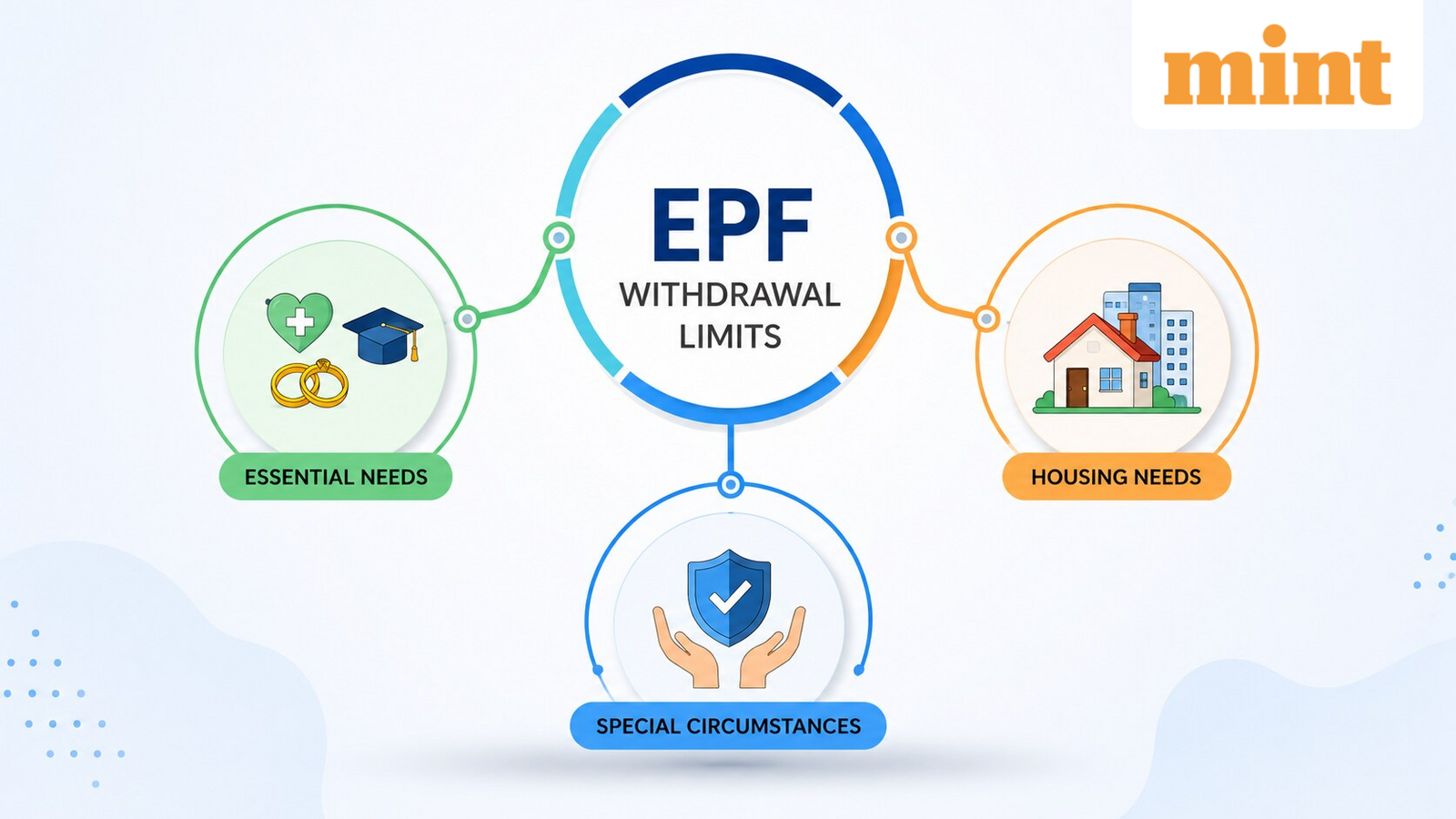
One of the biggest changes is the consolidation of 13 withdrawal provisions into just three broad categories: essential needs, housing needs and special circumstances. The move replaces the earlier system that had multiple separate withdrawal provisions, making the rules easier for members to understand.
Here’s what you need to know about the updated withdrawal categories and frequency limits.
Three categories for EPF withdrawals
Under the new framework, EPFO has grouped advance withdrawals based on the purpose for which the money is required. It means withdrawing EPF funds while a member is still employed.
Category I: Essential needs
The category covers expenses related to illness, education and marriage.
Category II: Housing-related needs
The second category combines all major housing-related withdrawals into a single framework.
Subscribers can make withdrawals for:
Purchase of a flat, house or plotConstruction of a houseRepayment of a home loanRenovation, alteration or improvement of a house
Members can make withdrawals under this category up to five times during their EPF membership, bringing various housing-related provisions under one simplified rule.
Category III: Special circumstances
The third category is designed for exceptional situations as notified by the EPFO’s Central Board.
Subscribers can withdraw funds in this category up to two times per financial year.
EPFO shared a “Smart Guide on New Rules on EPF Advances” on its official X account, summarising the new withdrawal categories and frequency limits under the EPF Scheme, 2026.
Up to 75% withdrawal allowed after 12 months of EPF membership
The revised framework also introduced a uniform guideline for partial withdrawals.
After completing 12 months of EPF membership, subscribers can withdraw up to 75% of their EPF balance, including both the employee’s and employer’s contributions, plus accumulated interest.
Digital claims enable quicker settlements
Apart from simplifying withdrawal categories, EPFO has also focused on improving the overall claim process.
Eligible online withdrawal claims are now targeted for settlement within three working days, reducing waiting time for members.
The claims process has also become paperless through Aadhaar-based online verification, eliminating much of the documentation that was previously required.
Minimum balance rule ensures savings
While the revised scheme provides greater flexibility, members must retain at least 25% of their eligible EPF balance after making a partial withdrawal. The requirement is intended to ensure that a portion of retirement savings remains intact even after advances are taken during employment.
Disclaimer: This is meant for informational purposes only. Please refer to the latest EPFO notifications or seek professional advice for the applicable rules and regulations.