
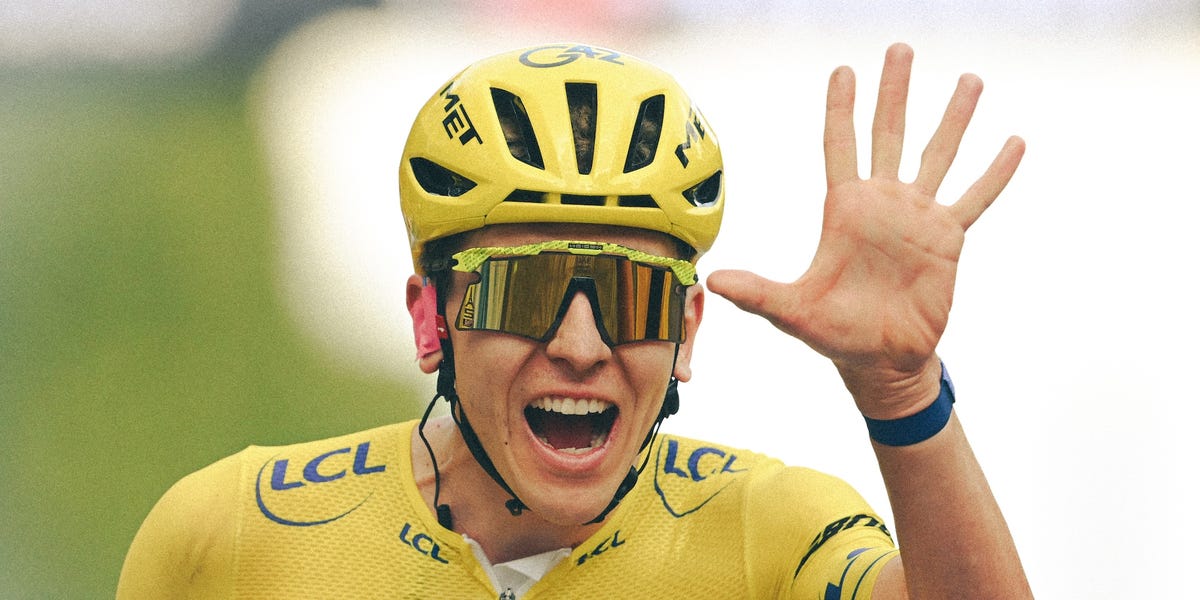
Tadej Pogacar is quickly cementing his status as one of cycling’s all-time greats, having won his fifth Tour de France title on Sunday in dominant fashion. The Slovenian rider impressed throughout the race – not least when he set a record on the iconic Alpe d’Huez, averaging a staggering 7W/kg for the entire climb.
Now, scientists have estimated Pogacar’s potential VO2 max. Shared with Velo, and due to be published in the International Journal of Sports Physiology and Performance later this year, the paper suggests the 27-year-old is close to the 100 ml/kg/min mark after analysing a number of his key performances.
‘The results were remarkably consistent,’ the researchers concluded. ‘Even under the most conservative assumptions, Pogacar would need a VO₂ max of between 90 and 102 ml/kg/min, with an average of 96 ml/kg/min.’
How to Estimate Your Own VO2 Max
One of the study’s researchers, Sebastian Sitko, has previously devised an at-home 5-minute VO2 max test for cyclists. It’s based on a simple equation, where ‘five-minute relative power output’ refers to the average watts you can produce over five minutes, divided by your bodyweight in kilograms.
For example, if you average 300W for five minutes and weigh 80kg, your relative power output would be 3.75.
VO₂ max = 16.6 + (8.87 × five-minute relative power output)
 3 Cycling Workouts to Improve Your VO2 Max
Before getting into specific VO₂ max training, it’s important to establish your functional threshold power (FTP). FTP helps guide your workouts and determine your training zones.
A practical way to estimate it is by measuring the highest average power – in watts – that you can sustain for one hour on the bike. Once you’ve got that number, try these interval sessions:
1. 5×515-20 mins warm-up5 sets × 5 mins @ 110-120% of FTP3 mins recovery @ Zone 110-15 mins cool-down2. 40/2015-20 mins warm-up6 sets × 40 secs @ 130% of FTP, then 20 secs @ 45% of FTP7 mins recovery @ Zone 1Repeat 3 times10-15 mins cool-down3. Zone 5 Intervals15-20 mins warm-up6-8 sets × 3 mins @ Zone 53 mins recovery @ Zone 110-15 mins cool-down
If there’s one thing Kori Sampson knows, it’s how to optimise your body composition for performance. To tap into his knowledge as an elite athlete and coach, we asked him to create a 4-week plan to help you move faster, recover quicker and keep pushing when the fatigue sets in – all while improving your muscle-to-fat ratio.
Ready to build muscle, burn fat and come out the other side looking, feeling and performing better? CLICK HERE to get 14 days of free access to the plan via the Men’s Health app.


Ryan is a Senior Writer at Men’s Health UK with a passion for storytelling, health and fitness. Having graduated from Cardiff University in 2020, and later obtaining his NCTJ qualification, Ryan started his career as a Trainee News Writer for sports titles Golf Monthly, Cycling Weekly and Rugby World before progressing to Staff Writer and subsequently Senior Writer with football magazine FourFourTwo.
During his two-and-a-half years there he wrote news stories for the website and features for the magazine, while he also interviewed names such as Les Ferdinand, Ally McCoist, Jamie Redknapp and Antonio Rudiger, among many others. His standout memory, though, came when getting the opportunity to speak to then-Plymouth Argyle manager Steven Schumacher as the club won League One in 2023.
Having grown up a keen footballer and playing for his boyhood side until the age of 16, Ryan got the opportunity to represent Northern Ireland national futsal team eight times, scoring three goals against England, Scotland and Gibraltar. Now past his peak, Ryan prefers to mix weightlifting with running – he achieved a marathon PB of 3:31:49 at Manchester in April 2025, but credits the heat for failing to get below the coveted 3:30 mark…
You can follow Ryan on Instagram @ryan.dabbs or on X @ryandabbs_