
There are many wonderful things about getting older (better self-knowledge! Retirement! Discounts on travel!), and many reasons we should celebrate the ageing process. But it does, of course, come with downsides.
One of these is the increased challenges of doing things we know are good for us, such as regular exercise. Workouts we used to find a breeze seem to suddenly leave us aching for days afterwards. Going for a run has increased risks of injury. It’s sod’s law: just when we arguably need the strength-building benefits of exercise the most, it becomes ever more difficult.
Even walking, thought of as a gentler but still incredibly impactful form of exercise, becomes trickier as we age. A new study explores why this is the case, noting that as we age, we unconsciously put more effort into stability rather than speed and energy efficiency. This means that older adults are more likely to do something called co-contraction, which refers to activating opposing muscles around the ankle at the same time – so the ankle is actually operating in a different way to how it did in your youth.
Co-contraction stiffens the ankle joint, which improves stability. That’s a good thing. But it also makes the act of walking feel more effortful. That’s why as people get older, walking often becomes slower and more tiring. ‘Stiffening the joint makes walking safer, but it also means the muscles are working harder without generating as much forward movement,’ explained the study’s lead author, Dr Cody Lindsay.
This is a change that happens without much thought, but there are some more deliberate choices we should be making to adapt our walking routine as we age. Finding longer walks more tiring or not being able to walk as fast doesn’t mean we should give up on walking entirely – it remains a highly effective form of exercise. What it does mean is that we need to change the way we approach walking to make it best fit this new stage of life.
Change how? We asked experts for their recommendations. Here’s what they said.
12 ways women should change their walking routines in midlife and beyond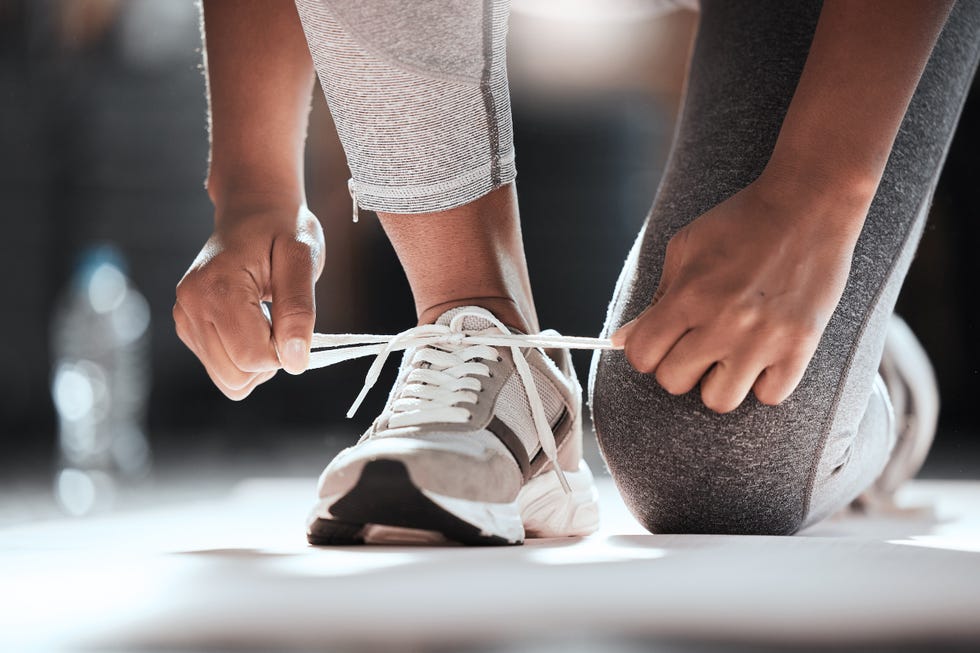
Yuri Arcurs peopleimages.com
Adjust pace and duration
If your body is yelling at you to slow down, listen. ‘It’s seen in popular culture that pushing through the pain and never giving up is something to aspire to,’ advises Anwen Davies, a certified personal trainer at Net World Sports. ‘However, in midlife, recovery can take a lot longer, joint issues and fatigue are more common, so it is important not to push yourself too hard. If you are experiencing pain or exhaustion, it’s worth reducing the pace or duration rather than pushing through.’
Sort out your shoes
As you age and oestrogen declines, connective tissue dips in quality, collagen becomes less elastic, the plantar fat pad (the natural shock absorber under the heal) thins, and tendon repair slows. All this means that having the right shoes is more important than ever. And having the ‘right’ shoes requires consistent, long-term attention.
‘Retire shoes on a schedule, not on appearance,’ recommends Dr Suzanne Fuchs, a podiatrist, foot and ankle surgeon, and sports medicine specialist. ‘Midsole foam compresses and stops absorbing force long before the upper looks worn. Replace at roughly 300–500 miles or every six months of regular walking. Tip: write the purchase date inside the tongue in permanent marker.
‘Get remeasured annually – and expect to size up. Feet genuinely lengthen and widen in midlife. A large share of women I see are wearing the size they wore in their 30s, and the resulting forefoot compression drives neuromas, bunion progression and nail trauma. Tip: measure standing, late in the day, both feet. Prioritise toe box width.
‘Add forefoot cushioning. Because the fat pad thins, a cushioned insole or a metatarsal pad placed just behind the metatarsal heads redistributes pressure off the ball of the foot. This is one of the highest-yield, lowest-effort changes available.’
Instead of going longer or faster, try adding incline or resistance
It’s natural to want to keep your fitness routine challenging, and to become frustrated if you can’t do that. But in midlife and beyond, it’s important to change the way you add difficulty. Your goal might not be to walk further or faster than ever before. Instead it could be to do with incline. ‘A flat steady pace walking is amazing for general health, but adding hills or an incline on a treadmill can help to activate your glutes, hamstrings and core much harder,’ says Anwen. ‘This can help to counteract the natural muscle loss that happens in midlife. It’s good to set objectives. If you own a treadmill, start with a slight incline of maybe 4-5%, or choose a hilly route for part of your walk. Once you start to find it easy, slowly increase the incline, or the challenge on your walking routes.’

Paul Biris
Try intermittent faster walking
Dr. Colin Pennington, a personal trainer as well as assistant professor and program director of the Exercise Science Program at Gwynedd Mercy University, explains: ‘The drop in bone mineral density from aging increases fracture risk, which is a serious concern. While walking provides cardiovascular benefits, steady-state flat walking is typically insufficient on its own to stimulate significant bone density, and cardio benefits are only proportional to the pace and intensity of the walking.’
He advises gently increasing the ‘walking work load’ to ensure you’re maximising the benefits, and one way to do this is through ‘intermittent bouts of fast-paced walking during bouts of moderate-pace walking’, which he explains ‘triggers greater adaptations in cardiorespiratory fitness and insulin sensitivity – more health “bang” for your buck.’
To get more specific, Dr Colin recommends: ‘After a 5-minute warm-up, alternate between 3 minutes of fast walking (where speaking in full sentences is difficult) and 3 minutes of moderate/recovery walking (able to speak in full sentences without difficulty). Repeat for 4-5 cycles (25-30 minutes total).’
Slow down your progress
‘Most stress fractures I treat trace to a sudden jump,’ says Dr Suzanne, ‘a new step goal, a walking vacation, a new job with a long commute. The tissue adapts; it just needs a slower runway.’ She advises progressing at a rate of no more than 10% extra per week. So if you’re currently walking 10 minutes a day, next week you should be doing 11 minutes and no more. It might be frustrating to move slowly, but it could save you from months of recovery from a serious injury.
Vary terrain
‘Walking on varied terrain forces active hip and gluteus extension and greater ankle range of motion, reducing repetitive localised joint impact while strengthening stabilising musculature,’ Dr Colin notes. ‘On outdoor walks, seek out packed trails, grass, or gravel to challenge subtle proprioceptive and balance pathways.’
Igor Alecsander//Getty Images
Work on improving your balance
‘Balance naturally can decline as we age, and poor balance is one of the the most common culprits for falls in later life,’ Anwen notes. The problem is that once you fall, you might become more cautious of falling again, leading to even more co-contraction. Try bolstering your confidence and your walking ability by building stability long-term, which should reduce the amount of co-contraction you end up doing. ‘Doing simple workouts like single leg stands while brushing your teeth or walking heel to toe for short stretches can help build balance without using any extra time in your day,’ says Anwen. ‘It sounds small, but this kind of practise genuinely reduces the fall risk over time.’
Add in strength training
‘Walking alone does not provide the same stimulus for maintaining strength,’ notes Richard Bennett, a strength and conditioning coach and personal trainer. ‘Strong calves, thighs, hips and trunk help us produce force and control each step. Treat walking and strength training as complementary. Walking develops endurance, while strength training helps maintain the physical capacity behind it. Walking is part of healthy ageing, but maintaining the capacity to walk well is the bigger picture.’
‘Walking is great for cardiovascular health, but it does not adequately train every major muscle group,’ agrees Dr Reuben Chen, a physician specialising in sports medicine, pain management, and longevity. ‘Adding resistance exercises, especially for the legs, glutes, hips, and core – can help build and maintain muscle strength, stability, and functional capacity as we all age.’
Strength training doesn’t have to mean powerlifting or hard-hitting gym seshes. Just a few sessions a week of bodyweight exercises such as squats, lunges and resistance band work will do the trick.
Alternate ‘types’ of walks
Anwen recommends: ‘A good approach would be to alternate a longer, easier walk with a shorter, brisker one during the week, rather than doing the same intensity every day. This gives the joints a varied load rather than repetitive stress.’ Colin agrees, suggesting: ‘Designate 2 days for interval/incline walking, 2 days for low-intensity walking, and 2-3 days for resistance and mobility training.’
Stevica Mrdja//Getty Images
Commit to warming up properly
Back in the day you might have reserved warm-ups only for particularly heavy workouts – long runs, big weightlifting sessions, that kind of thing. Now, warm-ups are required even for ‘gentler’ exercise such as walking. Anwen says: ‘Typically, this is a universal rule, but I stress that this is even more so important in midlife as the joints and muscles will need a bit more preparation. It can be as easy as a five-minute warm-up of gentle leg swings, hip circles and a slow-paced walk before you pick up some speed. Doing this will help reduce the risk of injury significantly, and it’s such a simple habit to build in.’
Rest is best
Similarly, you might think there’s no need to take days off for an exercise as gentle as walking. But it’s absolutely essential to take time to rest and recover. ‘Don’t overlook recovery as it can become increasingly important in midlife and beyond,’ says Dr Chen. ‘Women should allow adequate rest between more demanding sessions, pay attention to persistent soreness or pain, prioritise sleep and hydration, and avoid abruptly increasing walking volume.’
That doesn’t mean following up each hike you do with a day stuck in bed. Instead, it might mean that you take a slower, shorter walk on days between chunkier exercise sessions.
Stop ignoring pain
Straight talk time: you can no longer afford to be dismissive of your physical health. ‘Treat morning first-step pain as a signal, not a nuisance,’ says Suzanne. ‘Pain that’s worst with the first steps out of bed is the classic presentation of plantar fasciitis. If it persists beyond two to three weeks, get evaluated – early intervention is dramatically more effective than late.’
READ MORE HEALTH AND WELLBEING FEATURES: