
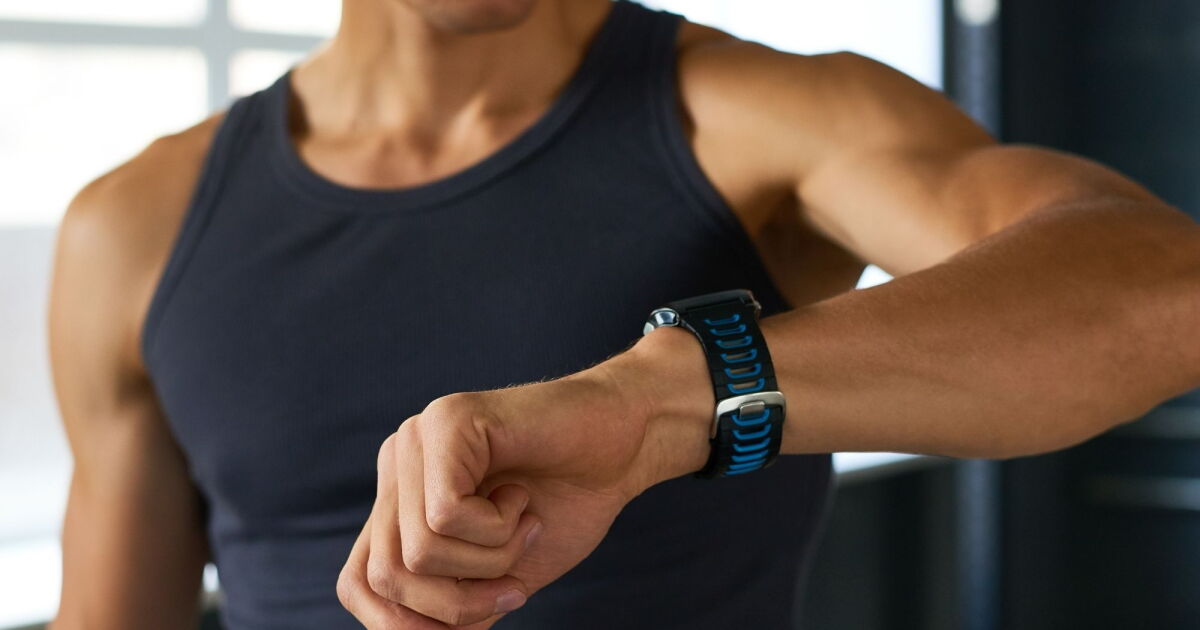
Congratulations! Your watch says you’ve grunted, sweated, and panted your way through 1025 calories on your morning run.
Before you reward yourself with a blueberry muffin, you might want to consider whether your smartwatch is lying to you.
Tests conducted by a team of researchers from Florida International University found that the physical activity energy expenditure calculated by a variety of commercial smartwatches consistently overestimated calorie output, and only worsened as the wearer’s body fat increased.
“You can’t treat the calories-burned number it gives you as an accurate number, because it’s not,” says lead author and exercise scientist Jason Kostrna.
“You could be off hundreds of calories each week and easily end up in a calorie surplus when you think you’re in a calorie deficit.”
Wearable trackers became the ultimate in fitness accessories a little over 15 years ago with the commercial debut of the “Fitbit”. Ever since then, people have relied on smart technology to monitor everything from walking pace to sleep cycle to heart rate to energy consumption.
Most derive biometric measures like energy expenditure using a process called photoplethysmography, which uses the reflection of light from an LED to measure fluctuations in blood volume beneath the skin.
Past studies have found that Fitbit devices tend to underestimate heart rates, steps, and calories burned. Yet there are surprisingly few evaluations across different ethnicities, body compositions, and intensities of physical activity.
Kostrna’s team put four popular wrist-worn fitness trackers to the test with a group of 58 participants, noting down variations in skin tone, height, and body fat percentage. Each volunteer was then put through an intense session of cycling on a recumbent ergometer.
Compared with the laboratory analyzer, the errors on the smartwatches averaged between 80 and 110 calories, or roughly 15 to 25%.
Of the four devices tested, the Samsung Galaxy Watch 5 and Garmin Forerunner 955 systematically overestimated energy expenditure the most. The Apple Watch Series 8’s overestimation was far lower.
Fitbit Sense 2 didn’t show a significant average bias in its accepted results, though 13% of its estimates were implausible. Taking those into account, the device was the worst performing of the four.
The good news is that there was no noticeable variation across the participants’ skin tones. Body fat, however, seemed to have a rather significant effect on the reliability of measurements. Having a higher percentage of body fat made readings far less accurate.
Whether this is a consequence of the technology used to measure blood flow or a problem with the algorithms that transform it into a measure of energy consumption isn’t clear.
For many users, a ballpark calorie count may serve as a suitable source of encouragement to push a little harder in their workout. In cases where precision matters, whether it’s for research, clinical judgements, or high-performance sporting success, those numbers could matter.
“They may be imperfect, but these devices can still have an important role to play,” says Kostrna.
“Track your own trends over time. If tracking helps, enjoy it. If it becomes too much, don’t fixate on it. Focus on how you feel and use the data as one tool to help you improve over time.”
This research was published in PLOS One.
Source: Florida International University