
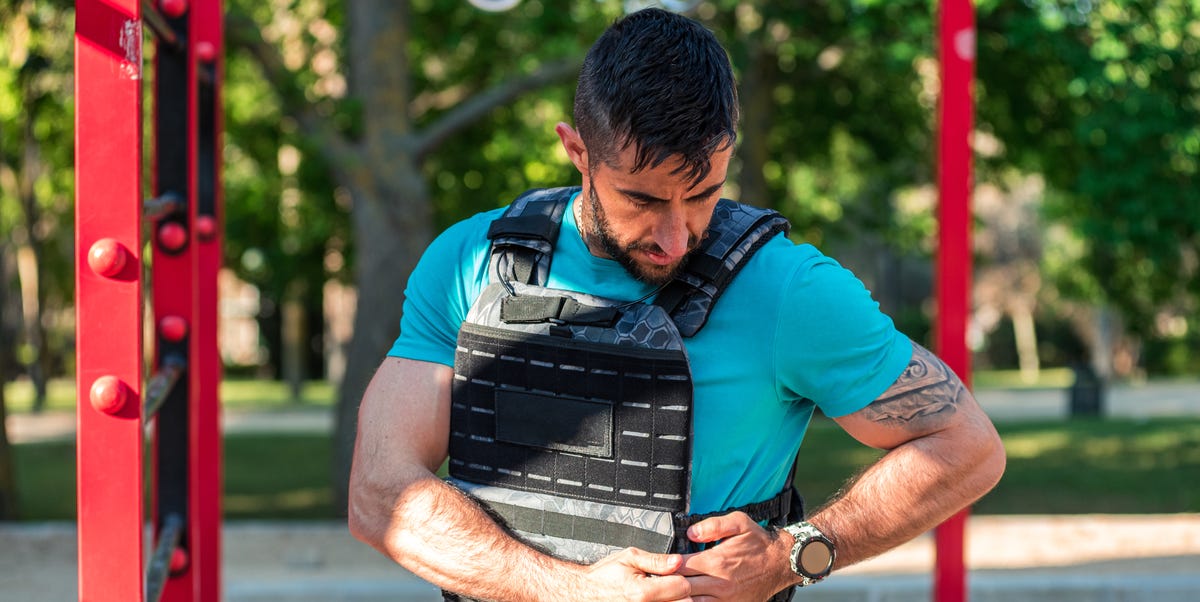
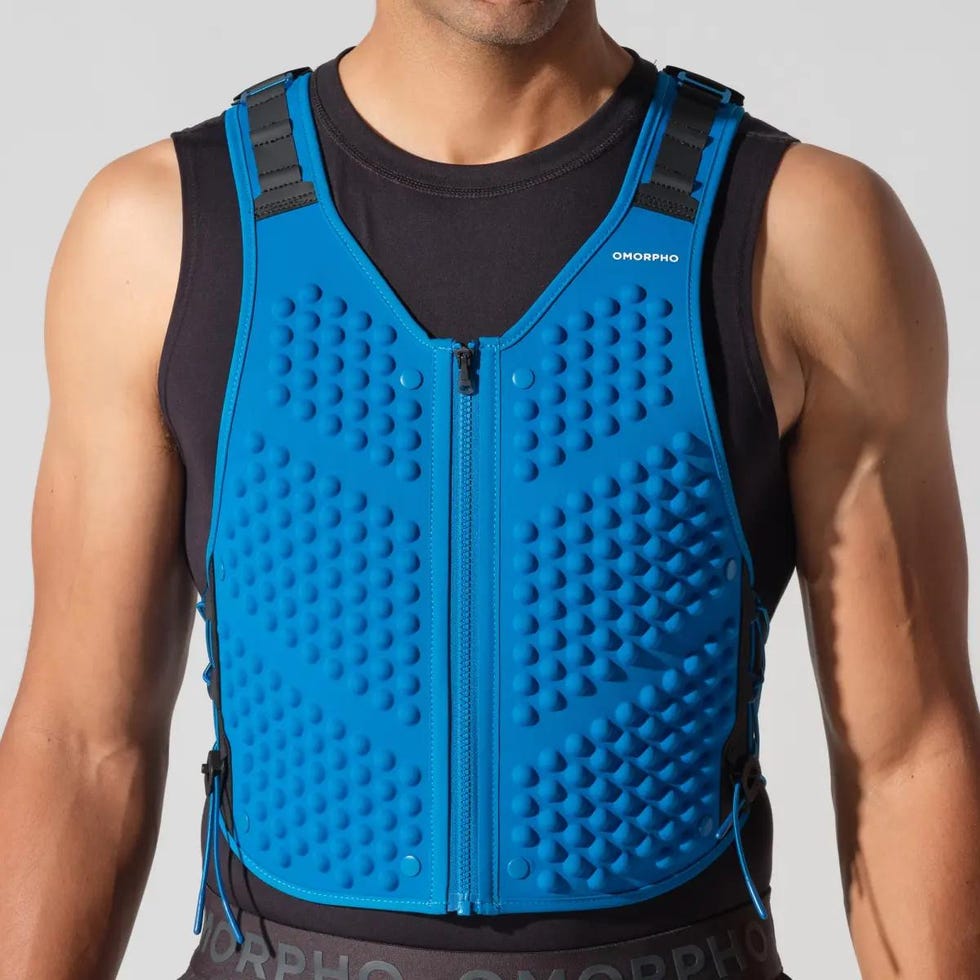
The OMORPHO weighted vest is a premium bit of kit. You see it. You want it. You believe that by simply wearing it you’ll become infinitely more manly and muscular.
At least, that’s how I felt the moment I first laid eyes on the 4.5kg G-Vest Icon, with its integrated body armour-style construction and sleek military-grade aesthetic. It’s turned celebrity heads too. Carlos Alcaraz is an early adopter. So too British boxer Ben ‘The Surgeon’ Whittaker and heptathlete Katarina Johnson-Thompson.
Pitched as the world’s most comfortable and versatile weighted vest, I took it for a spin at London’s Pace Club earlier this summer, and it didn’t disappoint. Comfortable? No doubt. Versatile? Sure, given it can be bulked up to 9kg by snapping on extra weighted panels. But I wanted to know how much mightier it could make me.
Could, for instance, cladding myself in extra ballast for a month of load-bearing workouts make me stronger, helping fortify my bones and beef up my brawn? Could powering through weighted sprint drills wearing the lighter 2.7kg G-Vest Run make me a faster, more powerful and more potent runner?
That was my pitch. In hindsight, writing this several weeks later, it was a fool’s errand. An obvious, fairly naive one at that. But I’m getting ahead of myself. Let’s rewind.
Here’s what happened when I used a weighted vest for all my workouts for 30 days – including the blunder I made along the way so you don’t have to.
What Happened When I Started Training with a Weighted Vest
The testing window fell midway through a training block for my first marathon, which meant I would be using the vest for three runs and three strength sessions per week.
Rather than diving headfirst into a weighted long run, I decided to start in the shallow end with a full-body calisthenics workout. The results were positive.
The added weight was almost imperceptible when performing squats and lunges, but noticeable when pushing off the floor for push-ups, burpees and, surprisingly, side planks. Its corset-like, form-fitting design also made it well suited to pull-ups and dips, allowing me to concentrate on technique rather than trying to hold a dumbbell between my feet.
The beauty of adding weight meant I could keep the session short, knowing I was challenging my body with extra load rather than extra reps. The full-body DOMS that followed suggested my body acknowledged the extra challenge.
Slipping on the lighter G-Vest Run for my next session, a conversational 10k run, was also pleasantly manageable. Unlike cumbersome vests I’ve used in the past, which strap heavy bars like gold bullion to your chest and back, I found OMORPHO’s version distributed the weight evenly across my upper body without compromising my running form.
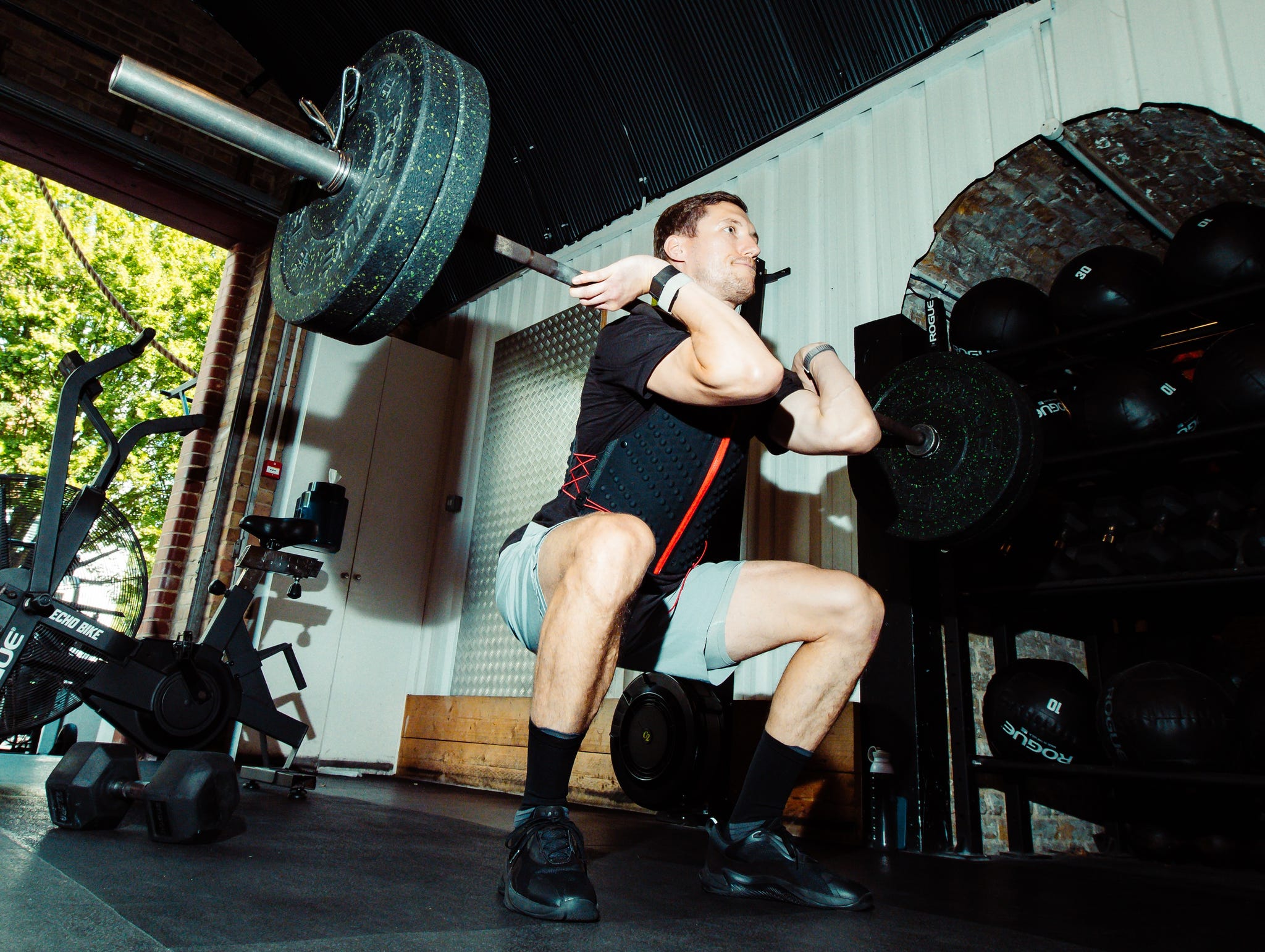
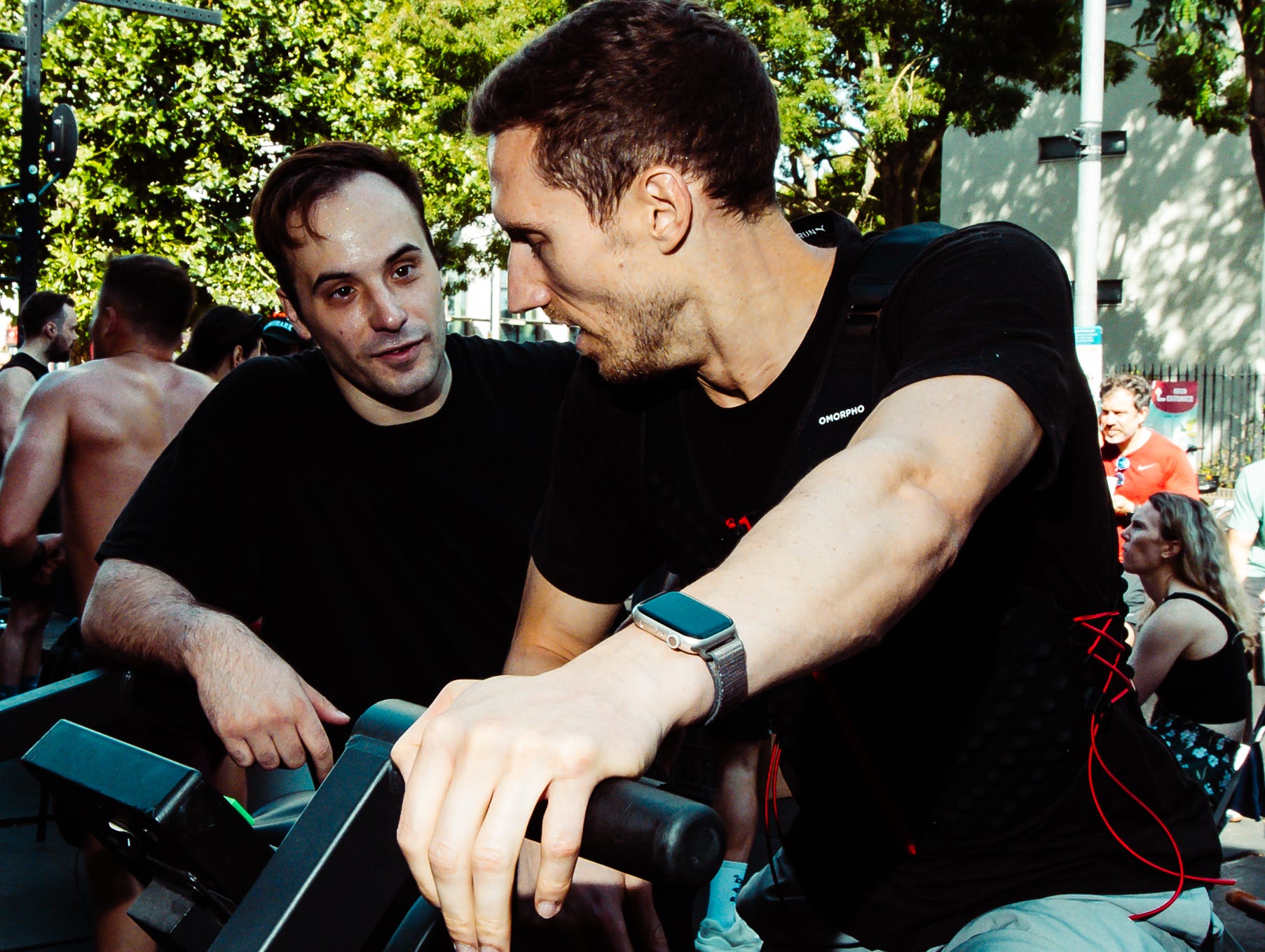
It similarly didn’t restrict my Oly-lifting technique for a CrossFit-style XENOM workout of barbell cleans, thrusters and push presses. Nor my breathing mechanics for a lung-busting blast on an Echo Bike.
I could have used it for CrossFit’s infamous weighted-vest workout ‘Murph’, but I’m not that much of a glutton for punishment.
I didn’t even get any funny looks while going about my business in the gym or on the track, thanks to the vest’s unobtrusive design. I did, however, discover one snag early on.
Transporting an extra 4.5kg to and from each training session – during a heatwave on a busy commuter train, no less – is an extra workout I and my fellow passengers hadn’t bargained for.
So far, so good. If a little sweaty.
XENOM / Kiara Jim
XENOM / Kiara Jim
Above: Sam trains in his weighted vest
The Benefits of Training with a Weighted Vest
The logic goes: get used to running, jumping, squatting, lunging, even walking under load, and when you remove the weight you’ll be able to run faster, jump higher and squat heavier.
It’s the same principle that OMORPHO ambassador Michael Johnson says he stumbled upon in practice decades ago, when speaking at the brand’s unveiling.
Blighted by chronic tendonitis one season, the four-time Olympic gold-winning sprinter swapped his iconic feather-light racing flats for the twice-as-heavy Air Max, in the hope that the extra cushioning would help.
It worked. It made the pain more tolerable. It also made him slower.
‘Switching to the heavier shoe made my times drop,’ Johnson tells Men’s Health. ‘But eventually I started getting back to the splits I was running in the racing flats. Once I got there, the psychological factor of knowing I was wearing a heavier shoe than my training partners and beating them in practice was huge.’
Getting comfortable in the heavier shoes, he says, ‘improved the training effect of my workouts from a physiological standpoint too’.
A few months later, Johnson won his historic 200m and 400m double at the Atlanta Games, breaking the 200m world record in the process. Whether the heavier shoes contributed is impossible to know, but the experience clearly stuck with him.
The team behind OMORPHO’s range of weighted vests, shorts and base layers would argue their kit is built on a similar premise – and there is some evidence that strategically adding load can affect performance.
A 2022 study found football players improved their 10- and 20-metre sprint performance immediately after warming up wearing a weighted vest equivalent to 10% of their body mass. Any heavier and speeds dipped.Another 2024 study on footballers observed that wearing a weighted vest equal to 12.5% of body mass for small-sided games twice a week significantly improved several measures of aerobic and anaerobic performance after six weeks.An older 1993 study also found that 20 weeks of exercise while wearing a weighted vest increased bone density by around 1%, compared with a 0.6% decline in a control group. However, as we’ll come to, that doesn’t mean simply adding a weighted vest to your daily walk has been shown to strengthen your bones.
One of the major benefits of wearable resistance, according to OMORPHO’s Head of Science Erin Feser, PhD, is improving training efficiency. Strategically overloading the body can, in effect, allow you to get more done with the time you have available.
‘Some people might not be able to exercise for longer because you have work and family and responsibilities, but adding load can make sure you’re getting more out of the time that you have,’ she tells MH.
Crucially, in the context of running and marathon training, that could mean less time on your feet.
‘Adding in more training volume, and more miles, is often where injury starts to become a concern. If you can increase the value of a training session without adding in more time, that’s a really smart way to get things done.’
In short, whether anecdotal, as in Johnson’s case, or under scientific scrutiny, there are reasons why strategically using a weighted vest could improve aspects of performance.
Now for the don’t-try-this-at-home section.
The Weighted Vest Mistake That Derailed My Marathon Training
Progress stalled, then ground to a halt, midway through this one-month test.
My marathon plan dictated I needed to tackle a 23k long run, including sections approaching race-day pace. Instead, with knees grumbling, calves tightening and pace slowing, I tapped out at 20k.
Then I barely touched my running shoes for a week while my aching body recovered.
What happened? Had I bitten off more than my body could chew, so to speak?
Seeking answers while I convalesced led me to the work of certified strength and conditioning specialist Dr Lauren Colenso-Semple, PhD.
Last year, the former PT-turned-academic took a deep dive into the research literature related to weighted vests and determined there was ‘no evidence’ that walking with a weighted vest improved bone mineral density, preserved muscle mass or accelerated the rate of fat loss. Walking alone, she concluded, won’t shift the dial.
So what about running?
When I explain I’ve been using a vest for all my workouts, her reaction is telling.
‘I’m curious as to why you would think that would be effective for marathon training,’ she says kindly, but bluntly.
Optimal marathon training, she continues, should involve exercising at different heart-rate zones, incorporating tempo runs, sprint intervals and some resistance work for injury prevention.
‘But the majority is probably going to be the long and slow zone 2-type training.’
Could using a weighted vest be beneficial as a kind of auxiliary tool, she ponders.
‘It could be, but not if you’re using it in lieu of those other things.’
If using a weighted vest is compromising any of those fundamentals, it’s not serving its purpose.
‘One important point to note,’ Colenso-Semple adds, ‘is whenever we increase intensity or volume of any type of novel exercise we need to do it slowly so we’re not suddenly going from nothing to everything.’
Or a conversational 10k to a race-pace half marathon, perhaps.
‘Then we’re way more likely to experience some nagging injuries or start to let form and technique slide because we’re fatigued.’
How to Train with a Weighted Vest Safely
A smarter way to use wearable resistance is to remember it is just one of several variables you can use to stress your body.
That epiphany hits me a day later while checking in with OMORPHO’s Feser.
In my enthusiasm to get to grips with the kit, I’d forgotten one of the core principles of progressive overload: increase onevariable at a time. One – not multiple.
‘Adding it to everything is probably too much of an overload, and you might have felt it after that long run. You probably needed extra time to recover,’ says Feser, whose doctoral thesis examined the merits of using wearable resistance when training for speed.
When increasing any variable, she elaborates, ‘think of your jump’.
‘If using the vest for group fitness or training for Hyrox or a marathon, for example, who might want to improve their capacity, what’s your jump? With some of our vests, if you’re adding that extra load you’re almost jumping 100% to the next weight category.’
Overload should be applied in ‘incremental jumps’.
For example, if a tempo session involves five 1k runs, Feser suggests doing the first two with the vest loaded with fractionally more weight, then reducing the weight for the final three intervals.
‘See how you feel. Do that for a couple of weeks, then continue to bump up the weight from there,’ she says.
In practice, this meant parking the weighted vest for my easy and longer runs, which were already increasing in time or distance with race day approaching, and reserving it for shorter sessions where I could more carefully control the additional load.
Feser suggests tempo runs can be one option because you’ll already be dialled into your speed, posture and form.
‘It’s a great time to add that extra challenge because you’re already honed in on aspects of your running technique, and that additional overload can help continue to drive adaptations in that direction.’
But this isn’t a green light to simply add a vest to every tempo session. Colenso-Semple’s point still stands: weighted running shouldn’t come at the expense of the fundamentals of your training programme.
And if the vest starts to grind you down, changes your movement mechanics or negatively affects your technique, Feser says that’s ‘an indication you’re overly fatigued and you wouldn’t want to continue using it for that session’.
How to Use a Weighted Vest for Strength Training
Unburdened by the weighted vest on my next long run, my knees feel happier and I’m able to sustain my target pace. I’m also more careful about how and when I use the vest, with no further adverse effects.
But what about the strength workouts in my plan? What’s the best way to use a weighted vest for resistance training without compromising running form or pace?
When I put that question to HYROX coach and Ironman finisher Jacob Shaw, an ardent fan of weighted-vest workouts, his answer is simple.
‘The best workout is the workout that doesn’t injure you,’ he tells MH.
A sub-60-minute Pro Doubles finisher, Shaw runs the only official Hyrox Performance Centre in the United States, frequently incorporating wearable resistance into his training plans. But only once his clients have nailed down the fundamentals.
‘The main risk of adding load is doing too much too fast,’ he says. ‘So if you’re training for a Hyrox, for example, make sure you’re proficient in all your movement mechanics like squats, lunges and burpee broad jumps using just your bodyweight. If introducing a vest, ensure it fits well, it doesn’t bounce, and start light.’
Plus, only increase one variable a week, he adds, repeating Feser’s advice.
In terms of deploying the vest for running sessions, Shaw says he’d start with a weighted hike, then a little run-walk, before gradually progressing to sprints and then hill sprints.
‘Remember, every step with the vest on raises the tax on your body. So use it as a tool to add to your training, rather than letting it destroy you in one workout.’
Get all that right, he says, and when you take it off, just like Michael Johnson found, ‘you’ll feel like you’re flying’.
Hyrox Coach Jacob Shaw’s Weighted Vest Workout
Assuming your mechanics are sound and you have plenty of time to recover afterwards, Shaw suggests trying one of his signature weighted-vest finishers.
It’ll take 20 minutes all in and combines just three plyometric exercises: a jump lunge, frog hop and burpee.
‘This is my most favourite bodyweight workout because you don’t need any equipment. You could be by yourself, anywhere. Add a vest to it and it’s fricking amazing,’ he says.
That said, given everything we’ve learned about increasing variables with a weighted vest, it’d be wiser to try the workout with just your bodyweight the first time round.
Take it from me, it’ll annihilate your quads whether you go weighted or not.
‘Remember, the best workout is the workout that keeps you injury free,’ says Shaw. ‘Increase one variable at a time. Take things slow. Enjoy the process.’
How to Do the WorkoutPerform each exercise for 30 seconds, then rest for 30. Repeat six rounds of jump lunges, six rounds of frog hops and four rounds of burpees, resting two minutes between each exercise.Note your reps in the first set of each exercise and try to match that number for the remaining intervals.
‘If you beat it every time then you were sandbagging that first one,’ says Shaw.
1. Jump Lunge
Step back, lower your back knee until just off the floor, then drive up off the ground and switch legs to land softly and continue into the next rep.
Interlace your fingers behind your head, lower into a squat keeping your knees apart, then drive up powerfully to jump off the floor. Land softly and cycle into the next rep.
3. Burpee
Drop your hands to the floor, jump or step your feet back into the top of a press-up, then back towards your hands. Drive up to jump off the floor into full extension.
My Weighted Vest Verdict After 30 Days
While certainly not ‘flying’ by the end of my month-long weighted-vest experiment, I’ve learned a few valuable lessons about how to use one – and how not to.
In summary: exercise with caution, use it strategically and, as Colenso-Semple would attest, beware the hype.
‘Weighted vests have been around for a very long time and right now they’re having a moment,’ she says, which is a red flag in her experience.
‘I find that many people who tend to gravitate towards these types of tools or gadgets are often missing some of the underlying foundation that would really move the needle. Probably more than something like a weighted vest or vibration plate or a TENS unit or any of these trends that are likely to come and go.’
In other words: don’t suit up if you’re not already nailing down the nuts and bolts of an effective fitness routine.
That means regular full-body resistance training and cardiovascular exercise. Gradual, progressive overload. Adequate nutrition and plenty of rest and recovery.
Throwing a weighted vest into the mix might progress your regular walk, run or bodyweight workout. Just remember it’s the cherry on top, not the whole cake.
And whatever you do, don’t make my mistake of increasing multiple training variables at once. The vest should add to your training – not leave you unable to do it.

Sam Rider is an experienced health and fitness journalist, author and REPS Level 3 qualified personal trainer. Having covered – and coached in – the industry since 2011, he’s road tested every workout concept, training accessory and diet plan you could dream of, while quizzing titans of the industry and reporting on the physical and mental exploits of Olympic athletes, World Cup winners and CrossFit Games champs. In 2016, in the name of science, he underwent a clean bulking transformation, packing on 10kg of lean mass in 10 weeks, before promptly dropping 10kg in two weeks after tearing his ACL on the football pitch.Sam graduated from the University of Leeds with a degree in History and completed his NCTJ Diploma in Journalism at News Associates in Manchester.