
A trainer says these five daily moves beat the occasional gym session for a trimmer waistline after 50.
After 50, you may have noticed a soft overhang at the front of your midsection, sometimes called an “apron belly.” The standard advice you see online is always the same: do more crunches, buy a gym membership, and work out harder. However, as you age and your metabolism naturally slows down, this advice isn’t necessarily the best approach.
You can’t pick and choose where your body loses fat. No exercise burns fat off the specific patch of skin it sits under, which means no amount of ab work will selectively trim a belly overhang. What exercise actually does is increase the amount of calories you burn, protect the muscle you already have, and make a modest calorie deficit easier to sustain. The combination of those three is what changes body composition over months, not days.
But with all the conflicting information online, knowing where to start can feel daunting. That’s why we talked to James Brady, CPT, a certified personal trainer at OriGym, who shares his top five daily exercises designed specifically to help trim belly overhang after 50. Read on for the exercises and detailed instructions. Then, when you’re finished, be sure to check out these 4 Kitchen-Counter Exercises That Flatten Belly Overhang Faster Than Gym Classes After 60.
Brisk Walking
Walking is the backbone of the whole routine as it is a fantastic exercise for elevating your heart rate and burning calories. “Brisk walking is an easy way to raise your heart rate and increase daily activity without placing too much stress on the joints,” explains Brady. “Gradually adding short, faster intervals can also make it more challenging.”
How to do it:
Start with 10 to 20 minutes at a pace where you can talk comfortably while slightly out of breath.
Stand tall with your shoulders relaxed and let your arms swing naturally.
Land midfoot and roll through to push off from your toes.
Once the pace feels easy, add short faster intervals of 30 to 60 seconds every few minutes.
Build toward 30 minutes on most days, breaking it into two shorter walks if that’s easier.
Aim for 20 to 30 minutes daily.
Bodyweight Squats
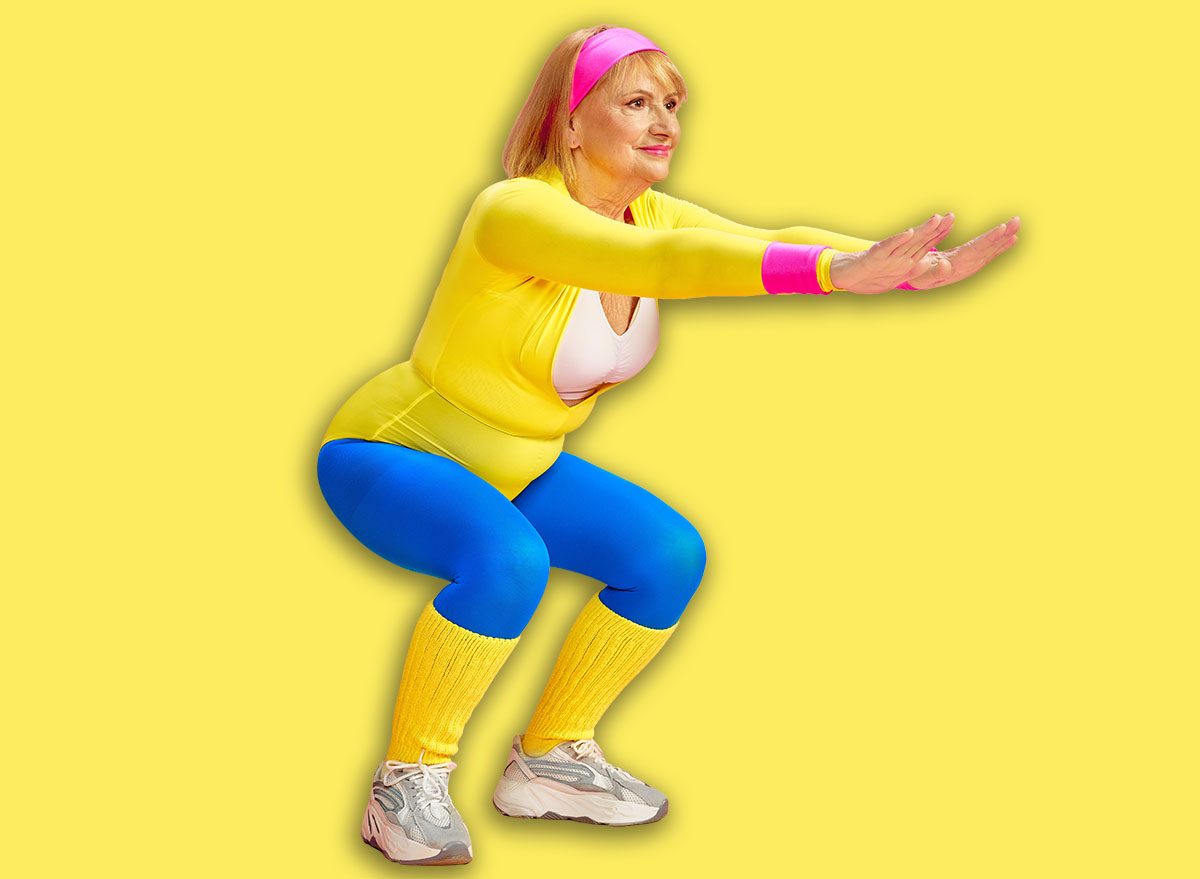
Squats recruit the largest muscles in your lower body, including your quads, glutes, and hamstrings. “Bigger muscles working together mean more energy burned per rep and more muscle preserved,” says Brady.
How to do it:
Stand with your feet roughly shoulder-width apart and your toes turned slightly outward.
Position a chair behind you if you want a target and a safety net.
Sit your hips back and down as though reaching for the seat, keeping your chest upright.
Lower as far as is comfortable while keeping your heels planted and your knees aligned over your toes.
Press through your whole foot to stand tall again, squeezing your glutes at the top of the movement.
Complete two to three sets of 10 to 15 reps, resting for 45 to 60 seconds between sets.
Standing Knee Drives
“Driving your knees up in a steady rhythm keeps your heart rate elevated while asking your abdominals to stabilize your trunk on every rep, so you get the conditioning benefit and the core engagement in one exercise, without lying on the floor,” explains Brady.
How to do it:
Stand tall with your feet hip-width apart and your core engaged.
Rest a hand on a wall or chair back if you want extra stability.
Drive one knee up toward your chest without letting your torso collapse forward.
Lower that foot under control and immediately drive the opposite knee up.
Keep alternating in a steady rhythm, picking up the pace as it gets easier.
Perform two to three sets of 20 to 30-second knee drives. Rest for 45 to 60 seconds between sets.
Step-ups
6254a4d1642c605c54bf1cab17d50f1e
Step-ups do two jobs at once: they build single-leg strength and they push your heart rate up, which makes them unusually efficient for a routine you’re doing daily. “Working one leg at a time also helps even out strength differences between sides, and the movement translates directly to stairs and curbs,” says Brady.
How to do it:
Stand facing the bottom stair or a low, stable step with a handrail within reach for support.
Place one whole foot flat on the step.
Press through that heel to lift yourself up under control.
Bring the other foot up to stand tall on the step.
Step back down with the same leg leading, then alternate sides.
Aim for two to three sets of 8 to 12 reps per leg, resting for 45 to 60 seconds between sets.
Planks
“Planks strengthen the abdominal muscles that support the midsection, although they do not directly burn belly fat,” explains Brady. “Start with a short hold from the knees or against a raised surface, then progressing gradually as strength improves.”
How to do it:
Start on your forearms and knees, or with your forearms on a countertop or sturdy chair seat.
Place your elbows directly beneath your shoulders.
Flex your core and squeeze your glutes so your body forms one straight line.
Hold the position while breathing through your nose and without letting your hips sag or pike up.
Complete two to three holds for 15 to 45 seconds. Rest for 45 to 60 seconds between holds.
Adam Meyer, RHN
Adam is a health writer, certified holistic nutritionist, and 100% plant-based athlete. Read more about Adam