
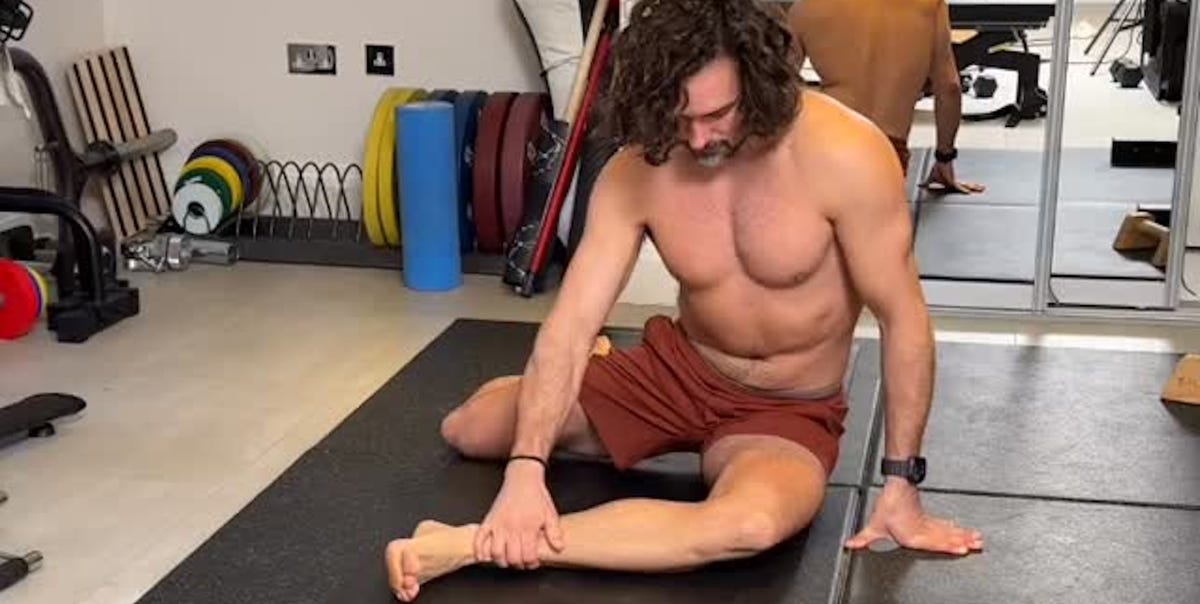
Muscle, power and strength are all fundamental for future-proofing your body, but there’s more to building long-term resilience than just high-impact movement. If you want to remain mobile and independent in your later years, you need to stop sleeping on mobility training. In fact, for the best potential outcome, it should feature in your everyday routine. Someone who’s well wise to the merits of mobility training is fitness coach and founder of The Body Coach, Joe Wicks.
Famed for his speedy bodyweight sessions and 15-minute meals franchise, the PT has spent years championing quick, simple workouts for improved wellbeing. Speaking to The Handbook last summer, he said: ‘I have this constant reminder that if I don’t exercise, if I don’t wake up and release that stress and tension from my body, and that frustration of not being able to sleep, of being woken up three or four times in the night, I carry that with me all day. I’ll be more irritable and impatient.’
One of his go-to morning sessions, Wicks shared on Instagram recently, isn’t a sweaty HIIT workout – it’s a full-body mobility routine.
It’s a short, 12-minute flow that gets the shoulders and hips moving. ‘If you struggle with stiff joints or muscles this can really help get things moving better,’ reads the caption.
If you want to try the routine for yourself, Wicks advises allocating 60 seconds to every movement, focusing on your breathing, and repeating the whole flow two to three times. ‘You’ll feel fantastic after this routine,’ he writes.
Joe Wicks’ Morning Mobility Routine90/90 Pigeon Stretch (both sides)
Keep your front shin as parallel to your mat as mobility allows and square your hips to the floor. Stay tall through the spine rather than collapsing over the front leg.
90/90 Hip Rotations
Sit upright with both knees bent at 90 degrees and rotate side to side under control. Try to move without using your hands, keeping your chest lifted.
Supported Cossack Squat with Overhead Reach
Shift your weight into one heel while keeping the opposite leg straight and toes up. Sit back into the hip and reach overhead to open through the chest.
Prone Swimmers
Lie face down and lift your arms in a slow arc from overhead to behind your back. Keep your forehead lightly on the floor and avoid shrugging your shoulders.
Downward Dog to Cobra Stretch
In downward dog, push your hips back and press your heels towards the floor. As you move into cobra, glide forward, lift your chest and keep your shoulders away from your ears.
Greatest Stretch in the World (both sides)
Step one foot outside your hand in a deep lunge, keeping the back leg long. Rotate your torso towards your front knee, opening through the chest without collapsing into the hip.
Malasana (Deep Squat)
Drop into a deep squat with your heels flat if possible. Press your elbows into your knees to open the hips while keeping your chest proud.
Quadruped Arm Circles
On all fours, brace your core and draw slow, controlled circles with one arm. Keep your hips square and avoid shifting your weight excessively.
Crab Reach
From a tabletop position, drive through your heels and lift your hips. Reach one arm overhead and rotate through the upper back rather than dumping into the lower spine.

Abbi Henderson is Acting Nutrition writer who covers health, fitness, women’s sport and lifestyle for Women’s Health and Men’s Health. Before settling in a British seaside town, she spent a couple of years living in Canada, where she contributed to publications such as Best Health, Foodism and Canadian Living, and discovered she is, in fact, a little outdoorsy. With a desire to help make healthcare, exercise and sport more accessible to women, she writes about everything from the realities of seeking medical support as a woman to those of being a female athlete fighting for equality. She has a personal trainer qualification, a couple of medals from her short time in competitive Irish dancing, and an Arsenal Women season ticket. When she’s not in front of a screen working, she enjoys weightlifting, going for walks and stopping for little treats (matchas and pastries), and trying new recipes (that are almost always pasta-based).