
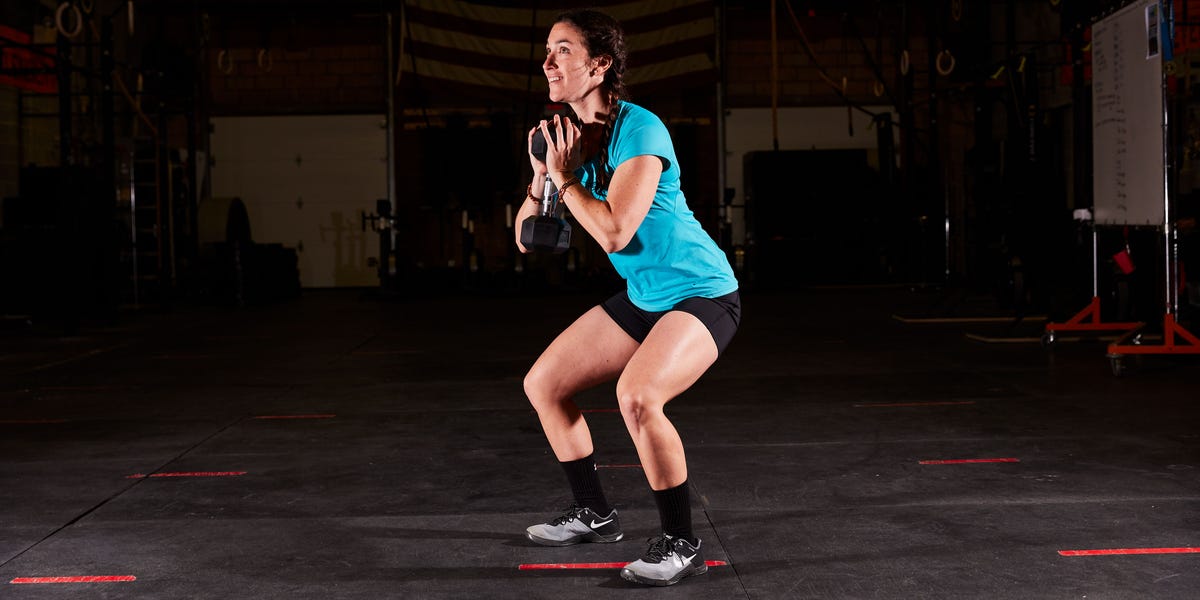
Once a week, I do a calf exercise at the end of my strength routine that involves rising up onto the balls of both feet, then lifting one foot off the ground and slowly lowering down on the other. It’s a good calf move, yes, but there’s more going on here that makes it a powerful move for runners.
This is a great example of an eccentric movement in that the focus is on the lengthening (or lowering) aspect, which is hugely important for runners, especially distance runners, says Anh Bui, DPT, CSCS, level 1 USATF certified-coach of Run Resiliently Physical Therapy.
“Eccentric training trains your muscles and tendons to be fatigue resistant, more resilient, and stronger,” Bui says. “If you can prevent that fatigue from happening earlier in a race, the better your endurance and running economy will be because you’re going to waste less energy.”
It can also help prevent injuries, many of which typically happen in the eccentric phase of running because muscles and tendons are loaded with at least three times your bodyweight in their maximally lengthened position, Bui says.
What’s more, a 2024 systematic review of research published in Frontiers in Physiology found that eccentric training significantly enhances sprint speed and athletes’ ability to change direction quickly.
To gain these advantages, here’s a primer on what Bui calls the “most demanding” type of muscle contraction, and exactly how to incorporate it into your routine.
Related StoryWhat It Means to Train Eccentrically
Before we dive into eccentrics, Bui says it’s important to explain another type of muscle contraction: concentric. If you were holding dumbbells at your sides and lift them up into a biceps curl, your biceps are shortening against a load, she says, which is a concentric action. “Then there’s isometric, which means if I was just holding the weight and the muscle was not shortening or lengthening at all, it’s still a type of load,” she adds.
Finally, we have eccentric contractions: “Let’s say I’m holding the dumbbells at the top of a bicep curl and now I’m going to slowly lower that weight against the load, so the muscle is lengthening against load,” Bui says—that’s the eccentric contraction, and it’s typically the most demanding kind of muscle contraction because it generates the highest mechanical tension on muscles and tendons.
Brad Schoenfeld, PhD, CSCS, a professor in exercise science at Lehman College in the Bronx, NY, adds this example: “Let’s say you’re doing a squat, when you raise your body up, you are doing the concentric action, when you are descending, you’re undergoing an eccentric action,” he says, and points out that both components are inherent to virtually any dynamic exercise you do.
Related StoryHow Does Eccentric Training Affect Running?
Eccentric and concentric muscle contractions are both happening while you run, too. When you’re in the mid-stance phase (when all your weight is on one leg), your quads work eccentrically to control the knee as it bends, Bui says, and the calves work eccentrically to control the ankle as it moves forward. As you move into the “toe-off” phase, the calves and hamstrings work concentrically, then the hamstrings shift back to an eccentric role just before your foot hits the ground again.
This eccentric action is exaggerated when you’re running downhill, she says, and it explains why your quads—which act as your eccentric brakes—may be particularly sore after a hilly run or race.
The eccentric demands can become more taxing as the run goes on. “Especially for longer races, like a half marathon or marathon, there’s more fatigue accumulating, and because of that, we see form breakdown in running gait,” she says. “If your form breaks down and you’re not stable, maybe your hips drop, maybe your knees collapse, maybe your ankle starts to pronate because your muscles are tired, it can make you a little bit more susceptible to injury,” she says, potentially leading to muscle strains and tendon injuries.
Indeed, a 2024 study out of Germany, involving 38 participants, found that after a half marathon, both quads and hamstrings were worse at producing force in the eccentric phase, and that effect was linked to higher injury risk (especially around the knee). That’s one reason it’s wise to take some recovery time before running again immediately after a distance race.
In particular, Bui sees a lot of hamstring strains (especially in sprinters, but also distance runners), which usually happen when the hamstrings are fully eccentrically elongated during the late (terminal) swing phase of the stride, if the hamstrings are not strong enough to withstand the load. Overstriding ups the risk even further.
Related StoryHow to Incorporate Eccentrics Into Your Routine
The good news is that, as Schoenfeld points out, if you’re doing dynamic exercises like squats and deadlifts, you’re already doing eccentric muscle contractions—but there are a couple of ways you can emphasize that part of the movement to get more bang for your buck.
One way to do that, Bui says, is by simply slowing down just the lowering phase of a movement. “I want you to think about counting to five on the way down in the squat and then move faster on the way up,” she says. “That’s actually really hard for people, especially if they do it with weight,” she says, although it’s best to start with three sets of 10 reps of just bodyweight. Slowing down can have the bonus benefit of challenging balance and stability, Bui says.
Once you feel good with bilateral movements, move onto unilateral ones. “For a lot of runners, incorporating eccentric single-leg exercises can be a very powerful tool,” Bui says, because running itself is essentially a unilateral sport. That might be a single-leg squat (for the quads) or single-leg Romanian deadlifts (for the hamstrings) with the same five-second count on the way down, she says.
Schoenfeld says another strategy is called “supramaximal eccentrics,” which involves using more weight on the eccentric phase than the concentric phase. For example, using the leg extension machine, press up with both legs, then release one leg and lower down with just one leg. You’re essentially loading your legs with double the weight on the way down.
You could also try a wall squat where you stand up with both legs, then lower with one. And of course, there’s the aforementioned calf raise example—go up onto the balls of both feet, then slowly lower with one leg only. Bui says eccentric calf raises are particularly good for runners with a history of Achilles tendinopathy or calf strains (though it’s best to avoid this if you have an active injury in these areas).
There’s also something called flywheel training, Schoenfeld says, which can be effective. You can find these machines, which have handles attached to a flywheel, for home use or in some gyms. “When you’re pulling it up, it stores the energy in the flywheel, and when you come down, it allows you a greater eccentric action,” Schoenfeld explains, adding that research backs this up.
Finally, outside of the gym, downhill strides could also be helpful, Bui says. “You can practice running downhill, fast, but keep it controlled,” she says. “Stay tall, take short quick steps to keep your feet close underneath you, and look 10 to 15 feet ahead of you.”
The key: Don’t overdo it. The way to work eccentrics into your program is to pick one or two out of the six or so moves you’re doing on a strength day and make them eccentric-focused, both experts say. “If you try to do every single exercise of the circuit with eccentric intention, you’re going to be very fatigued,” Bui says. She also suggests avoiding eccentrics on the same day you have a quality run workout, like intervals or a long run, because they’ll just compound the fatigue.
Ideally, sprinkling in a few eccentrics before your next race will do the opposite: help you feel fresher for longer.